Thursday, August 25, 2011

Let the Sun Shine In

I am often puzzled at the things that politicians pretend to care about.


There are times when parliament seems to be in a constant state of manufactured outrage - ranting and raving about things that we all know they as politicians don't care about, but things they hope will get the public upset.


Such is the political paradigm in Australia today.


The fuss over Andrew Stoner and the solar feed-in tariff is exactly that.


Image from here
I covered the solar issue a few month ago during O'Farrell's aborted attempt to slash the feed-in rate from apparently unsustainable levels.


In short. the Labor government had introduced a tariff of 60c per kilowatt hour for power gathered by solar panels and "fed back" into the network.


The scheme was incredibly generous and, unsurprisingly, massively oversubscribed.


As a result, the Labor government reduced the rate to 20c, but allowed all people who signed up at the 60c to retain that tariff.


The change was announced on 27 October 2010. A Google News Search brought up this article on news.com.au, purported to have been published at 11:40 on that day, saying:


Hansard shows that sometime around about 17:30 that day a bill was introduced to the Legislative Assembly:


There was a short debate on the bill between 20:00 and 21:20 and the bill was passed with support from both sides of the chamber.


It is interesting to note that, during her speech in support of the bill, Catherine Cusack (Lib) said the following:


There was outrage from the Coalition a few days later when it was revealed that Keneally had signed up to the scheme before the rate was reduced. She was revealed to have signed up 5 days after the government flagged an intention to review the sceme and less than 2 months before the changes were announced.


Keneally was asked this question by Donald Page (Nat):


In any event, Keneally managed to arrange things such that she missed out on the 60c rate regardless.


The issue sprang to life again today when the ALP released this statement:


Now, I'm as enthusiastic as the next person when it comes to highlighting hypocrisy. In fact, few things give me more joy than seeing a hypocrite being revealed for who he or she really is.


But I'm not sure that the mud here sticks.


Firstly - i've had a cursory search of the internet and I cannot find any statement made by Stoner directly in support of the changes. 


That said, when the tariff was reduced he, along with his party, supported the change.


I've also posted the question above asked by one of his Coalition colleagues.


I've searched Hansard for 27 October for any mention of Stoner, and there is none.  In his press release John Robertson says that he was granted a pair for a portion of that day - presumably the parties keep some record of these things, so I've no reason to doubt that he did indeed pop out of parliament to get the application in. 

A search for his name and the word solar brings up three entries:

  • A question on 28 October (the day after the change) where he asks the then Minister for Energy Paul Lynch, when he was first advised about the blow-out in cost of the scheme
  • A dixer from Leslie Williams (Nat) to Stoner on 24 May 2011 (after O'Farrell announced the change in the tariff but before the backdown) about the effect of Labor's Solar Bonus Scheme, and 
  • A question from Linda Burney (ALP) on 24 May 2011 challenging Stoner in relation to a written guarantee he gave to a constituent that the bonus scheme would not be amended retrospectively.
At the end of the day, the criticism from Labor appears to be that he signed up to the scheme that his party (at the very least, if not Stoner himself) has called a massive waste of government money.

The fact that he signed up for the program on the last possible day is thrown in, almost as if to suggest he had some sort of insider knowledge.

I have a little trouble getting outraged about that.

He didn't break any laws.  He didn't lie, cheat or steal.  He took advantage of a scheme put in place by Labor that was about to be brought to an end.

True, his party did then and has since coming into power criticised Labor's decision to set the tariff at 60c.

That said, there are some taxes that I think are too low - but I'm not going to pay extra in (even if I could) because there are other taxes that I think are too high, and I don't expect that excuse to carry much weight with the State Debt Recovery Office.

I thought the "metro" train systems proposed by the Labor government were a terrible idea - but had they been built I would see no hypocrisy in using them, given that I as a taxpayer would have funded their construction.

I agree that the 60c tariff was far too high - but if I owned a house rather than an apartment you can bet every dollar you have that I would have jumped all over that 60c tariff, and been pretty pleased about the result.

Being opposed to a policy doesn't mean you have to be self-righteous about it and refuse the benefit accrued.

Look, Stoner was pretty stupid in the way he went about it.  Everyone in parliament surely must have known that the amendment was coming, and to wait til the last day and then go about it in the way he did was asking for trouble,

But he has taken advantage of the opportunity afforded by a particularly stupid Labor policy, as did thousands and thousands of of NSW residents.

And that doesn't make him a hypocrite.

Tuesday, August 23, 2011

Train of Thought

Arguably the Coalition's biggest election promise (and certainly the biggest infrastructure promise) was to build the North West Rail link.


It is an enormous project with an massive price tag for any State Government.  That said, it is one of those projects that just has to happen if Sydney is going to handle its population growth in a sustainable, sensible way.


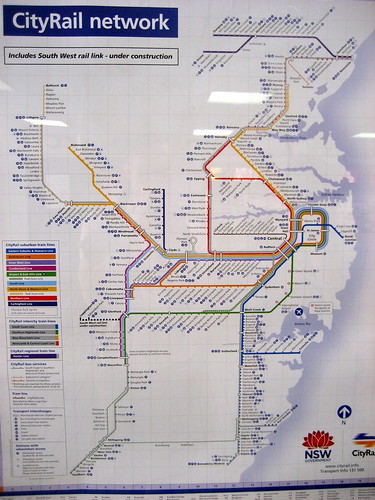
The problem is less obvious when you view the Sydney train map as we usually see it:


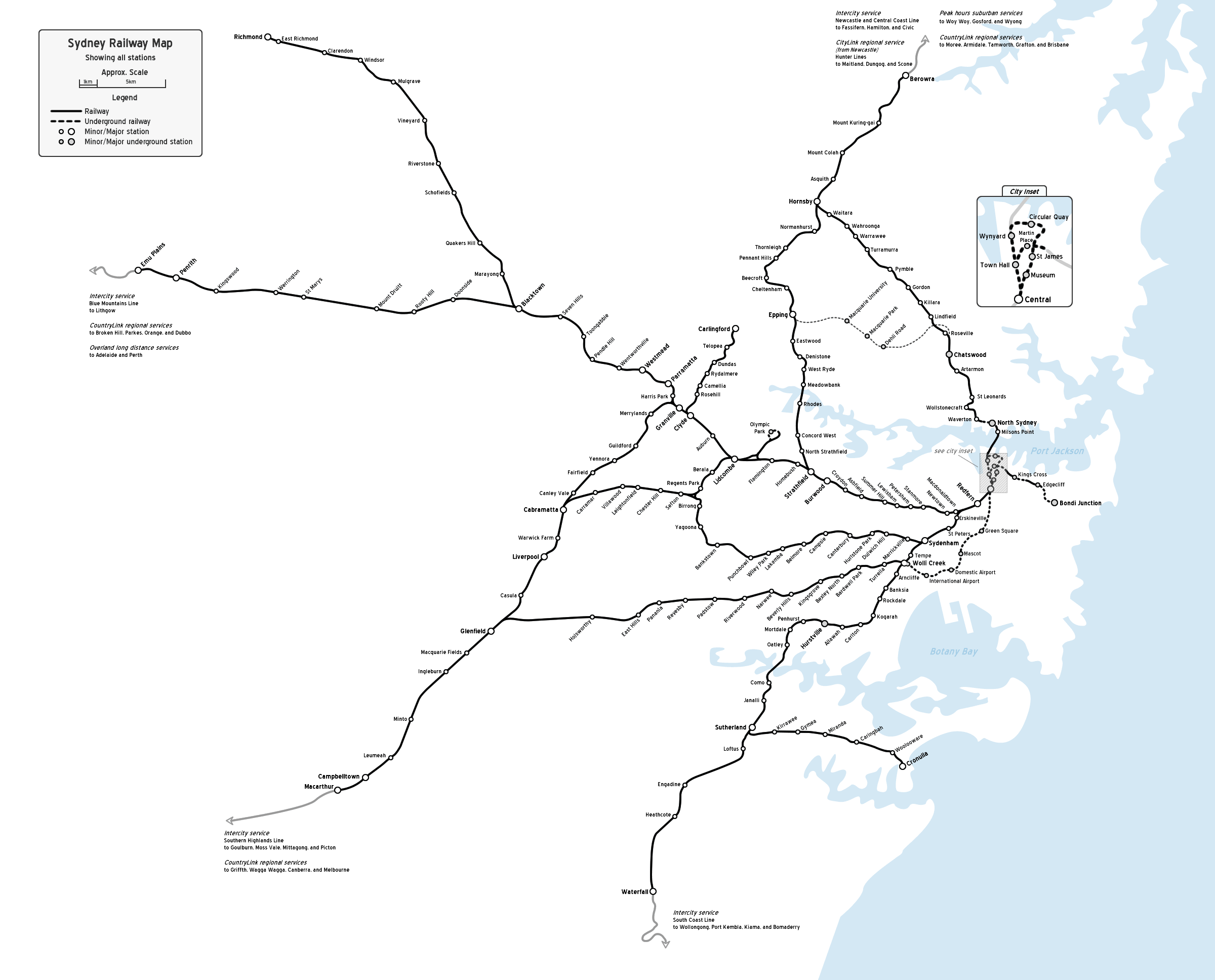
Of course, the train map looks nothing like that in real life:


Picture from Wikipedia
The most important map, though, is this one:


That map is taken from Labor's Metropolitan Transport Plan. The most important things to note are the North West and South West Growth Centres.


The government has asked all local councils to accept additional residents by rezoning.  Those that cannot be fit into present developed areas will have to go somewhere.


Of course, whether Sydney should be allowed to grow in this way is another discussion that should be had, but lies somewhere beyond the scope of this post.


It is pretty obvious that the South West Rail link will be needed to service the South West Growth Area.  The route can be seen on this map, marked in black on the bottom left, and it is expected to be completed in 2016:


The North West Rail link is not only needed to service the North West Growth Area, but also to give people in the North West an option for getting to the city other than the M7, M2, and Lane Cove Tunnel.


Driving to the city from these areas is very expensive, which would not be a problem if there was a reliable, frequent, late-running train service, which of course there is not.


The other obvious gap in the map is the train line to the northern beaches, but that appears to be off everyone's radar at the moment.


I had planned to write here about the long history of rail lines promised for the North West, but franly the history is too sordid and confusing.  Suffice to say that if you would like to be walked through the Labor Government's inablity to accomplish anything substantive in this area then the Wikipedia will explain it all.


Of course, Labor did deliver the Chatswood-Epping connection. That said, this was originally meant to be the Parramatta-Chatswood connection, and was completed at a cost way above the original budgeted cost for the Parramatta-Chatswood plan.


The problem is not of O'Farrell's making. In fact, the Labor government that preceded his is not entirely to blame either.  Bradfield laid the plans for Sydney's train system.  The plans were visionary - the problem is that over 100 years later Sydney has outgrown those plans.  


Sydney's train lines in the late 1800's
For years we have desperately needed a government that was able to make a plan, commit to it, provide funding and ensure that Sydney had room to grow.


Of course, as history shows, the Labor government's fixation on roads meant we now have a pretty good road system.  Admittedly it costs a bit to use it, but we got roads that the government could never afford to have build (or so they say). I, for one, have no trouble with a portion of user pays on our roads.


By contrast, train lines will inevitably need to be subsidised by the government as commuters will usually not pay enough to cover costs. 


But train lines offer a potential for growth that roads do not. One only need to look at cities like Los Angeles to see the consequences of failing to provide good, efficient and affordable public transport.


Buses, especially in the North West and the Northern beaches have partially filled the void.  But buses have a limited capacity - many people avoid them because they are irregular, unreliable, and often stop running an inconvenient times.


This story published today in the SMH that the planners are reconsidering the location of the stations.


This is appropriate - whilst I have no doubt that many people have been complaining about the time it is taking to "turn the first sod", it is essential that a little time be taken to get things right the first time.


A well planned, efficient train system is vital to a thriving city - and this process is part of planning things out in a sensible fashion.


As someone who works in the Sydney CBD and catches the train every day, I shudder to imagine what Sydney would look like if we did not have the train system that we do.


But train systems require constant re-investment if it is to cope with the inevitably uneven population growth.


For decades now Sydney has not had the benefit of decisive planning and investment in the train system. If O'Farrell really does achieve his stated objective of being the infrastructure premier, then Sydney will have the benefit of his political courage for decades to come.


If not, then he will join a long list of premiers who promised big and failed to deliver.

Tuesday, August 16, 2011

A hair-brained idea?


Ex-Premier is a pretty tough gig. It's even tougher when you don't retire but rather remain as a humble back-bencher.  Moreover, a back-bencher for a party reduced to only 20 seats after one of the most inevitable and yet humiliating defeats in Australian electoral history.


Whilst I had plenty of criticism for Keneally in her time at the helm, at the end of the day the defeat she presided over was unavoidable. There was nothing she could do to prevent it besides hope that O'Farrell implode in spectacular fashion.


Upon being defeated she had the good sense to step aside and allow the rebuilding to commence, although whether her choice of replacement is any better suited to the task is another question entirely.


Photo from here
It seemed fait accompli that Keneally would step aside after the election, and speculation was rife as to what her plans were.


She committed to serve out her term to quell speculation that she was planning to pursue a career in Canberra.


In any event, that seemed to me to be an unlikely course - how much success could she really have with this defeat hanging round her neck?  Keneally wasn't solely to blame for the loss, but she was still part of the Labor caucus in the years leading up to the defeat.


Assuming she obtained preselection for a NSW federal seat, it is not difficult to imagine the tactics an effective Coalition campaigner would adopt.


In the event, Keneally really has gone to ground since the election.  She stopped tweeting, and she was either not offered or was refused a cabinet position. Presumably she has been doing some work behind the scenes, but her profile has been pretty much zero.


In fact, according to this piece she is the only Labor MLA to not have given a speech this term.


Photo from here
On 2 August, however, Keneally burst back onto the political radar.  And she did it with a haircut.


Personally, I couldn't care less how Keneally wears her hair.  On the day the new haircut debuted , there was a frenzy on Twitter as journalists frantically reported the rampant gossip.  I found it all rather unedifying.


The Tele published this rather breathless piece about the new 'do, including reporting that Keneally's "preferred hairdresser" refused to comment.


Nick O'Malley gave us this drivel (which I still can't believe the Herald published):


As if that wasn't enough:
Now, that's all by the by.  The point I want to make is that Keneally knew this would be the reaction.  Whether this reaction is justified or not, she must have expected a fuss.


That's not to say she shouldn't have cut her hair.  If she wants to shave her head and get a dozen piercings it's no concern of mine.


But her actions start to seem a little more calculated when you look at what has happened in the fortnight since.


Predictably, everyone was aflutter about the new haircut for a few days, The next day this piece was published in the Daily Telegraph dredging up all those old questions about what Keneally's plans were.


The journo took the opportunity to quote a "senior Labor source" saying "I think she's sticking with the line that she's going to stay but you wouldn't be wrong to say it's possible she'll go earlier."


Keneally would have known that she didn't need to do anything to keep her name in the headlines for the next few days - bored journos would keep filing stories about the hair for a few days.


According to this piece in the Southern Courier published on 8 August, "The Southern Courier was the only media Kristina Keneally agreed to speak with last week after her new hair-do quickly became the hottest political ticket item on returning to parliament."


She also "insisted there was no basis to any of the rumours that she was considering resigning" although the quote provided immediately following seemed a lot more ambiguous that the conclusion drawn:


In this piece published in the SMH she revealed that she had been appointed to the board of South Cares, the South Sydney Rabbitohs' charitable arm.


Today there was a puff piece in the Tele talking about Keneally and a concert next week.


What's important to note, besides the fact that both of these stories would no doubt be heavily based on a press release issued by her office, is that both carried posed photos.  The length of her hair in the photos proves that they are not convenient recycled stock photos, but rather the result of a photo shoot.


Most surprisingly of all, Keneally has also reappeared on twitter.  As Premier, she posted over 2500 tweets, but had not posted since the election.


Suddenly, on 9 August, she resurfaced with this:


SInce then, she has been responding to tweets, retweeting colleagues, having a dig at Fred Nile, and generally using twitter most effectively.


So, does this mean anything?  I think it does.  I just wish I knew what.


It can't be a leadership tilt.  Not even NSW Labor could be that stupid, and I doubt Keneally thinks they are.


Nor do I think a move into the Federal parliament is likely.  It just doesn't make any political sense.


It is possible that she is looking to retire from parliament, and is presently increasing her profile to try and score a job, either in the private sector or perhaps some important government position.  This would seem like an odd way to do it though.


Maybe this is all just part of her trying to take a more active role and perform well as a local member. But again, she doesn't need profile to make that happen.


Of course, only Keneally and her staff will know for sure what is going on.


But it seems to me that she is trying something.  Hopefully we won't have to wait long to find out what.

Tuesday, August 9, 2011

Petty Petitions


Sometimes there is a policy that is all up and no down.


The Coalition policy on petitions was one of this.


A debate in parliament was promised whenever a petition with more than 10 000 signatures was tendered.


In a climate where the Labor government was (among its many faults) seen as horribly out of touch and contemptuous of public opinion, this was a clear point of differentiation - "We will let YOU dictate the agenda."


It was genius, and I have no doubt it swung a significant number of undecideds.


Of course the cynic's response would be "Well yes - but what does "debate" mean?"


I had a look at the Hansard today to see what I could find.


The first place I ended was the Standing Orders (which can be found here). Suffice to say they proved to be instructive reading, especially given that I had not had the opportunity to have a look at them before.


The NSW Parliament website also provides a significant amount of information relating to the form and lodgement of the petitions.


On the second day of the new Parliament (4 May 2011), Brad Hazzard (MInister for Planning and Infrastructure) moved that the Standing Order be amended to insert the 10 000 person petition standing orders.  They are as follows:


As the new Standing Order 124 says, the debate upon the presentation of a petition will run for a maximum of 24 minutes.


The interesting part of the Hansard on the day the Orders were amended was this rather astute comment by Michael Daley (ALP) as he declared that Labor would not oppose the amendment:


On the face of it, he is right.  What these petitions do is bring about a chat - but that is all.  Of course, if anyone in the parliament supports the substance of the petition then it is within their power to bring a notice of motion.


That said, there is no "call to action", as it were.  If the parliament was forced to actually cast votes against the substance of the petition, that may well cause the members to consider their position on the issue rather than tweeting or doing whatever it is members of the house do when they are not hurling abuse at the other side.


In any event, the next day (5 May 2011) Clover Moore presented, on behalf of her constituents, a "Petition requesting an inquiry into development processes on the Barangaroo site and the creation of a dedicated Bays Renewal Committee to coordinate redevelopment around Sydney Harbour"


As per the standing orders, debate was set down for the third sitting day of the following week, that being 11 May 2011.


Ms Moore spoke in support of the petition, outlining the cogent reasons she opposes the development. She went on to say "While I understand that the Government has indicated that it does not endorse the petition's proposed special commission of inquiry, I ask that it at least undertake an expert review of the project."


Brad Hazzard (Lib) then spoke and doesn't seem to say anything much on point, as did Linda Burney (ALP) and Craig Baumann (Lib).


And that was where it ended. I don't now how long it took to gather those 10 000+ signatures, but I suspect that some may see the time taken as being time wasted.


Sure, the issue got discussed.  I don't know if there was much media attention, but I've not been able to find anything.  Certainly there was no change in policy, and the Coalition made it clear that they didn't plan to accede to the petitioner's demands.


It is also worth noting that before these changes were made, the relevant minister was, as per Standing Order 125, obliged to provide a "response" within 35 calender days to any petition signed by more than 500 people.  This obligation remains, and many petitions signed by 500+ people have been tabled before this Parliament.


Such petitions are tabled as a matter of course, the most recent being a petition seeking the "upgrade and retention of hospital facilities, including the development of a level 5 hospital for the northern beaches" tabled yesterday (8 August 2011)


The full list of Petitions signed by more than 500 people can be seen here.


The responses have been tabled, and are available on the NSW Parliament website through the above link.  Whether anyone has bothered to read them is another question entirely.


Part of one of the recent responses
Only 6 petitions have been tabled this session that had 10,000 signatures:

  • Requesting increased funding for Northern Sydney Palliative Care Community Services and for Palliative Care Community Services in all areas of NSW
  • Requesting that a community health centre be built in Yamba during this parliamentary term
  • Requesting the funding and construction of a new Wagga Wagga Base Hospital within four years
  • Opposing the proposed Industrial Relations Amendments (Public Sector Conditions of Employment) Bill 2011 and requesting for public sector workers to have access to: pay rises relative to cost of living increases; the Industrial Relations Commission; and good faith bargaining
  • Opposing the planned sale of land at Royal North Shore Hospital and requesting that the Government preserve the land for future expansion of the campus and as open space for use by patients and the community, and
  • Requesting a major review of the Environmental Planning and Assessment Act 1979; the repeal of Part 3A of the Act and the appointment of a Special Commission of Inquiry into the Barangaroo site development processes

All of the above have been debated as per the standing orders. 


Now, I follow NSW politics pretty closely.  I think it fair to say that if the petitioners hoped that the petition would get them some state-wide attention, then they have failed.


I had no idea that people wanted a community health centre in Yamba, and I doubt many people not directly involved did either.


Does that mean the time was wasted?  No.  There has been a debate in the parliament, and no doubt members may have turned their mind the issue and considered their position.  It may well be that the local member or the relevant minister has taken some action behind the scenes to bring about the action sought,


Further, it may well be that the local papers have covered the debate, and additional pressure may not be placed upon the local member.

But I think someone who voted for O'Farrell believing that a petition would provoke some real debate would have to be disappointed by the way the system is operating.

Returning to the politics of allowing a debate to be forced, it appears that the petition idea is not going to adversely affect the legislative agenda of the O'Farrell government in any way.


No doubt there are people and lobby groups across the state thrilled out of their minds about the chance to get their cause debated in parliament.


And yet, it seems, no one in Parliament will actually have their view challenged in any way.  But would anyone who doesn't actively peruse Hansard have any clue about this? I doubt it.


All up and no down.  Smart politics

Wednesday, August 3, 2011

A Pokie in the Eye

I try not to rant too much on this blog.


There are already plenty blogs out there where you can read shamelessly partisan, bile-driven blogs on politics.  Frankly, for the most part, they hold little interest to me.


Today, however, I've found it hard to write without, well, getting angry.


Why? This:


Full story from the Tele
As the report quite neatly puts it, these cuts fly in the face of the "horror budget" and "budget black-hole" we've been hearing about since the Coalition was elected.


According to Mike Baird, the Treasurer, the budget is "utterly out of control".  


He was quoted in the Tele as saying "It is the medicine that this state has needed for a decade, and no one has wanted to administer it because it's tough".


I've already written about the cuts to the Prison system.  This report says that there will be big cuts to DOCS.


The entire basis for the proposed IR changes is that the state's wage bill is out of control. Whether you agree with that statement or not, the clear implication from the Coalition is that the state cannot afford the wage bill and that it needs to be contained.


So why ON EARTH are we gifting a massive tax cut to the clubs?  


I'll tell you why - the completely disproportionate lobbying power wielded by the club lobby in NSW. Its power in this state is somewhat similar to the National Rifle Association in the States - and the government's response is not dissimilar.  Snivelling subservience.


O'Farrell has used the "budget black-hole" to justify all manner of cuts and changes.  Why has this disproportionate and unnecessary tax cut been spared - a tax cut that will be fromally announced at the same time as any number of budget cuts to rescue the state's "disastrous finances"?


It's disgusting.


I'm not going to write about the social harm that gambling causes - if you're interested google will tell you all you need about that.  But I would also commend @cyenne40's excellent blog to you.


What I would like to do is look at is the budget implication of this change.


First of all, what is the annual tax payable at present?


Note that this is clear profit - it's is not a portion of each bet.  It is a proportion of the amount of cash that is pulled out of each machine every morning,


The precise calculations are complicated, so I've not replicated them here, but if you're interested you can find the details here and here.


We all know who the majority of this cash comes from.  It's the people least able to afford it.


Despite what the clubs would have you believe, pokies cause an incredible amount of misery and suffering, which makes it all the more horrifying to see the power the clubs command over the government.


The total value of the proposed cuts is approximately $75 million per year.


John Robertson was quoted as saying that the funds would pay for "2250 police officers or 3030 nurses," which appears to the standard yardstick for budget cuts these days.


If you look at the budget papers, you can see that the revenue from  "Club Gaming Devices" is approximately $700 million - meaning that the tax revenue from poker machines in clubs is to decrease by approximately 10%.  


Total Tax Revenue is approximately $20 billion and total revenue is approximately $55 billion.


The change is only 0.1% of the total revenue of the state, so the net effect to the bottom line is minimal.


One thing that I learnt from examining the budget papers to prepare this post is this: we are so often told that the reason that the government will never outlaw pokies is that they rely on the gambling revenue.


This is not borne out by the budget figures.


Total revenue is, as I have said, approximately $55 billion.  Total poker machine revenue is $1.1 billion.  That's about 2%.


There can be no doubt that the government could find other sources for that revenue. $1 billion is one sixth what we collect in payroll tax, is equal to 4% of what we receive in commonwealth grants, or just over twice what the state collects in fines every year.


The most laughable part of these changes are the extra "community grants" that the clubs are "required to make".


The present CDSE guidelines state:


What does this mean? The clubs get a "deduction" for every dollar they donate to these programs!  


As a deduction, the pokie machine revenue is reduced by the same amount as the community contribution. So, if the club is on the highest tax bracket, then their pokie machine tax is reduced by approximately $0.30 for every $1 donated.


Let me put that another way.  The government chips in three out of every 10 dollars.  So, to say that the clubs donate a certain amount is downright deceptive - they do donate the money, but the government refunds up to 30% of the donation!


I will wait with interest to see whether the payments will continue to be offset against the poker machine tax, but it is difficult to imagine they will not be.


In any event, it is shameful to suggest that the deal is good for NSW.  The value of the tax cut vastly exceeds the increase in the community payments - so why on earth not simply axe the tax cut and commit to donate $75 million per year to community projects?


Look, clubs are great in theory.  I visit clubs - heck, I'm a member of my local club.  I go there for a meal, sometimes a show - I've even enjoyed the odd game of bingo.  Occasionally I may even put $5 through a pokie.


They do provide a community service, and I appreciate that a lot of good is done.


But there is no way that the good that is done outweighs the enormous and often irreparable harm that is done to the community as vulnerable, hopelessly addicted people pour their paychecks, their savings and heaven knows what else into a poker machine.


Perhaps some clubs can't survive without their poker machine revenue.  Perhaps some would have to close.  


On the other hand, imagine if the money that the government saved as the problem gambling diminshed was used to fund community clubs.


Imagine if we forced clubs to find a way to survive other than ripping cash from the pockets of the addicted.


Imagine if we had a government that was determined to finally wean NSW from her disgusting gambling habit.


Instead, we can see that the snivelling subservience that we got so used to with the Labor party looks likely to continue.


Hang your head in shame.  Barry.  The lot of you standing with him too.  I hope one of the no doubt many gambling addicts in your electorates contacts you and tells you about the havoc that gambling has wrought in their lives.


Maybe then you'll reflect on what you've done here.  And weep.

Monday, August 1, 2011

A Corrective Approach?

The debate over the cutting of corrective services jobs is, in some ways, an odd one.


On one hand, i have long been a proponent of identifying corrective options other than imprisonment.  That is not simply a function of my employment (criminal defence lawyer) - rather, my experience with the system has shown me that an alarmingly small number of offenders are "bad".


The typical criminal offender is not evil.  Childhood abuse, social dysfunction, drug abuse and resulting mental deficiency - these are the trends that defence lawyers see in serious offenders.


That is not to say that people should not be imprisoned - many offenders are a danger to the community.  Others need to be rehabilitated.  Moreover, the community needs to know that if you commit a serious offence then you risk a term of imprisonment.


But that does not mean that many people who end up in gaol could not be dealt with in another way that produces a better result for the community.


An example is the chronic kleptomaniac, who is far better dealt with by a referral into treatment rather than time in prison.


Unfortunately, a large proportion of the community has a fundamental misunderstanding about the conduct of the criminal justice system, fueled mostly by talk-back radio.


Perhaps this is a little mean.  On the other hand, perhaps it is 100% accurate.
The utterly indefensible survey being undertaken by the Victorian Government is a terrible and yet entirely unsurprising example of a government pandering to the perception that judges are "out of touch".


The survey can be found here, but please don't complete it.
It was for this reason that I loudly applauded the NSW Coalition for "swearing off" the law and order auction that had characterised previous NSW election campaigns.


Of course, as I wrote about here, they promptly ruined all their good work by enacting life sentences for cop killers.  As I said then though, given the offence remains extremely rare it will not have an appreciable impact on inmate numbers.


In any event, I am hopeful that the government will continue to investigate alternatives to imprisonment for offenders.  Whilst periodic detention was abolished last year (a decision I disagree with) it appears that Intensive Corrections Orders (info about them here, if you're interested), which were introduced in its place, have been a success to date.


I hope that NSW will not follow Victoria's lead in abolishing suspended sentences.  A suspended sentence is a manifestly useful and frequently appropriate sentencing option, and its abolition would inevitably lead to an increase in inmate numbers.


With the abolition of periodic detention numbers last year, those persons on Periodic Detention Orders are slowly leaving the system as their sentences end and they are not replaced by new offenders.


As of January 2011 (the most recent figures I have easy access to) approximately 1500 inmates were serving periodic detention.  Compared to a full-time custody total of approximately 10 000 inmates, that is a significant portion that is now being weaned out of the system.


Even if some people who would previously have been getting periodic detention are now been imprisoned full time, that is still a large number of spaces opening up.  The obvious implication is that it may be necessary and prudent to reduce capacity.  Any reduction in capacity will lead to a fall in staffing.


In fact, at the time that periodic detention was abolished, I accused the then Labor government making the changes, at least in part, because it would be a cheaper option.


Of course, there are two sides to the argument.  The government has spoken to the unions to "foreshadow wide budget cuts".  The Herald is reporting that Parramatta, Tamworth and Berrima may all close.


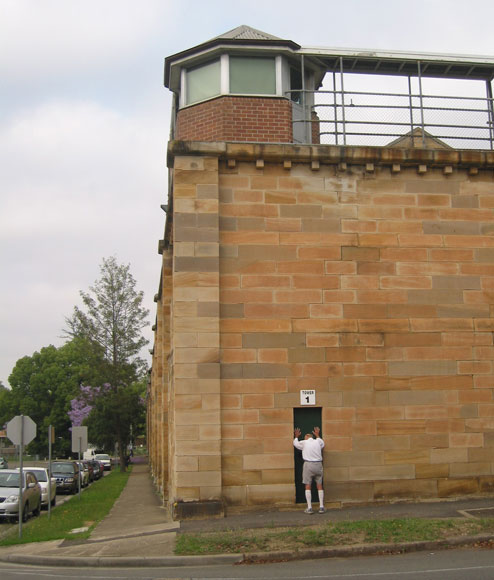
Parramatta Gaol. Photo from here
Once the cuts are officially announced, we can expect more talk about the savings and, if we are really unlucky, Labor's black-hole.


The opposition are already speaking: shadow attorney-general Paul Lynch was quoted in the Herald as saying that ''Fewer prison staff must mean prisons will be less safe. If the cuts cause longer prisoner lockdowns, then they'll make prisons even harder to manage.''


Hopefully the unions will be able to come up with a better argument than this, from Public Service Association general secretary John Cahill: "It's all about money, not rehabilitating inmates ... which is a good short-term approach but when they get out they're more cranky and they're more likely to reoffend."


It's hard to imagine a sillier analysis - I'm no criminologist, but I suspect that you would find that "ex-inmate crankiness" is pretty low on the list of causes of crime.


In any event, this all comes as the government continues its tussle with Fred Nile over ethics classes, which looks more likely to become a major problem if this tweet from @marktobinsydney is to be believed:


With a little luck, the government will be able to cut through the rhetoric on correctional services with some numbers about prison populations and the fact that there is simply excess capacity in the system.


A commitment that conditions at the prisons (for staff and inmates) will not be negatively affected should go a long way to assuaging concerns.  Of course, whether that is a commitment they can make is another question.


What O'Farrell will be desperately hoping is that this does not become another front he has to fight, as it seems likely that he is going to have his hands fairly full in the months to come.