Showing posts with label GST. Show all posts

Wednesday, June 13, 2012

A Goods and Services Budget


The NSW State budget was released yesterday with the usual fanfare.

Journalists were locked away for hours to pore over the documents and then breathlessly emerge like time travellers to frantically tweet and post articles telling us who the WINNERS AND LOSERS were, and the reasons that people would spend the next few days being very very outraged.

The budget is obviously a complex creation, and I'm not going to try and summarise the whole thing. If that's what you're after you'll find that information easily enough somewhere else.

I still view my task as a blogger to plug a gap that the mainstream media is leaving, and that's what I plan to do tonight.

So, what particular issue is it that is most deserving of further attention?

This:
Cut from this SMH article
$5 billion??? That is an enormous number. To provide a sense of scale, that is an average of $1.25 billion per year, or more than 2% of the projected revenue for 2012/2013.

ALL gambling revenue in 2012-2013 comes to approximately $1.8 billion revenue. A similar amount will be received in royalties -  the amount paid by mining companies to the state for the right to mine our minerals (in NSW, mostly coal).

So I thought a closer look was required at how this enormous amount of money was stripped from our books, and why.

To start with, it's important to look at last year's budget to work out exactly how big the change was.
And this year?
The difference?
2012-2013: $1 424 000 000
2013-2014: $1 443 000 000
2014-2015: $1 394 000 000

That's a total of $4.3 billion just over the next 3 years - presumably the figure for 2015-2016 (not provided in last year's papers to enable a comparison) brings the total to $5 billion.

What do this years papers have to say about this?
Further on:
Chapter six of the budget papers tells us more about why the total GST collected by the Federal government is falling.

These reasons include:

  • People are saving more and spending less
  • The price of GST-exempt goods are rising faster than the prices for taxable goods, meaning we are spending a greater percentage on GST-free goods:
  • Finally, NSW's GST share has fallen from 30.9% to 30.7%
These changes are significant, and place enormous strain on an already stretched budget. The Coalition can't be blamed for it, but most punters are not going to understand or even be aware of the fall in GST revenue, meaning that whilst they won't be blamed for it they also can't use it an excuse.

How permanent the loss is also remains to be seen. Certainly the trend in food increasing in price is likely to continue.  Of course, that only serves to further highlight what utter folly exempting food from the GST was, but that is a battle lost.

This $1.25 billion per year will barely garner a headline, mostly because it is boring and no one is going to march anywhere because of it.

But it is important to contrast it to the viciously derided "Labour Expense Cap" that will result, apparently, in the loss of 10,000 jobs and result in compulsory redundancies. IT will save just $2.2 billion over 4 years, or approximately $500 million. 

THAT is just how significant this figure of $5 billion over 4 years is. And why it is a little amazing that it is not getting more attention.

Monday, October 17, 2011

Tax is not a four letter word

I recall a tweet from a friend a while ago complaining about the Tax Office being credited with a special 20c coin celebrating the 100 year anniversary of the Australian Tax Office.


Photo from here
The reason for her complaint (if I can be so bold as to put words in her mouth) was that tax is at best a necessary evil, and at worst a horrifying example of governmental encroachment upon our lives.


This was a girl that would find a very happy home with the Republican Party in the US (especially their Tea Party colleagues) - governments should be small, spending should always be the absolute minimum (except of course for defence) and taxes should be cut, cut and then cut again.


This view is far less common in Australia.  Whilst the Federal Coalition has shown a new-found enthusiasm for small government of late (no doubt in part due to the happy synergy this has with opposing the Carbon Tax) their efforts on this front are positively lacklustre in comparison.


With that in mind, it is surprising (at least to me) how strident opposition can be to new taxes.  I've already mentioned the Carbon Tax, but we need only think back to the GST for an example of how easy it can be to oppose a tax.


As I said on twitter today, it is just too easy for a lazy journalist to find someone worse off under the tax, and publish a double page spread of the family in front of their McMansion weeping over $15 a week.


Every business failure is blamed on the new tax - even those businesses that haven't turned a profit since walkmans were the next big thing.


This is the reason why O'Farrell's suggestion that the GST be increased is probably never going to see the light of day.


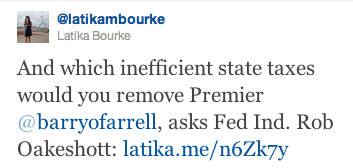
The story was brought to my attention by O'Farrell's exchange today with ABC journalist Latika Bourke:


I had a look at Oakeshotte's piece.  His Private Member's Bill seems pretty outlandish, and I imagine I'll return to it another time.


I'm more interested in the NSW Government's submission to the Tax Forum, a document I'm ashamed to say I had not read before today. It can be found here, and it worth a gander - it is shortish and written in fairly plain English.


There is a bit of commentary about the imbalance between Federal and State governments when it comes to Revenue and Expenses - in short, the Federal government holds the purse-strings for the states.  There is a lot of talk about the Spirit of the Constitution (which, for me, is a short step from discussing "the vibe").


There is also an interesting proposal regarding the treatment of fuel excise - essentially NSW wants her share of the fuel excise sent straight over to be spent on road infrastructure.


It is the proposal on GST that has got people talking today though.


What the paper calls for is this: 


Why are they more efficient?  These two tables explain why:


To understand those tables, it is essential to grasp the concept of "Excess Burden".  Wikipedia says the following:


The average burden is the average at the present rate.  The marginal burden is the additional burden for the next $1 - a marginal burden of 10% means that $1 extra of tax will mean $0.1 of burden.

Looking closely at the numbers, it can be seen that some taxes actually have negative burdens.  Presumably Tobacco excise is negative because of the saved health costs, meaning that for every $1 we tax cigarettes there is a positive effect elsewhere.


The numbers that we are interested in are the numbers for GST compared to some of the State taxes.  The differences are stark, and clearly show the benefit of eliminating these State taxes in favour of more GST.


There are other benefits as well.  Eliminating one of those taxes in favour of a higher GST-rate would save huge amounts of money on administration (for government and business). 


If the Federal government was really smart what they would do is remove GST's food exemption. With some carefully targeted income tax cuts and/or welfare increases the lowest earners would not be worse off, and we would have a tax system that is simpler, cheaper to administer, less prone to fluctuations and, above all fairer.


Will it happen?  Of course not.


Even for a popular government, an increase in the GST-rate is politically disastrous.  We all remember how hard it was for Howard to convince us the GST was a good idea (and even then it probably hurt him at the 1998 election). For the present Federal government?  Fuggeddaboudit.


Moreover, where is the benefit for a Federal Government?  The State Governments will score big as some hugely unpopular taxes are eliminated (I'm thinking especially of land tax or payroll tax) but the Federal government will be the big bad guy.


How do I know?  Read this awful piece on the NSW Labor website.


The writing in this piece (especially the quotes) is so awful I want to poke my eyes out, but I can also acknowledge that it is effective. The image of Barry's hand in your pocket - it's awful, horrible writing, but even this piece would do the job.  Imagine a slick, well crafted, intelligent campaign. It could actually make the next NSW election competitive.


O'Farrell's proposal isn't going to happen.  What is more likely is that the GST issue is a feint to win a share of income somewhere else so that the Coalition has the funding room to reduce payroll tax a little more.


Another good idea that will never see daylight. A shame - but certainly not a surprise.