Showing posts with label mandatory sentencing. Show all posts

Tuesday, January 29, 2013

Shooting Their Mouth Off


I'm getting pretty sick of anonymous police sources mouthing off in the media.

That mood is not assisted by the topics they choose to complain about. There is a saying "No police officer ever met a new power he didn't like."

That's not universally true, of course. In fact, in recent years, some police officers have shown remarkable sense in pursuing smarter, rather than harsher, ways to deal with crime.

Today, however, we saw police demanding mandatory penalties for gun possession:
Full story here
No doubt they were able to point to extensive research that proved that such a change would reduce gun crime. Or at least some evidence that it was the best way to deal with the issue?

No.

First there are two examples of sentencing, presented without any context whatsoever, meaning the reader has no way of knowing whether the sentence was appropriate or not. This is a constant issue with media reports that, frankly, one has become more accustomed seeing in the Terrorgraph.
Then, there is this unattributed (and, I have no doubt, thoroughly invented) claim:
Then we have this brilliantly detailed analysis:
I'm sorry, but if you're going to make such a definitive claim without a shred of evidence to back it up, then you're flat out lying to achieve a political goal.

And the paragraphs following are not evidence:
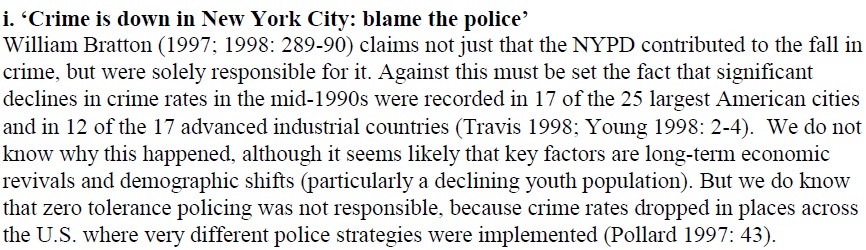
To reduce the New York Zero Tolerance experiment to "zero tolerance penalties on gun possession" (what even does that mean?) is to grossly distort history.

The changes in New York were wide ranging and encompassed a fundamental shift in policing in New York. Sentencing was a very discrete and comparatively insignificant part of the changes.

The following is from a paper entitled "Zero Tolerance Policing":
Whilst crime was reduced, there is also disagreement as to the extent to which zero tolerance policing as a whole had an effect. This from "Beyond Zero Tolerance":
These police officers are launching a cowardly, anonymous attack in the media without a shred of evidence to back it up.

In fact, the only sensible suggestion in entire piece (the government having either not suggested one or not having had it quoted) comes from John Robertson.
A guideline judgment is a decision from the Court of Criminal Appeal that sets out a framework for sentencing an offence.

At present we have a number of guideline judgments in operation, including for High Range Drink Driving and Armed Robbery. If the Attorney General sought such a judgment, and the court was satisfied that it was appropriate, a framework for sentencing persons convicted of gun possession could be handed down.

It would be something along the lines of "A person convicted of XXXX should in the ordinary case be facing a term of imprisonment of between three and five years."

Alternatively, the government could impose what is known as a Standard Non-Parole Period - a period of time that should be imposed on a mid-range example of an offence.

By way of example, the Standard Non-Parole Period for Murder is 20 years, whilst for Sexual Assault it is 7 years.

Of course, that all assumes that the penalties being imposed are actually insufficient, and no one quoted in this piece was actually able to prove that. Until someone does, this piece remains little more than a baseless attack on the legal system.

Monday, September 24, 2012

Stay Directly In Gaol


Sometimes standing up for an individual's rights can put you in a difficult position.

As many of you would know, my day job is a criminal defence lawyer. Some of my clients have been accused of pretty awful criminal offences. Others who I have represented on sentence have admitted committing awful offences.

That's ok. I'm proud to stand up for someone and make sure they receive the just penalty, rather than the penalty that an ill-informed public baying for blood might deem appropriate.

Having said that, I'm sensitive to society's views on criminal punishment. By way of example - at present the maximum penalty for a person who sexually assaults a person under the age of 16 is 20 years imprisonment.

At present, there are a select group of offences that are deemed worthy of imprisonment for life (including, for example, murder and some examples of gang-rape.

If someone wanted to make the argument that sexual abuse of a child should be added to that list, then that is a discussion we should have. I'm not backing any such change - but it's a reasonable argument for someone to make.

What I will almost always oppose are changes that remove a court's discretion. I wrote earlier this year about the new law mandating life-imprisonment for murder of a police officer earlier this year.

But if there is a particular maximum penalty that needs to be increased, then so be it.

This is why I was so interested to watch this documentary from the always excellent Louis Theroux:
Screenshot from here
The doco is fascinating, and thoroughly worth a viewing. In short, Theroux spends a few days in a mental hospital in the US that was built for paedophiles who are still deemed to be too great a risk for a release, but who had finished their court-imposed sentence.

The offenders were kept in good conditions (at least when compared to a prison). They had all sorts of luxuries and benefits that are not afforded to regular prisoners.

And so it should be. These men had all completed the sentence that was imposed by the court, and there was no longer any basis for "punishing" them. They had rec-rooms, DVD players, sports competitions - they just weren't allowed to leave and re-enter the community.

The problem was that an idea that is perhaps good in theory was perhaps always destined to fail - the "inmates" were almost never approved for release. Even those that completed all the necessary rehabilitative programs found that accommodation difficulties, judicial review or plain bureaucratic SNAFU's meant that they tended to remain there indefinitely - even once approved for release.

But in theory, I think the idea has merit. A person who had completed his or her sentence should not be punished further - but surely there is merit in keeping those people separate from potential victims.

The problem in NSW is that there is not even an attempt to ensure that punishment is not any part of the preventative detention.
Full Act available here
This act, in short, allows the state to apply to the Supreme Court of NSW to keep a person in custody after the completion of his or her sentence if the person is service a sentence for a "serious sex offence".

This isn't simply keeping the person away from potential victims - a person who is subject to such an order is kept in gaol, as if their sentence was not yet finished.

It is abhorrent, but no one really seems that fussed. They're just sex-offenders, after all.

Today Greg Smith announced that the scope of the act was to be widened:
If it was simply a matter of preventing these offenders from re-integrating into the community, and if they were housed and cared for in such a way that made that clear, then I would have some sympathy for the position.

But that is clearly not the case. These people will simply be kept in gaol as if they were still serving their sentences.

And that's the problem. An idea that would be a necessary evil if carefully thought through and sufficiently funded becomes an arbitrary, capricious law that unnecessarily and grossly breaches human rights.

Why? A few cheap headlines in the Terrorgraph.

Worth it?

Monday, May 23, 2011

Mandating a change

"Mandatory" and "Sentencing" are two words that do not belong in the same sentence.


They have been thrust together in the last few days by the Coalition's announcement that the Government intends to table legislation next week making a life sentence mandatory for persons convicted of killing a police officer.


Mandatory Sentencing has, to say the least, a chequered history in Australia.  After the scandal that eventuated in the Northern Territory when a "three strikes and you're in" policy was tried, most governments have been loathe to try again.


There are already a few areas where New South Wales has mandatory sentencing, although it might be more accurately described as being "mandatory sentencing lite".


There are a multitude of driving-related offences where a magistrate must, upon, conviction, disqualify the driver for a minimum term.


Further, if a person breaches an Apprehended Violence Order "with an act of violence" then the person should be sentenced to a term of imprisonment "unless the court otherwise orders".


There are also some offences for which a life term is mandatory. Section 61 of the Crimes (Sentencing Procedure) Act 1999 details two situations in which a life sentence is mandatory:


- Where as person is "convicted of murder if the court is satisfied that the level of culpability in the commission of the offence is so extreme that the community interest in retribution, punishment, community protection and deterrence can only be met through the imposition of that sentence" 


or


- in particularly serious drug supply matters, where the court considers it appropriate.


These "mandatory sentences" still allow the court to consider the objective seriousness of the offence in deciding whether the imposition of a life sentence is appropriate.


Between 2003 and 2008, it appears that at least 7 people have been sentenced to life imprisonment for murder in New South Wales.


So - does New South Wales need mandatory sentencing for police killers?  I would suggest no.


If the sentence for persons who murder a police officer are too soft, then it is open to the government to, for example, insert an additional subsection into section 61 It could read, for example:

"A court is to impose a sentence of imprisonment for life on a person who is convicted of murder of a police officer acting in the execution of his or her duty unless the court is satisfied that the circumstances of the case do not justify it."


That would, in effect, mean that the court will start with a life sentence and decide whether it appropriate to give anything less.


It would also leave some discretion for the judges to decide whether a life sentence is appropriate or not, rather than mandating a blanket rule.


That said, the law already hands down more serious penalties for murders where the police officer is the victim..


Section 21A of the Crimes (Sentencing Procedure) Act 1999 mandates that any offence is aggravated (and the penalty therefore increased) where the victim was a police officer.


Further, the Standard Non-Parole Period (the sentence the court must impose for a "mid-range" offence) is 25 years where the victim is a police officer.


The crime of murder carries a life sentence as a maximum penalty.  There is no minimum sentence, and no requirement that a person even be imprisoned, but unsurprisingly the stats reveal that the penalties are very heavy.


For the 112 offences recorded in the Judicial Commission's statistics between 2003 and 2009, the shortest sentence imposed was one of 12 years.  Most received at least 18 years, with 37 persons (or 33%) receiving more than 25 years.


The statistics I have access to do not provide a breakdown of the sentences for police offices.  However, the case of Penisini is a useful example.


Without getting lost in the detail, Penisini was sentenced for the brutal murder of Constable Glenn McEnallay.  


Glenn McEnally. Photo from the Daily Telegraph
The Constable briefly pursued Penisini's car after he was informed that it was stolen.  After the stolen car collided with a gutter,  Penisini got out the car and fired 5 shots through the drivers side window of McEnalley's car.  The officer died 7 days later.


While assessing that the matter fell towards the upper end of seriousness for a murder (not least of all because the victim was a police officer), the court took into account a number of mitigating factors (including the plea of guilty, remorse and youth) and sentenced him to 34 years imprisonment, with a non-parole period of 23 years.


If you're interested, the sentencing judge in Penisini lists and gives a brief description of the previous matters where the court decided that a life sentence was appropriate.  That part of his judgment is extracted in the Court of Criminal Appeal decision and can be found here (see paragraph 13).


As the Court of Criminal Appeal said when it declined to increase the penalty to life imprisonment (as was sought by the Crown), "The sentence... imposed was a heavy sentence, even for the crime of murder."


I do not propose to enter a detailed analysis of the decision in Penisini, nor do I suggest that that penalty was correct or otherwise.


What I do say is that it is a good example of the way in which the court is able to consider both the aggravating and mitigating factors in a murder where the victim was a police officer.


If the penalty was a mandatory life sentence, there is by definition no discretion whatsoever.  Every case is different, and while it is wholly appropriate that heavy sentences be imposed for persons who kill police officers, this move would remove all room for discretion and increase penalties where there is no evidence that the court's decisions are unduly lenient.


There a multitude of other reasons why mandatory sentencing could create negative results.  No doubt pleas of not guilty will become more common, given there is to be no allowance for a plea of not guilty.


Further, it is instructive to look at that list of matter where the court has previously imposed life sentences.  The examples include:


- Serial Killers
- People who killed for pleasure
- A double murder involving torture and gratuitous violence
- Contract killings and 
- A political assassination


All of the above offences were heinous in the extreme, and wholly deserving of a life sentence.  It is difficult to understand what it is that makes the killing of a police officer so much worse that it should be the offence singled out for a mandatory life sentence.


Worst of all, the fact that this suggestion comes out of the blue forces one to wonder whether the change is being made purely for political purposes - to muddy the water as the Coalition brawls with the police union over their pay increases.


Either way, in the absence of examples where the government suggests that the sentences are unduly light, there would appear to be no need for a change.  And certainly not a move towards mandatory sentencing.