Showing posts with label public-private partnerships. Show all posts

Wednesday, June 6, 2012

Linking up?

There are some topics that, one would have thought, NSW Labor would be wise to avoid.

Abscence makes the heart grow fonder, and there can be no doubt that the voters will soon become more cynical about the Coalition, and less more favourably disposed towards O'Farrell.

How long it takes for the public to attain the required level of cynicism will depend on the topic.  Wages and conditions for public servants will alwys be a hot topic - after all, the Coalition is a government drawn from the right, and they are practically expected to hurt the public service.  And so they have.

On other issues, however, the left should be slower to throw stones. And there is no issue that Labor should be quicker to retreat from than Infrastructure spending.

The Labor government achieved very little in the way of infratstructure during its time in government.  True, a number of large road projects were built - but they were funded by private companies, resulting in heavy tolls - and not tolls carefully calibrated to encourage commuters onto puiblic transport, but rather heavy tolls calibrated to deliver the maximum return to the private companies.

When it comes to public transport, the Labor can point only to the Airport Link and the Chatswood-Epping Rail-link.

The Airport link is not nearly as impressive as one might suppose.  It was sorely needed (indeed, the only surprise is that it wasn't built before) - but it was funded by the private the sector, meaning that the cost to use it is so high that, even from outer parts of Sydney, it is often cheaper to use a cab.
The Chatswood-Epping Rail Link is great - until you consider that it was meant to be the Parramatta-Chatswood Rail-Link, until budget blow-outs and general incompetence meant that it was shortened and still, incredibly, managed to come in well over budget.
Parramatta-Epping is the dotted link - the solid line had already been built
So Labor has no right to throw any stones.

And yet:
During the last election, a commitment from Labor magically appeared - NSW would spend $500 million and the Federal Government would contribute $2 billion to link Epping to Parramatta.

This was an obscenely cynical promise. By the point that the promise was made, Labor knew that they had no chance of winning. They also knew that O'Farrell has committed to the North-West Rail-Link - an extremely expensive but equally necessary project. Pennies would need to be pinched.

Moreover, the Parramatta Epping Link was now Labor's idea - and if O'Farrell decided to fund it then it would be "Labor's idea" - and all credit for the plan would evapourate.

What Labor's promise really meant was that the Parramatta link would never be built - or, at the very least, it would slip well down the priority list. Like I said, cynical.

This is what press releases like this from Labor are meant to achieve. It is meant to damage O'Farrell for not doing something that Labor would relentlessly hammer him for doing.

Does it work? Probably. But far less than it would if Labor actually had a good record of building the infrastrusture that the press release talks about.

The problem is that of course Labor has no such record - and the public remembers that Labor squibbed on building that link in the first place.  It seems pretty unlikely that an attack on the Coalition for not building is going to do anything other than remind the public about Labor's (many) failings.

Penny Sharpe (who I generally like and respect) might be better advised to find a credible basis to attack O'Farrell. Because this infrastructure line sure ain't much chop.

Thursday, December 22, 2011

A Wider View

Public Transport has to be among the highest priorities for a state government.  For a government in a state where public transport has been neglected and designed on the back of an envelope for so long, the need is even more pressing.

It is appropriate that the O'Farrell be pressured to keep its public transport promises.

But that doesn't mean that no new roads should be built under any circumstances.

Certainly when it comes to chosing between a road project and public transport project, it would be tough to convince me that the road project is a better option.
Photo from here
Road projects typically begat more traffic, and frequently result in no net reduction in travelling times.  NSW's long history of road project shows how often that is the case.

Having said that, there is a place for the Public Private Partnerships that the Labor government was so enamoured with.  Many of the roads we now have were built at little or no cost to the public purse, meaning that the government had funds available to spend on public transport.


The fact that, for the most part, they failed to do so is a separate issue.  PPP's are, in principle, a good idea. User pays to drive, which seems like an eminently sensible way to give commuters the option they often need, but also encourage public transport for those who are able.

Cross-City Tunnel - an adject (financial) failure.  Map from here
The problem in NSW was the repeated failure of companies who engaged in these PPP's. Why they failed is a bit beyond the ambit of this post, but suffice to say it must be difficult to convince a company to engage in a new partnership when the last few infrastructure partnerships with this government have been such abject failures for the private sectors.
Map from the RMS website
The M5 is operated by Interlink. Interlink has a contract allowing it to collect tolls until 2023, upon which ownership will revert to the state.

The road is 2 lanes for most of its length.  Labor negotiated at length with Interlink to widen the road to 3 lanes, but it appears that agreement was never reached.

As part of the election campaign, O'Farrell promised that the road would be widened, and he has now signed a contract the deliver on that promise.

The original plan had been that the toll collection period be extended by 4 years.

Labor had, during the campaign, criticised that option, saying that it was $680 million (tolls of $170 million per year times 4 years) in exchange for a project that would cost $350 million.  Of course, that ignored the obvious fact that it was $680 million 13 years from now in exchange for $350 million worth now, which any first year actuarial student will tell you is a very different proposition.

In any event, agreement has now been reached on the following terms:
- tolls collection period extended for 3 years
- truck toll to increase from 2.5 times to car toll to 3 times
- the government to contribute $50 million in noise abatement

Usually, widenings like this only achieve something if they occur at the bottle neck. I almost never drive on the M5, and don't think I have ever done so in peak hour, but I understand that the main bottle-neck is at the M5 tunnel.

This article suggests that a duplication of the tunnel would be enormously expensive - some $4 billion. With the other promises that O'Farrell has to fund, that would seem to be thoroughly beyond the government's means.
The tunnel entrance. Photo from here
However, O'Farrell claims that 60% of the road users get off before the tunnel, meaning that these users will get considerable relief once the work is done.

That would seem to be consistent with a traffic study that suggests that the widening will decrease the rate at which traffic levels build up on the road.

At the end of the day, this deal appears to cost the government very little, and may actually result in a significant benefit to many drivers. True, in the fullness of time traffic will expand to fill this new space - but user pays means that this new traffic will provide significant income to the government once the tolls are removed in 2026.

There is one final thing to be said - the Cashback scheme.  This is amongst the dumbest ideas a NSW government has ever had.  Private vehicles who use the M5 are entitled to claim back their tolls.  Why?  It's hard to say.

Now that Cashback is in operation there is no way that O'Farrell could "sell" a proposal to remove it. That's roughly $100 million per year that could be far, far better spent.

But I suppose that's the kind of thing we've come to expect.

Thursday, April 21, 2011

Delivery on track?

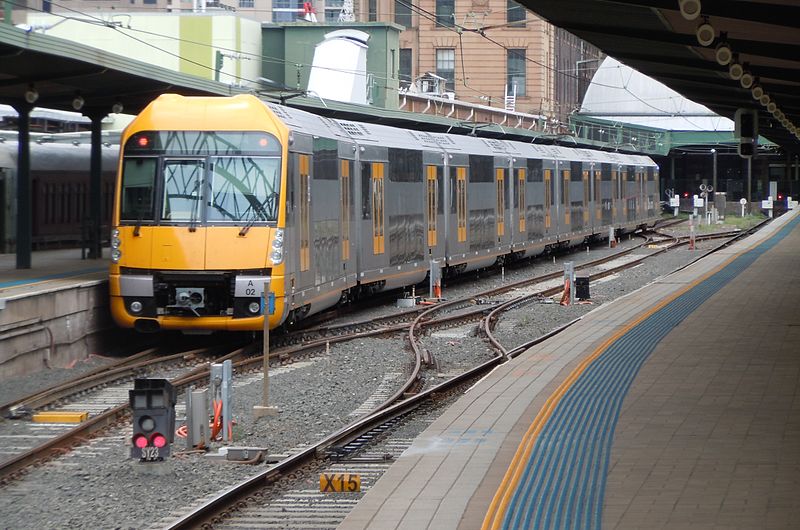
The delivery of the Waratah trains is long, long overdue.


A Waratah Train.  Photo from Wikipedia
John Watkins, then transport minister, said in 2006 that they would be on the tracks by 2008.


This delivery was important and urgent not only because these carriages are an essential upgrade of the rolling stock.  They will result in more carriages on the tracks, but also will allow the retirement of older models.


According to Wikipedia, the train design is based on the Millenium trains. Given the extraordinary difficulties encountered with the Millenium trains shortly after their launch, perhaps we should have expected some drama.


Millenium Train.  Photo from Wikipedia
The CityRail website says that there will be 626 waratah carriages delivered, which is "equivalent to 50% of the current suburban fleet".  What this allows CityRail to do is retire the entire L, R and S sets, which entered service between 1972 and 1980, and are not air conditioned.


One of the old carriages.  Photo from Wikipedia
These non-air conditioned carriages are hated by everyone for at least 6 months of the year, and getting rid of them will no doubt drastically increase passenger comfort.  


Additionally, there are only 498 carriages in the L, R and S sets, meaning that the number of active carriages will be increased by 128.


Whether this will lead to an increase of the number of services does not appear to be clear, as of course there will be staffing and other cost implications.


The concern is that the process has been so fraught with delay and drama it has become a "I'll believe it when I see it" kind of project (like so, so many under the Labor Government).


The Herald reported today that the trains may be entering service within two months, but that Downer EDI (the manufacturer) has released the trains to RailCorp before all the work on them is completed.


If RailCorp is not satisfied with the trains or if significant operational issues become apparent, then all hell could break loose.


Downer has apparently already anticipated a $440 million loss on the whole project.


The project was another of those public private partnerships that have been such a disaster over the last decade (the Cross City Tunnel and Airport Link spring to mind).  Perhaps counter-intuitively, the private stakeholder having awful financial results is not a good thing.


If companies can't make a financial success of these partnerships, then they will quickly lose interest in being involved, meaning the government is going to have to not only manage the project (something governments at all levels don't have a great record with) but also absorb all the financial risk.


The question is, of course, WHY have these projects been a disaster?  Is it the government simply picking the lowest bid - a bid that they know the company cannot possibly hope to meet and make a profit?  


An Inquiry into Public Private Partnerships was conducted by the Public Accounts Committee in 2005 and 2006.  The report noted that "the Government’s aim is not to maximise risk transferred to the private sector" but rather to "optimise the allocation of risks to the public and private sectors according to which party is best able to manage these risks."


That's all good and well, but it seems clear that this goal has not been achieved to date.


The position that the Coalition government finds itself in is that the trains are now arriving on their watch.  The trains will be an improvement, and should be recognized as such, although we can all expect to hear a great deal about how long ago they were promised.


That said, the government is going to have to have a close look at how we manage major contracts like this, whether for infrastructure, vehicles or the like,


There are probably very few people who think that private companies should not be involved at all.  Government should stick to government where possible, and (where appropriate) use private companies to produce and build.


But these arrangements need to be mutually beneficial.  If NSW is seen as a place where the lowest bidder wins and then inevitably makes a crushing loss on the project, we will lose the top bidders, to everyone's detriment.


It remains to be seen whether the Coalition government is any better at dealing with business to get things built.  If so, it could be the starkest distinction between this government and the one before it.