Showing posts with label police. Show all posts

Saturday, February 9, 2013

Adult in the Room

Sometimes we really need a Premier to be the adult in the room. The Craig Thomson debacle was a good opportunity for O'Farrell to show that this was who he is able to be.

I'm not going to repeat the background of Thomson - anyone with a pulse in Australia must know who he is and what he is alleged to have done. In any event, his lawyer has been extremely active in the media over the last fortnight, talking about the legal process, the public manner in which he has been arrested, not to mention many of other complaints.

One of the complaints that (unsurprisingly) resonated with the media was the suggestion that he had been strip-searched by NSW Police, a claim apparently denied by police:
It eventually transpired that it was in fact Corrective Services who had searched Thomson, not police:
Full story here
Anyway, this is what Barry O'Farrell has to say about the issue:
Full story here
It's just unhelpful. O'Farrell needed to either explain why what was done was standard procedure for all persons going into custody, or he needed to explain why Thomson was singled out.

That joke was made in full knowledge that it would be the line that the journalists ran, and it's more than just a cheap shot. If Thomson was in fact singled out, then it is a serious matter. If he was not singled out, the Corrective Services deserve to be backed up by their premier.

I know it may sound like I'm being a little precious, but I just think that O'Farrell needed to be the one acting like an adult in the face of the frantic arm waving from Thomson's lawyer. Instead, he delivered a cheap joke.

Not really good enough.

Tuesday, January 29, 2013

Shooting Their Mouth Off


I'm getting pretty sick of anonymous police sources mouthing off in the media.

That mood is not assisted by the topics they choose to complain about. There is a saying "No police officer ever met a new power he didn't like."

That's not universally true, of course. In fact, in recent years, some police officers have shown remarkable sense in pursuing smarter, rather than harsher, ways to deal with crime.

Today, however, we saw police demanding mandatory penalties for gun possession:
Full story here
No doubt they were able to point to extensive research that proved that such a change would reduce gun crime. Or at least some evidence that it was the best way to deal with the issue?

No.

First there are two examples of sentencing, presented without any context whatsoever, meaning the reader has no way of knowing whether the sentence was appropriate or not. This is a constant issue with media reports that, frankly, one has become more accustomed seeing in the Terrorgraph.
Then, there is this unattributed (and, I have no doubt, thoroughly invented) claim:
Then we have this brilliantly detailed analysis:
I'm sorry, but if you're going to make such a definitive claim without a shred of evidence to back it up, then you're flat out lying to achieve a political goal.

And the paragraphs following are not evidence:
To reduce the New York Zero Tolerance experiment to "zero tolerance penalties on gun possession" (what even does that mean?) is to grossly distort history.

The changes in New York were wide ranging and encompassed a fundamental shift in policing in New York. Sentencing was a very discrete and comparatively insignificant part of the changes.

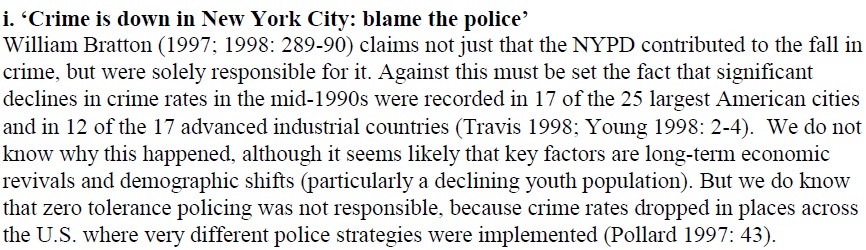
The following is from a paper entitled "Zero Tolerance Policing":
Whilst crime was reduced, there is also disagreement as to the extent to which zero tolerance policing as a whole had an effect. This from "Beyond Zero Tolerance":
These police officers are launching a cowardly, anonymous attack in the media without a shred of evidence to back it up.

In fact, the only sensible suggestion in entire piece (the government having either not suggested one or not having had it quoted) comes from John Robertson.
A guideline judgment is a decision from the Court of Criminal Appeal that sets out a framework for sentencing an offence.

At present we have a number of guideline judgments in operation, including for High Range Drink Driving and Armed Robbery. If the Attorney General sought such a judgment, and the court was satisfied that it was appropriate, a framework for sentencing persons convicted of gun possession could be handed down.

It would be something along the lines of "A person convicted of XXXX should in the ordinary case be facing a term of imprisonment of between three and five years."

Alternatively, the government could impose what is known as a Standard Non-Parole Period - a period of time that should be imposed on a mid-range example of an offence.

By way of example, the Standard Non-Parole Period for Murder is 20 years, whilst for Sexual Assault it is 7 years.

Of course, that all assumes that the penalties being imposed are actually insufficient, and no one quoted in this piece was actually able to prove that. Until someone does, this piece remains little more than a baseless attack on the legal system.

Tuesday, September 18, 2012

An Opportunity to Improve?


Well, we were waiting to see what the suggested amendment was going to be, and now we know. Except, I'm not certain what to think.

I wrote about the proposed changes to the right to silence a little while ago, and I won't repeat the reasons that I think it is an awful idea.

One thing I mentioned last time was that it would be interesting to see the way the actual law was drafted.

This is what part of the new section 89A of the Evidence Act looks like:
That's interesting, for a number of reasons.

The big problem with the changes is that they are going to pressure lots of people, particularly innocent people, into giving an interview when it would be hugely contrary to their interests to do so.

When similar changes were introduced in the UK, a 24 hour legal aid service was provided so that anyone arrested would be able to get in person advice before deciding to give an interview.
And extract from a UK government website
The English courts have held, as I understand it, that if a person could not get legal advice before the interview then the "old rules" applied.

Naturally enough, the efficacy of the changes for the UK was used to justify the changes in NSW, even though there was no intention of providing funding to Legal Aid so a similar service could be provided.

My experience is that if a person is arrested and says they want to speak to a lawyer, the police usually just fling a yellow pages at them and give them a cordless phone.

Since a lawyer is unlikely to come down to a police station unless the person is able to pay for their attendance, it's extremely rare for a person to actually get legal advice before they get interviewed.

The new section says that the new rule will only apply once they have been given the "opportunity" to obtain legal advice.

It will be fascinating to see the way the courts interpret the word "opportunity".

Technically, every arrested person is already afforded the "opportunity" to seek legal advice. If they say they want to speak to their lawyer, or any lawyer, the police will give them that cordless phone.

But I fancy the drafters had something a little more substantial in mind. But what?

The good thing about the drafting is that it means that the issue will be left up to the courts to interpret with very little precedent to be guided by, other than the UK system.

Given the way in which this section flies in the face of centuries of legal protection for the rights of the individual, it is my hope that the court reads "opportunity" very narrowly, perhaps limited to an in-person conference with a solicitor who has been given the chance to obtain a detailed account from you.

Of course, there are still a number of significant problems with that system. People will be giving interviews before the police have had to provide a brief of evidence, before it is clear what charges will be preferred, and before it is clear whether police have any prospect of proving the charges without you opening your fat mouth.

But it's something at least.

The full proposed amendment can be found here along with an invitation to make a submission. If you are so inclined, you have my permission to plagiarize as much of my writing as you like.

Tuesday, August 14, 2012

The Silent Menace


Here's a hypothetical situation for you to consider.

You're out with some friends on a Saturday night. You've had a few drinks - you're not drunk, but you're enjoying your night. It's a dark pub in the city - there is music, flashing lights, people everywhere.

You look over your shoulder and see your friend being punched by someone you don't recognise. You don't know how it started, and your friend may well deserve that punch, but you immediately run over to try and help your friend.

As you arrive, suddenly there are people everywhere. You get a knock to the head - you're not sure who or it was. Suddenly you're just trying to defend yourself.

After 10 seconds of chaos, someone grabs you round the throat, and before you know it you're on the ground, handcuffed. You're taken to a police station, put in a 1m by 2m cell with a clear plexiglass wall and given an icepack for that lump on your forehead.

You wait there for about 2 hours and start to sober up. You are offered the chance to call a lawyer, but it is 1am on a saturday night, and of course you don't have any lawyer's mobile phone number. The few law firms that you find in the Yellow Pages don't pick up, and in any event, how would you pay for their services?

Then, a police officer approaches you, takes you in a room. As he's setting up, you ask what is going on, and he says "We're investigating what happened in that pub. This is your chance to tell your side of the story."

You respond "Do I have to?" and he replies "No." You say "Am I going to be charged" and he says "Maybe."

He turns the video camera on and is joined by another officer. The say "You are not obliged to say or do anything unless you wish to do so, but whatever you say or do may be used in evidence. Do you understand?"

You say yes, and police start asking questions.

You know you did nothing wrong, and you've got nothing to hide. Do you answer the questions?

If you said yes, you almost certainly just made a massive mistake. Don't feel bad - the vast majority of people (innocent or guilty) who are charged with an offence give an interview. People who are innocent are even more likely to start talking.

I've been working in criminal defence work for four and a half years, and I am yet to see even one interview given by a client that helps them. Not once. I have NEVER even heard of a situation where police decided not to charge someone because of what they said in their interview.

The problem is this - by the time they speak to you at 1am that night, police have taken statements from security, the barman, the alleged victims, and anyone else who they think might help. They have viewed the CCTV footage, if it exists. They have sat down and worked out what they think happened.

They have all the information. You have none. They know what they plan to charge you with, and what the elements of the offence are. You do not.

If you say anything, ANYTHING that differs from what the CCTV footage shows, the police will do everything in their power to use it to your disadvantage. If you forget something, or in your muddled, disorientated state of mind during the interview and then bring it up when your matter is heard, you will be hammered for it.

If you get home and find a huge bruise on your back and suddenly remember that punch you got just before you got hit in the head, or if you remember something that you forgot to mention - too bad so sad, you missed your chance. Anything you add now looks like something you've invented specially.

Interviews are almost universally a very bad thing for accused persons.

This is what makes the changes announced today all the more shocking:

NSW will be the very first jurisdiction in the country to take these steps.

Why is this change such a bad thing? A lot of reasons.

Firstly, the person being interviewed will almost never have had the benefit of legal advice. There will usually not be a lawyer there to protect and advise them, even if they could afford to pay for one. They won't know what they are to be charged with, they won't know the elements of the offence, and they won't know if they are guilty or innocent.

Police, by contrast, will know what they are trying to prove, and will ask difficult, confusing questions to trap you into admitting something, or at least into contradicting what they know they can prove.

These changes will be an even more powerful emotional tool for police to use to convince a person to give an interview. Of course they cannot literally force someone to start answering questions - but once people are told that, in effect, that if you don't tell us what happened it can be bad for you, it is difficult to resist the natural willingness to answer questions.

Moreover, at present I can as a solicitor give general advice that an interview is almost universally a bad thing. I tend to tell anyone who talks to me about my job for more than a few minutes.

If this change is made, that advice will change to "it depends". It will be pretty much impossible to advise a person whether giving an interview is a good idea without spending a decent amount of time talking to them about what has happened - and that assumes that you even know what you are going to be charged with. At 2am in the morning, there is no way that going to happen.

The second issue is the presumption of innocence. The basic principle is that the Crown needs to prove its case beyond reasonable doubt.

That is a heavy burden - but it is the right burden. Anyone can make an allegation against someone, but we don't want to have to come to court and prove that we didn't do something. Not only is proving a negative all but impossible, but the prosecution have far, far greater resources than all but the wealthiest of defendants.

Police have incredible investigative powers that are not even worth comparing to an individual's. 

The third issue is that there has been no report, no investigation, and no consultation.

Well, that's not quite true. In 2000 the Law Reform Commission closely examined the right to silence and produced this quite excellent report. Their conclusion?
Section 89 of the Evidence Act presently reads:
This mooted change comes completely out of the blue. To my knowledge no one has been actively campaigning for it, no one has suggested that it is a major problem to be fixed, and no other jurisdiction in Australia has tried because it because it is a pretty bloody stupid idea.

The only people quoted in O'Farrell's press release are O'Farrell, AG Greg Smith, the Police Minister Mike Gallagher (3 Liberal politicians) and Police Commissioner Scipione (police being famous for never having met a new power they didn't like).

It is also pretty interesting to look at the reasons that have been proffered by the Coalition as the story broke today.
If by exploited O'Farrell means "being used to the accused's advantage" then I suppose a lot of other rights are in danger.  On that definition, accused person's constantly "exploit" their right to a trial, and their right to legal representation, not to mention their right to a presumption of innocence. 

Unless O'Farrell can point to some evidence of this right being somehow illegitimately exploited then this is a non-sensical criticism.

And to say it an "importan legal right" and then comprehensively rip it to shreds - I don't even know what to say about that.
Well, yes. Of course accused persons restrict information given to police! The police are trying to prove them guilty of an offence that they deny committing! Is O'Farrell expecting these people to actively assist police in trying to prove them guilty?

If police uniformly and reliably investigated matters with the intention of finding the truth (not just "getting their man" as is so often the case), and if the police never made a mistake, never jumped to a conclusion and never relied on their "gut" rather than the evidence, then perhaps this wouldn't be such a problem. But we all know that is a fantasy.
Ah, that old chestnut! Common sense! Also known as "We have no evidence that this is a good idea, but it sounds good, so we're going to do it!"

That's why you hear so much talk about "common sense" from some people. It's a wonderful way to avoid annoying things like "evidence", "specialised knowledge" and "research".
Brad Burden is the head media guy for O'Farrell, and his tweets today got me madder than any others.

Bring into line with the UK? What possible reason is there that we need to have the same laws on this topic as the UK does?

Bringing laws into line with other states can sometimes makes sense. At the moment the states are working on bringing together the laws surrounding heavy vehicles. This makes a lot of sense - the heavy vehicle regulation in NSW is eye-wateringly complicated, and having to work with the laws in 6 other states and territories must be an absolute nightmare.

To suggest that there is a good reason to bring laws into line with the UK is ridiculous in the extreme.

It is also worth noting that in the UK there is a scheme whereby any accused person can at any time have access to legal advice 24/7. There are duty lawyers who are always available to attend police stations and give advice

In NSW, you have the right to access legal advice, but it is impossible to find unless you have the mobile number of a criminal lawyer in your pocket. Legal Aid do great work in NSW but their funding has no prospect of even coming close to this level of service - they are hard-up providing enough lawyers just to make the court appearances for their clients during waking hours.
This was the tweet that really made me crazy. This change has nothing to do with victims of crime. It is about making it easier to convict someone of an offence. To link it to "victims of crime" is just plain deceptive.

That segues pretty well to the biggest complaint I have about these changes.

Everyone is going to be talking about the way that these changes will affect people who are guilty of crimes and trying to hide it. Case in point:
I have no problem with something that makes it easier to lock up people who are guilty of offences. That's good, and proper, and should be encouraged.

What upsets me about these changes is the effect that it will have on people who are not guilty of anything.

If you are innocent of any crime, the absolute worst thing that can happen to you is a police interview, especially before you get legal advice. Police will know the evidence they want to get from you. They will spin your answers, they will provide you with information as and when it suits their questions, they will change tack and try and catch you in a lie, and they will give you every opportunity to say something they can prove is untrue.

There is no magistrate to rule questions out, and there is most likely no lawyer there to help explain things to you. And your answers will be mercilessly used to convince a jury that you are in fact guilty.

And more innocent people will go to gaol as a result. Fact.

Nice one Barry.

Friday, January 27, 2012

Lies, Damned Lies and Press Releases

Are the Coalition REALLY understaffing stations in South West Sydney?

On one set of figures, sure. In this Daily Terror story, we see the following:

(blogger isn't letting me upload photos, so I'll copy and paste)

   WESTERN Sydney police were understaffed while dealing with a frightening spate of drive-by shootings, while in the Premier's north shore electorate there were more than enough officers.
   As of December 31, the southwest metropolitan region had just 2305 police officers - 44 less than it should have.
   In Bankstown, there were 260 officers on duty even though the authorised strength of the command was 272, and there was also fewer officers in shooting hotspots Cabramatta and Fairfield.
   The shortfall came despite a police class graduating in mid-December and the fact the force was overstaffed state-wide, with 16,092 officers compared to 15,806 budgeted for by the state government. In Barry O'Farrell's Ku-ring-gai electorate, there were 174 officers - four more than the authorised strength of 170.

Assuming those numbers are correct, it is clear that the Ku Ring Gai numbers are higher (as a percentage of the "authorised strength") than the numbers in some SouthWest Sydney Local Area Commands.

What interested me was how fair those numbers are.  As the old saying goes, "lies, damned lies and statistics".

We are told the numbers in Ku Ring Gai - 174 officers (102.3%).  We are told the total for South West Metro Region - 2305 officers (98.1%).  Interesting, the only LAC we are given numbers for is Bankstown - 260 officers (95.6%).

I think it's fair to assume that those Bankstown numbers are the very worst the writer of the press release could find.

Labor also had a news item on their website that explained that Rockdale LAC is presently "three officers short" but does not tell us what their budgeted figure is.

What interested me in all this was a population comparison.  How do the population figures between the areas compare? Does that explain the difference?

The only LAC's that we have figures for Bankstown (260/272) and Ku Ring Gai (174/170), so we'll compare those.

Unfortunately, it's a little hard to work out what the population of the LAC's are.  What I've done is refer to the NSW police website to work out what postcodes are included in each of those 2 LAC's, and then used the 2006 census figures to work out the approximate population of those LAC's.

Imperfect, but I don't think NSW Police will respond to a media enquiry from me, so you're stuck with it.  First is the postcode, second is the population in 2006.

KU RING GAI (174/170)

Arcadia, Berrilee, Fiddletown, Galston 5103
Asquith, Hornsby, Hornsby Heights, Waitara 32 280
Berowra, Cowan 4 867
Berowra Heights, Berowra Waters 5 180
Brooklyn 1 699
Canoelands, Forest Glen, Glenorie 3 161
Dural, Middle Dural 7 907
East Killara, Killara 11 824
Gordon 5 993
Mount Colah 6 975
Mount Kuring-Gai 1 550
Normanhurst, North Wahroonga, Wahroonga 21 715
North Turramurra, South Turramurra, Turramurra, Warrawee 19 808
Pymble, West Pymble 14 096
St Ives, St Ives Chase 17 334
Thornleigh, Westleigh 19 028
TOTAL 178 520

BANKSTOWN (260/272)

Bankstown, Bankstown Aerodrome, Condell Park 37 958
Bass Hill 7 224
Birrong, Potts Hill 6 755
Chester Hill, Sefton 14 877
Chullora, Greenacre, Mount Lewis 22 462
East Hills, Panania, Picnic Point 19 511
Georges Hall 8 049
Lansdowne, Villawood 11 716
Milperra 3 887
Padstow, Padstow Heights 14 484
Revesby,Revesby Heights 13 853
Yagoona 14 876
TOTAL 175 652

So, Ku Ring Gai, with its 174 officers, and 178 520 residents, has 1 officer for every 1026 residents, whilst Bankstown, with 260 officers and 175 652 residents, has 1 officer for every 676 residents. In fairness, those numbers are based on the 2006 census but on the 2011 police numbers, and the LAC may not fit precisely with the suburb demarcation, but I think I've made my point.

That's not even considering the fact that, as I look at a map, Ku Ring Gai has a far bigger area than Bankstown, which all things being equal should mean it would need more officers to cover it.

My point?  I think it's fair to assume that the Terror's story is based on a Labor Press Release.  I don't have a copy of that release, but the above analysis took me about an hour of poking around (admittedly as I tried to watch the Australian Open Semi Final), and how many journalists have that long to spend on research?

And, if it is in fact all taken from a Labor press release, it just goes to show how you can use statistics to prove almost anything.

Lies, damned lies, and statistics indeed.

Friday, November 25, 2011

The Thin Blue Picket Line


Compensation for police officers injured in the line of duty is an inevitably difficult issue for a government.

Police work is physically dangerous.  It always has been - you can do all the OH&S assessments you like, but criminals will still shoot at police and police will still need drive at 200+km/h to catch drivers who don't stop.

Of course, physical injuries are just part of the danger.  There can be no doubt that policing can and does cause not mental distress and mental injury.

For those reasons, it is unsurprising that police have high numbers of officers on stress leave, sick leave and disability leave. And yes, it costs an absolute fortune to pay all these officers who are on leave for work related injuries.

That's part of the price we pay to have a police force.  They will suffer mental and physical injuries. They need to know that if they are injured they will be (financially) protected - or else they simply won't do the job.

Having said all of that, the government needs to find the funds to pay for this.  And when budgets are tight (not that I couldn't suggest a few places to find the cash) the government may find it difficult to justify the cost.

Moreover, the government's arguments about getting officers back to work do make sense.  As I understand it, there is presently a tendency for officers to receive a large lump sum payout once they are assessed as being permanently incapacitated.  This article claims that these payouts are collequially known as "mortgage busters" - and having worked in public service myself I don't find that hard to believe.
Police Minister Mike Gallagher looking upset about something.  From here
It may well be that there should be a shift in attitudes so that officers who are injured (mentally and physically) are encouraged to get back to work once they are able, rather than been sent out to pasture.  That said, this fact sheet put together by the police union suggests that there are also significant changes to not only the timing but also the quantum of compensation, meaning that officers may be financial devastated if they are injured.

What's the solution?  Well, for once, I'm not going to smug and tell the government what it's doing wrong.  They are either going to upset the police, who have a tremendous amount of bargaining power given the nature of police strike action, or they are going to create a budget headache.

Rightly or wrongly, the role of police in the community gives the force a disproportionate ability to cause chaos with their strikes. This means that if you want to take something away from police, you need to be certain that you will win the public relations argument.
Striking police earlier this week.  Photo from here
I can't see how the O'Farrell government can do that.  Of course, given the recent poll results they may take a "devil may care" approach,  but if they want to avoid a protracted and ugly campaign they will have to give something away.

Of course, the inevitable problem for a Liberal government is that once they start giving into strike action, they can essentially make a rod for their own backs.  If unions know that the O'Farrell is willing to give in if pushed hard enough, they may be all the more likely to take action.

The solution may well be for the Liberals to cave on some apects of the plan and find a middle ground.  If a middle can be charted (perhaps where officers forced onto payments rather than a payout are not financially penalised) then the Liberals may achieve their goal of giving police a motivation to go back to work.

But if the government digs its feet in - let's just say that this could be one strike that really does do some damage.

Tuesday, July 5, 2011

Burqa Burqa


The Burqa story was made for tabloid.

It has all the ingredients.  A sense of injustice because someone has apparently dodged the law because of a sneaky lawyer.

Racial elements, with a heady dose of Islamaphobia. There were scuffles outside court and a chance to use the words "radical cleric" in a headline.

Finally, who could resist the chance to have a shot at the court system?


In short, it was a tabloid editor's wet dream.

For those of you not in the know, a Muslim by the name of Carnita Williams was pulled over by a highway patrolman for not displaying her P-plates.  

For some reason that is not clear, she then leaves the car, and is clearly captured on the car's video camera ranting and raving at the officer.  The officer, to his credit, keeps his composure and does his job well.


The view from the in-car camera.  Photo from The Daily Telegraph
Later on that day, police alleged, Carnita Williams made an official complaint by lodging a statutory declaration at Campbelltown police station that the officer had threatened to rip her veil off.


The video was retrieved and viewed, and not long after Police launched a prosecution against Ms Williams for making a false complaint.


I'm not sure precisely what she was charged with, but by way of example, section 314 of the Crimes Act says that "A person who makes an accusation intending a person to be the subject of an investigation of an offence, knowing that other person to be innocent of the offence, is liable to imprisonment for 7 years."


At the Local Court she was convicted and sentenced to six months imprisonment. On 22 June that decision was set aside on appeal to the District Court, and she was acquitted.


The problem lay in that police could not prove beyond a reasonable doubt that it was Ms Matthews who made the complaint.  Police apparently did not ask her to confirm her identity when the filed the complaint.


It appears that Police may not have in fact had the power to force her to remove her veil when making the complaint, although whether they should have accepted her complaint without her doing so is worthy of reflection.


Ms Williams outside court.  Photo from The Daily Telegraph
Suffice to say, the media went into a bit of a frenzy over the case.


As you can see from the watermark on the above video, the major networks all played the video.  The Daily Telegraph led with little else for over a week, milking the story further by covering the paper's attempts to have a copy of the statutory declaration in question released to the media.


When the Police Commissioner sought the power to order women to remove burqas, the Tele had this graphic for us:


From The Daily Telegraph
Barry O'Farrell quickly acted on the pressure from the Tele, and was quoted yesterday as saying "I don't care whether a person is wearing a motorcycle helmet, a burqa, niqab, face veil or anything else - the police should be allowed to require those people to make their identification clear."


The changes mooted would allow police to force a person to identity themselves when spoken to by police in relation to minor matters, not just serious ones (as section 11 of the Law Enforcement (Powers and Responsibilities) Act empowers).


The interesting thing for me was that just most Islam-related lobbies and interest groups have supported the changes. The Islamic Council of NSW and Mulsim Australians were good examples.


Watching SBS news as I write this, a reporter claimed that every Muslim she spoke to on the street (both those wearing burqas and those not) supported the changes.


Predictably, civil libertarians were unhappy, but then they never are.


The issue of burqas is a sensitive issue.  Accusations of racism and xenophobia are often just below the surface.  


On the other side, the campaign by the Telegraph was a powerful one, and you don't need a Newspoll to tell you that changes would be popular.


That said, the poll on the Telegraph website (96.5% in favour of changes) was probably less than scientific.


Normally I would bemoan any change brought on by a newspaper campaign.  Often they are ill-founded and based more upon stoking fear in the community.


This time round, however, there seems to be a genuine need for the changes. Police need to be able to positively identify people who they suspect have committed an offence.


The real test is going to be the precise composition of the laws.  On what basis will police able to demand that a woman remove her burqa? What safe-guards will there be to ensure that the new powers are not abused?


No doubt there will be a lot of people (including me) taking a very careful look at the wording of the section when they are released to ensure that the government is not using this as a chance to dramatically increase police powers.

Monday, May 23, 2011

Mandating a change

"Mandatory" and "Sentencing" are two words that do not belong in the same sentence.


They have been thrust together in the last few days by the Coalition's announcement that the Government intends to table legislation next week making a life sentence mandatory for persons convicted of killing a police officer.


Mandatory Sentencing has, to say the least, a chequered history in Australia.  After the scandal that eventuated in the Northern Territory when a "three strikes and you're in" policy was tried, most governments have been loathe to try again.


There are already a few areas where New South Wales has mandatory sentencing, although it might be more accurately described as being "mandatory sentencing lite".


There are a multitude of driving-related offences where a magistrate must, upon, conviction, disqualify the driver for a minimum term.


Further, if a person breaches an Apprehended Violence Order "with an act of violence" then the person should be sentenced to a term of imprisonment "unless the court otherwise orders".


There are also some offences for which a life term is mandatory. Section 61 of the Crimes (Sentencing Procedure) Act 1999 details two situations in which a life sentence is mandatory:


- Where as person is "convicted of murder if the court is satisfied that the level of culpability in the commission of the offence is so extreme that the community interest in retribution, punishment, community protection and deterrence can only be met through the imposition of that sentence" 


or


- in particularly serious drug supply matters, where the court considers it appropriate.


These "mandatory sentences" still allow the court to consider the objective seriousness of the offence in deciding whether the imposition of a life sentence is appropriate.


Between 2003 and 2008, it appears that at least 7 people have been sentenced to life imprisonment for murder in New South Wales.


So - does New South Wales need mandatory sentencing for police killers?  I would suggest no.


If the sentence for persons who murder a police officer are too soft, then it is open to the government to, for example, insert an additional subsection into section 61 It could read, for example:

"A court is to impose a sentence of imprisonment for life on a person who is convicted of murder of a police officer acting in the execution of his or her duty unless the court is satisfied that the circumstances of the case do not justify it."


That would, in effect, mean that the court will start with a life sentence and decide whether it appropriate to give anything less.


It would also leave some discretion for the judges to decide whether a life sentence is appropriate or not, rather than mandating a blanket rule.


That said, the law already hands down more serious penalties for murders where the police officer is the victim..


Section 21A of the Crimes (Sentencing Procedure) Act 1999 mandates that any offence is aggravated (and the penalty therefore increased) where the victim was a police officer.


Further, the Standard Non-Parole Period (the sentence the court must impose for a "mid-range" offence) is 25 years where the victim is a police officer.


The crime of murder carries a life sentence as a maximum penalty.  There is no minimum sentence, and no requirement that a person even be imprisoned, but unsurprisingly the stats reveal that the penalties are very heavy.


For the 112 offences recorded in the Judicial Commission's statistics between 2003 and 2009, the shortest sentence imposed was one of 12 years.  Most received at least 18 years, with 37 persons (or 33%) receiving more than 25 years.


The statistics I have access to do not provide a breakdown of the sentences for police offices.  However, the case of Penisini is a useful example.


Without getting lost in the detail, Penisini was sentenced for the brutal murder of Constable Glenn McEnallay.  


Glenn McEnally. Photo from the Daily Telegraph
The Constable briefly pursued Penisini's car after he was informed that it was stolen.  After the stolen car collided with a gutter,  Penisini got out the car and fired 5 shots through the drivers side window of McEnalley's car.  The officer died 7 days later.


While assessing that the matter fell towards the upper end of seriousness for a murder (not least of all because the victim was a police officer), the court took into account a number of mitigating factors (including the plea of guilty, remorse and youth) and sentenced him to 34 years imprisonment, with a non-parole period of 23 years.


If you're interested, the sentencing judge in Penisini lists and gives a brief description of the previous matters where the court decided that a life sentence was appropriate.  That part of his judgment is extracted in the Court of Criminal Appeal decision and can be found here (see paragraph 13).


As the Court of Criminal Appeal said when it declined to increase the penalty to life imprisonment (as was sought by the Crown), "The sentence... imposed was a heavy sentence, even for the crime of murder."


I do not propose to enter a detailed analysis of the decision in Penisini, nor do I suggest that that penalty was correct or otherwise.


What I do say is that it is a good example of the way in which the court is able to consider both the aggravating and mitigating factors in a murder where the victim was a police officer.


If the penalty was a mandatory life sentence, there is by definition no discretion whatsoever.  Every case is different, and while it is wholly appropriate that heavy sentences be imposed for persons who kill police officers, this move would remove all room for discretion and increase penalties where there is no evidence that the court's decisions are unduly lenient.


There a multitude of other reasons why mandatory sentencing could create negative results.  No doubt pleas of not guilty will become more common, given there is to be no allowance for a plea of not guilty.


Further, it is instructive to look at that list of matter where the court has previously imposed life sentences.  The examples include:


- Serial Killers
- People who killed for pleasure
- A double murder involving torture and gratuitous violence
- Contract killings and 
- A political assassination


All of the above offences were heinous in the extreme, and wholly deserving of a life sentence.  It is difficult to understand what it is that makes the killing of a police officer so much worse that it should be the offence singled out for a mandatory life sentence.


Worst of all, the fact that this suggestion comes out of the blue forces one to wonder whether the change is being made purely for political purposes - to muddy the water as the Coalition brawls with the police union over their pay increases.


Either way, in the absence of examples where the government suggests that the sentences are unduly light, there would appear to be no need for a change.  And certainly not a move towards mandatory sentencing.