Showing posts with label shootings. Show all posts

Wednesday, April 25, 2012

A Gun to Your Head?

It's hard to work out what I feel about this report:
Full story here
There was a similar story in the Australian that focussed on O'Farrell's refusal to rule out mandatory sentences for gun crime:
Full story here
Those of you who read regularly will know how I abhor populist Laura Norda policies (see here, for example). Almost invariably they take away discretion from courts and impose harsh, punitive penalties whilst have no effect whatsoever on the crime rate.

It is really easy to appear tough on crime, but extremely difficult to actually do something that reduces the incidence of crime. Greg Smith (for the most part) deserves recognition for what he has achieved in this area since he entered the AG role.

The reason I'm conflicted about O'Farrell's comments is this.  In the past, Premiers would have been desperate to be seen to be "taking action" and "making changes" to "keep our community safe". They would lambast the judiciary, introduce new penalties and rant and rave on radio about how they are fixing the problem.

O'Farrell's approach has been a little more subtle.

I wrote earlier about changes to the criminal law that were (ostensibly) introduced to help prosecute these offences.  Most of the changes were (as I discussed) superficial at best, but it got Labor off the Coalition's back.

What I'm wondering is whether there is a bit more to this than meets the eye.

First of all, he made the comments at the traditional home of reactionary law-making - talkback radio.

Second of all, he didn't promise action the way past premiers would have - when asked about mandatory sentencing he said he was "open to all options".
He knew that the papers would uncritically pick up on that comment, and I'm convinced that was the intention.

Thirdly, he made vague comments about the sentences the offenders would be given, banking that the media would pick up on that. The Herald came through for him:
The result? Stories about how O'Farrell is outraged by the crime, which somewhat dulls Labor's attacks. Talkback listeners would have eaten up his comments yesterday.

He hasn't made any commitments, so he won't need to deal with the fallout that would follow from actually making those changes.

Maybe I'm just being excessively pragmatic about things. But I care far more about the changes that get made rather than meaningless posturing. And if we have to have one of those two, I know which I would prefer.

Monday, February 20, 2012

Shooting from the Hip

Nothing is more likely to create bad law than a political crisis.

The media focus on the shootings in Sydney has clearly reached the stage where O'Farrell and Greg Smith felt they had to act.  And act they have.

No one seems to have considered whether there was actually any problem with the law.  Do the present laws provide police with the charges they need to do their job?

Are there gaping holes in the law where police are powerless to act? Is there evidence that the shooters would be stopped by tougher penalties or new laws?

I think you know the answers to those questions.

What I wanted to do was have a look at the changes at the law and try to analyse what (if anything) will be achieved through their introduction.

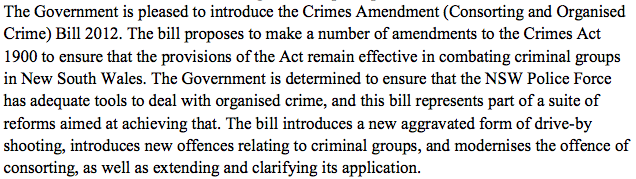
The relevant bill is the Crimes Amendment (Consorting and Organised Crime) Bill 2012. It can be found here.

It introduces some new offences and increases penalties for some others.  I'll cover the changes one at a time, in the order they were discussed in Smith's speech.

Firing at a Dwelling House
At present section 93GA of the Crimes Act) reads as follows:
The change is the insertion of (1B):
In other words, the maximum penalty is increased by 2 years where the shooting was part of "organised criminal activity".  Does change accomplish a great deal?

Probably not a lot, but there is no inherent difficulty with the change. It makes sense that such an offence should carry a heavier penalty where it was performed as part of orgnaised criminal activity.

The next definition is small change to law on criminal groups.  Presently section 93T reads, in part, as follows:

The change will replace subsection (1) with this:
Essentially the change softens the prosecution's burden, in that the police no longer need to prove that the offender knew or was "reckless as to whether the conduct contributes to the occurence of any criminal activity", they now need only prove that the offender knew or ought reasonably to have known.

This offence is notorious for being difficult to prove - how can the police prove what a person knew, or ought reasonably to have known?  It requires the prosecution to provide enough evidence about the all the circumstances of the offender's involvement in the "group".

It's not even easy to prove what a criminal group is - have a look at the definition:
Moreover, this is an offence that is most commonly "tacked on" when a person is charged with a far more serious offence, such as drug supply.  This means that the number of criminals who police are now able to prosecute that they couldn't otherwise prosecute will be small indeed.

The bill also adds a new offence of directing a criminal group, and directing a criminal group whose activities are ongoing:
Essentially, all the same issues arise.  Criminals not being in the habit of taking minutes when meeting mean that it will be pretty difficult to prove that a person was "directing" the activities of a group.

Any time police are able to charge a person with directing a criminal group, they will almost certainly be able to charge the person with all the offences committed by that criminal group.  How is this new law supposed to assist police in prosecuting anyone they wouldn't otherwise be able to prosecute?

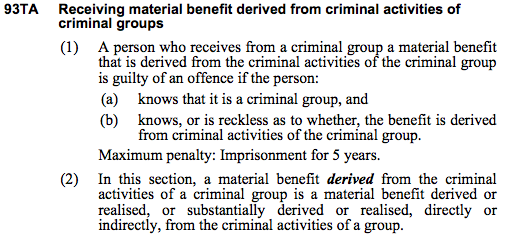
The next change is the introduction of section 93TA, which reads as follows:
As Smith puts it:
That's true.  What he doesn't mention is that we already have section 193B, which reads as follows:
It is difficult to imagine who could be guilty under the new section 93TA who is not also guilty of s193B, meaning that this change accomplishes precisely squat.

The final change, and by far the most troubling one, is this:
There is also a defence:
There is presently section 546A, which reads as follows:
It should also be noted that, as best I am able to tell, no one has ever been prosecuted in s546A.  Ever.

It is a deeply troubling section, for a number of reasons.  First of all, it is the very definition of "guilty by association". If you spend time with people who have convictions, you are committing an offence.

Moreover, police have to warn you first.  That's fair enough, given that you may not know that they are convicted persons.

What that means, however, is that police will be able to approach you and tell you that someone is a "convicted person", and to hell with their privacy.  There is otherwise no entitlement or reason for you to have that information.

A convicted person is someone who has been convicted of an indictable offence.  Without getting stuck into the detail, that casts an incredibly broad net.  I don't have the resourses to determine how many people in NSW fit that category, but it must be an enormous number.

There is also the fact that the law will be applied pursuant to a police discretion (ie only people they have warned first) means that it is open to police to pursue whoever they want in relation to this offence.  Groups or people can be targeted maliciously or without good reason.

That is a power that worries me.

It gets worse.  The defences to the offence are so broad that they can be easily manipulated by people committing the offence.

If you are given an official warning for consorting with someone, get them to hire you, or enrol you in some bogus "training".

It seems unlikely that police will be able to prosecute many people at all for the offence, despite the repugnance of the provision.

But we should come back to the original intention of the changes.  As Smith put it:
You can read that as "Do SOMETHING legislatively to get Labor off our backs."

The result?  Four minor changes at the margins that will interest criminal lawyers and no one else.  One change that is entirely redundant.  And one change that gives police truly incredible powers but then includes defences that will make the offence easy to circumvent, meaning that it is unlikely that anyone will be prosecuted for it.

How is it that these changes are meant to help police stop the shootings?  No one's really sure.  I'm not even sure whether anyone has asked what the hold-up is.  I doubt it is the lack of useful laws, and if it is then it is difficult to see how these changes will help.

The end result - Labor are now reduced to whining about the efficacy of the changes in a way that will not resonate with most people.
 Mission accomplished, I'd say.  Good governance be damned.

Friday, January 13, 2012

A Shot in the Dark

Shootings are scary things, and they are all the scarier when they appear to be at random.

Sydney journos have whipped themselves into a frenzy over the recent spate of shootings in Sydney, mostly confined to the city's West and South-West.

We have had front pages, large colour spreads and the usual proliferation of online articles.
From this ABC report
From this Daily Terror report
These stories are scary - there can be no denying that.

What's all the more unnerving are suggestions that innocent parties are being targeted.

Having said that, any suggestion that the residents of a home shot are entirely innocent should be taken with a grain of salt.

The residents are hardly likely to say to the police "Well, yeah, there is that guy I owe $100 000 for that bulk purchase of ecstasy I made, so yeah, maybe that was who it was."

Same goes for speculation that the shooters got the wrong house.  Some crims are stupid, no doubt, but few are as bumbling as we've seen in many movies, and crims aren't generally in the business of shooting up homes for fun.

That's not to say I'm certain that every victim is actually a drug dealer - there is no way I could know that. It's also not to say the public's fears are entirely unfounded. I'm just suggesting that if you're not involved in crime, the chance of having your house shot up is pretty miniscule.

The fact that the people being shot at are not so pure is reflected in the unwillingness of many victims to give statements to police.

From this 9News story
Which bring us to this fairly idiotic tweet from Labor:
What, exactly, does Labor suggest that O'Farrell has done to bring about this rise in shootings?  Has he relaxed gun laws?  Has he released bikies from prison?

Of course not.  If ever there was a case of an opposition trying to blame a government for something that is beyond their control, this is it.

Labor knows that they can't say "You should have X or Y before now" because whatever it is that they want to allege the Coalition should have done, Labor didn't do it either.  So better to just criticise and try to make a fuss.

Having said that, the government is in fact doing something, or at least thinking about it.
From this 9News story
Whilst I can't criticise the government for considering such a change, I certainly hope that they don't start moving down this path.

People who have been arrested have a right to silence. Except in very particular circumstances, that right is pretty universal.  You don't have to talk to police if you don't want to.

The fact that these victims don't want to talk to police is almost certainly because they have something to hide. They shouldn't be forced to give a statement to police about it.

If police want to investigate the victims on the assumption that "If bikies are shooting up their place, they must have something to hide" then they are free to do so.  But to force people to give a statement would seem to be a step too far.

In any event - if your husband is a drug dealer, your place is shot up and police then force you to give a statement, are you going to tell police all you know?  Of course not - you'll lie, which means the police will at best get nothing useful,. but at worst will get set off on wild goose chases.

The last thing I want to write about is this press release from Nathan Rees, Shadow Police Minister.
So, Rees knows that that the High Court struck down the bikie laws brought in by Labor, but thinks that O'Farrell should "replace" them?  How?  With what?  And how will that help?

He also wants O'Farrell to "outlaw bikie gangs."  How, exactly, does he propose that be done?  What kind of law would permit that?  If Rees offering a serious alternative, or is he just criticising with no reasonable alternative?

There's no doubt that it is an opposition's just to criticise, highlight flaws and (in a perfect world) try and push a government towards better solutions.

But Labor's approach here is to simply try and blame the Coalition for something outside their control, and then suggest that Something Must Be Done without offering any sensible basis for doing so.

I'll leave the final word to @PrestonTowers.