Showing posts with label trains. Show all posts

Wednesday, May 8, 2013

Training for Disaster

There is still not a lot going on in NSW politics - which is probably why this story got so much airtime:
Full story on the ABC website
Indeed, the NSW government was able to act with remarkable speed to change the law and make the cameras legal:
Also from ABC Online
Now, I have feelings about CCTV cameras, but rather than repeat them here I'm just going to link to a piece I wrote for The Drum on that very topic.

The only thing I would add is that simply changing the law to create an exemption to privacy laws makes somewhat of a mockery of the privacy legislation as a whole. Whilst almost no rights can be absolute (given that many rights of yours can come only at the expense of someone else's right), one would have thought that the government would at least pause to reflect on the decision from the Administrative Decisions Tribunal before diving in and just changing the law.

Anyway.

The other incident this week has been another disastrous morning for CityRail. For details, I encourage you to take a look at the always outstanding Transport Sydney that provides, amongst other things, a nifty table of the nature of the disruptions:
The Shadow Transport Minister was, as usual, busy that day reporting on her commute and the associated dramas:
Penny's twitter account is here
Along with John Robertson, there was a press release and even a press conference.

Whilst I've commented before about whether Labor has any right to criticise about the O'Farrell government's performance in the rolling out of new CityRail Infrastructure, these delays are a different issue. On the Transport Sydney blog:
The cuts may not be to blame - but it is clear that insufficient (or, at a minimum, poorly directed) maintenance is. On this issue, Labor's opposition has generally been good, and appropriate.

And yet we have this:
Polls that swung towards O'Farrell in the last few months. Obviously those polls don't take into account this week's train dramas, but there have been plenty dramas up to now, and they don't appear to have made even a bit of difference.

I don't really have an easy solution for Labor - at least not at this stage. But they would want to be finding one - and fast.

Tuesday, November 20, 2012

Training to Fly

I'm back from foreign parts!

As coincidence would have it, just 3 days after I caught a train home from the airport, I saw this story pop up on twitter:
Full story at SMH
My wife and I both paid the utterly exorbitant fare to get from the Airport to Central because, frankly, it's cheaper and easier than the alternative.

Parking at Sydney Airport costs so much you feel a compulsion to check that they got the decimal point in the right spot. A cab to our place (or, realistically, even to central station) was still far more expensive, and likely would involve far longer queues.

At the end of the day, the Airport Line is the obvious option, And, on the rare occasion I get to fly anywhere, it's the option I almost invariably use.

The high fares date back to the opening of the Airport Line. The Labor government's enthusiasm for building infrastructure without having to pay for it gave us toll-roads all over the city - but how were they going to get a rail-line built in the same way?

Simple - charge an eye-wateringly high fee to use only those new stations. It creates an absurd situation and further complicates an already convoluted fare system, but I suppose that's hardly a priority.

From a purely commercial point of view, it makes sense. Millions of commuters (including myself) still find the airport line to be "good value" in the sense that it is cheaper and easier than the alternative - so why not?

Well, the answer should be obvious - governments have, as part of their role, the provision of public infrastructure. Building lines like the Airport Line are why we pay taxes.

Sydney is lucky enough (or unlucky enough, if you live under a flight path) to have an airport within a short train trip of the city. That it took as long as it did to build a train line is more than a little ridiculous.

Many people complain what an awful greeting the enormous fees are to an international traveller - what the complainers don't realise is that the typical traveller would happily drop $30 to get to their hotel from the airport. That's a pretty small number compared to many cities in Australia and internationally.

My gripe, however, is that "People will pay it" is not a good argument to charge people for something that falls well with the ambit of governmental responsibility.

Last weekend, as I left London to catch a Virgin Atlantic flight home, I caught the tube to Heathrow Airport. It cost me a little over 3 quid.

Of course, I also got to use the outstanding Oyster Card system, but that's another discussion.

People will pay more to use the Airport Line. But that doesn't mean that they should have to pay it.

Australian governments need to move away from the idea that public transport should be priced such that "user pays". When I use public transport everyone benefits - the car I don't use doesn't clog up the already over-crowded roads.

Of course, the only way this problem will get fixed is if the government buys the airport line, and given the (real or imagined) budgetary constraints, that hardly seems likely.

So, on we go, no doubt to the relief of the owners of the airport and taxi plates across the city.

Wednesday, July 11, 2012

Training for Success

In my school career I only ever attended full-uniform schools.

Some of those schools were more enthusiastic about what constituted necessary adherence to the prescribed standard, but nonetheless there was always a uniform, and there were always consequences for breaching them.

The question of whether we should wear uniforms was always a favourite for lazy English teachers trying to pick debate topics. If you were on the side arguing in favour of uniforms you always blathered on about how being dressed appropriately makes a difference to your mindset and, consequently, the quality of your work.

These days, when I no longer wear a uniform but rather have to keep to no less oppressive standards of dress (being able to choose the colour of your suit, shirt and tie doesn't change the fact that you are forced to wear a suit, shirt and tie). I believe that it's not so much that the standard of work rises when one is dressed - what happens is that ones attitude to the workplace is different when it is a workplace that imposes some standards on how one is presented.

There are workplaces where it is important to instill some sort of respect for the workplace itself - if the employer couldn't care less about how I present myself to my colleagues and the customers, why should I care about the quality of my work?

I'm sure there is research on this, but it's late, I've been at work all day, I've just spent half an hour reading about organisational management in preparation for writing this blog (the sacrifices I make for you people!) and I still need to make and eat dinner before the Tour de France starts, so I'm going to let you do your own reading.

Suffice to say that workplaces enforcing dress codes can be an important step.

It's all got to do with the Bureaucratic Organisation. In short, there is a management theory that prescribes, amongst other things:

- Clear jurisdiction of roles
- Heirarchial management
- Strict rules and procedures for employees
Max Weber, bureaucratic enthusiast. From here
As I stretch my memory back to second year accounting, a bureaucratic structure is well used in organisations that benefit from tight control of the responsibilities and roles that employees have. It is great for large government bodies and the like, and awful for any organisation that needs to respond quickly to change. It stifles creativity and innovation, but it provides predictability and reliability.

Obviously a poor fit for most organisations.  But for CityRail, it seems about right.

My theory is that this is the context that this announcement from CityRail should be viewed in:
Full story here
As should be expected, twitter had it's fun with the topic:
But joking aside, this focus on neatness may well be part of a move towards a more bureaucratic structure at CityRail.

It's hard to imagine a structure more suited to bureaucracy. Everyone below management (so, the people who actually get stuff done) have pretty clearly defined roles and rigidly enforced rules for performing those roles. The last thing I want my train driver doing is using his bloody initiative, that's for sure.

And if you want to instill a culture of following the rules, abiding by procedure and doing things by the book, what better place to start with than appearance?

Sure, it seems petty, and in fairness it probably is. But what it does is start instilling a culture of doing things by the book. It doesn't make sense to have tightly controlled boundaries in one area, but then have a slovenly attitude (pun intended) to another.

No one really cares about how the train driver dresses. But I, for one, care very much about his attitude to the rules - and if making him wear his cap properly or not at all is the best way to make it happen, then I'm all for it.

Having said that, the people telling us about how great this organisational structure is are the same people who make you fill out those blasted personality tests so that you know that the reason you can't stand that person you work with is because you have fundamentally different ways of approaching conflict in the workplace when really you know that it is just because they are a twat.

So maybe it's all rubbish and you just wasted 5 minutes of your life. But maybe not.

Tuesday, August 23, 2011

Train of Thought

Arguably the Coalition's biggest election promise (and certainly the biggest infrastructure promise) was to build the North West Rail link.


It is an enormous project with an massive price tag for any State Government.  That said, it is one of those projects that just has to happen if Sydney is going to handle its population growth in a sustainable, sensible way.


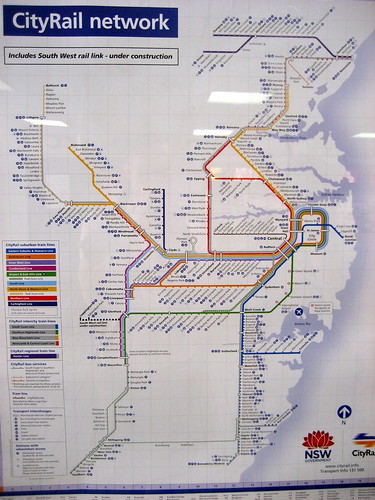
The problem is less obvious when you view the Sydney train map as we usually see it:


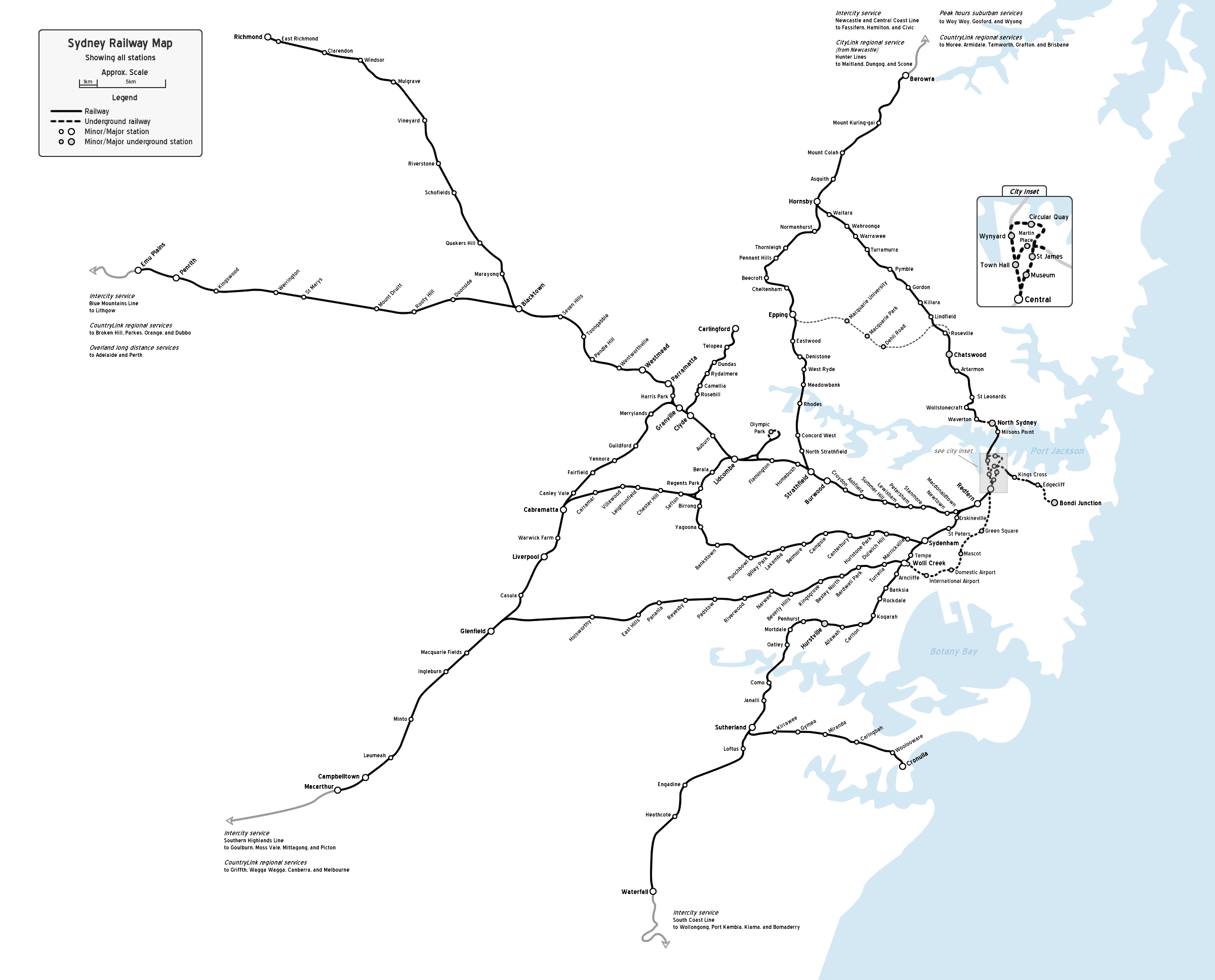
Of course, the train map looks nothing like that in real life:


Picture from Wikipedia
The most important map, though, is this one:


That map is taken from Labor's Metropolitan Transport Plan. The most important things to note are the North West and South West Growth Centres.


The government has asked all local councils to accept additional residents by rezoning.  Those that cannot be fit into present developed areas will have to go somewhere.


Of course, whether Sydney should be allowed to grow in this way is another discussion that should be had, but lies somewhere beyond the scope of this post.


It is pretty obvious that the South West Rail link will be needed to service the South West Growth Area.  The route can be seen on this map, marked in black on the bottom left, and it is expected to be completed in 2016:


The North West Rail link is not only needed to service the North West Growth Area, but also to give people in the North West an option for getting to the city other than the M7, M2, and Lane Cove Tunnel.


Driving to the city from these areas is very expensive, which would not be a problem if there was a reliable, frequent, late-running train service, which of course there is not.


The other obvious gap in the map is the train line to the northern beaches, but that appears to be off everyone's radar at the moment.


I had planned to write here about the long history of rail lines promised for the North West, but franly the history is too sordid and confusing.  Suffice to say that if you would like to be walked through the Labor Government's inablity to accomplish anything substantive in this area then the Wikipedia will explain it all.


Of course, Labor did deliver the Chatswood-Epping connection. That said, this was originally meant to be the Parramatta-Chatswood connection, and was completed at a cost way above the original budgeted cost for the Parramatta-Chatswood plan.


The problem is not of O'Farrell's making. In fact, the Labor government that preceded his is not entirely to blame either.  Bradfield laid the plans for Sydney's train system.  The plans were visionary - the problem is that over 100 years later Sydney has outgrown those plans.  


Sydney's train lines in the late 1800's
For years we have desperately needed a government that was able to make a plan, commit to it, provide funding and ensure that Sydney had room to grow.


Of course, as history shows, the Labor government's fixation on roads meant we now have a pretty good road system.  Admittedly it costs a bit to use it, but we got roads that the government could never afford to have build (or so they say). I, for one, have no trouble with a portion of user pays on our roads.


By contrast, train lines will inevitably need to be subsidised by the government as commuters will usually not pay enough to cover costs. 


But train lines offer a potential for growth that roads do not. One only need to look at cities like Los Angeles to see the consequences of failing to provide good, efficient and affordable public transport.


Buses, especially in the North West and the Northern beaches have partially filled the void.  But buses have a limited capacity - many people avoid them because they are irregular, unreliable, and often stop running an inconvenient times.


This story published today in the SMH that the planners are reconsidering the location of the stations.


This is appropriate - whilst I have no doubt that many people have been complaining about the time it is taking to "turn the first sod", it is essential that a little time be taken to get things right the first time.


A well planned, efficient train system is vital to a thriving city - and this process is part of planning things out in a sensible fashion.


As someone who works in the Sydney CBD and catches the train every day, I shudder to imagine what Sydney would look like if we did not have the train system that we do.


But train systems require constant re-investment if it is to cope with the inevitably uneven population growth.


For decades now Sydney has not had the benefit of decisive planning and investment in the train system. If O'Farrell really does achieve his stated objective of being the infrastructure premier, then Sydney will have the benefit of his political courage for decades to come.


If not, then he will join a long list of premiers who promised big and failed to deliver.

Monday, May 30, 2011

Faring Pretty Well

Public transport fares are a difficult issue for any government.


It goes without saying that it would be great if there were no fares and public transport was subsidised 100% - no doubt there are many people who take that view.


The problem is of course government's limited resources - when there are only so many dollars to go around, it makes sense that the people using public transport chip in.


How much should that contribution be?  As of right now, NSW train passengers (just to take an example) pay approximately 25% of the cost.  In other words, 75% of the cost of running CityRail is covered by government funding.


Taken from Prices and Services Report
For some people, fares are far too high, so they don't use public transport.  For others (like me) the fares are low enough that we would happily pay a fair bit more before we were tempted to jump into a car.


Early 2010, we were introduced to the MyMulti ticket. The most generous MyMulti ticket allows you to travel anywhere you could get to without a countrylink (the area bounded by Newcastle, Dungog, Scone, Lithgow, Richmond, Goulburn, Bomaderry and Bondi Junction) as well as unlimited bus and ferry.


As of June 2010, a MyMulti3 cost $2280 for a yearly pass.


The strange thing is this - a yearly ticket from Gosford to Wynyard is still available to be purchased for $2464.


Before the election, O'Farrell promised to reduce fare prices for CityRail services.  The table provided (and still available on the Liberal website) promised savings of $100 on all yearly tickets, regardless of the original price.


There would be the same reduction for persons buying MyMulti tickets.


Today Gladys Berejiklian announced tickets would be falling by 9% (see this table)


The cut applies to all monthly, quarterly and yearly tickets, but not to individual tickets or, crucially, weekly or fortnightly tickets.


These cuts are well in excess of the cuts promised during the election.


I don't have any stats on this, but anecdotally it seems to me that, as a percentage of total trips, not many trips are made on individual tickets.


But, judging from the queues every monday morning, a lot of people travel on weekly and fortnightly tickets.


Last year Labor introduced fortnightly tickets in an attempt to reduce the number of people queuing on monday mornings, which made a lot of sense. That said, the tickets somewhat inexplicably did not give any discount compared to buying a weekly (in the way that discounts are given for monthly, quarterly and yearly tickets).


What the changes announced today effectively do is increase the discount for a monthly, quarterly or yearly purchase.


So, what discount is allowed at the moment?  I'm going to assume that most people buying these tickets are commuters, and are therefore travelling between the same two stations five days a week.


Using the example of Gosford to Wynyard, we can see the following:


Return: $15.60
Weekly (7 days, so 5 workdays): $56, or a 28.2% discount
Monthly (28 days, so 20 workdays): $224, or a 28.2% discount
Quarterly (90 days, so approx 65 work days): $616, or a 39.3% discount
Yearly (365 days, so approx 260 work days): $2 464, or a 39.3% discount


As you can see in the table released today, the additional discounts apply to the monthly, quarterly and yearly tickets only.


The new price structure works out as follows:


Return: $15.60
Weekly (7 days, so 5 workdays): $56, or a 28.2% discount
Monthly (28 days, so 20 workdays): $204, or a 34.6% discount
Quarterly (90 days, so approx 65 work days): $560, or a 44.8% discount
Yearly (365 days, so approx 260 work days): $2 240, or a 44.8% discount


The My Multi tickets will fall in price as well, but only by the amounts promised during the campaign - $9 for a monthly, $25 for a quarterly and $100 for a yearly.


A yearly MyMutli3 will therefore cost $2 180 (still cheaper than a Gosford to Wynyard yearly).


I guess my thoughts are this: first of all, kudos on the Liberals for overdelivering.  It's not often we see that a party over-deliver after a win, and it is not often that we see fares reduced outside of an election year, so they deserve credit for that.


That said, one would have thought that the massive budget black-hole would prevent any such generosity, but perhaps I'm too cynical.


Secondly, why are people still able to buy yearly tickets between two stations in situations where it would be cheaper to buy MyMulti3 tickets? I don't know whether CityRail have a policy of suggesting the MyMulti tickets were it is in fact cheaper, but I would have though that to do so would only be fair.


What I'm really interested in though is whether these changes well directed.  We certainly should be encouraging more people to buy monthly, quartly and yearly tickets, because the cost to CityRail is less (staffing at windows, servicing of machines etc) - but if a 39% discount wasn't enough to convince you to commit, is 45% going to be?


Is this discount just throwing money away for a good headline - or will it actually have an appreciable effect on consumer behaviour? Or is it just meant to be a recognition of sorts that monthly, quarterly and yearly ticket prices are generally too high?


A lot of people still buy weekly tickets for all sorts of reasons - perhaps they might be planning on changing jobs, or locations, or perhaps they are not sure when they might take a week or two of leave.


Perhaps others don't have sufficient funds available to "pre-pay" for the travel to such a degree, even though in the long run it works out cheaper.


I'm certainly not complaining - I'm a yearly ticket buyer, so that is $100 extra in my pocket next year.  I just hope that this move is being done for more than a positive headline.