Showing posts with label CityRail. Show all posts

Wednesday, May 8, 2013

Training for Disaster

There is still not a lot going on in NSW politics - which is probably why this story got so much airtime:
Full story on the ABC website
Indeed, the NSW government was able to act with remarkable speed to change the law and make the cameras legal:
Also from ABC Online
Now, I have feelings about CCTV cameras, but rather than repeat them here I'm just going to link to a piece I wrote for The Drum on that very topic.

The only thing I would add is that simply changing the law to create an exemption to privacy laws makes somewhat of a mockery of the privacy legislation as a whole. Whilst almost no rights can be absolute (given that many rights of yours can come only at the expense of someone else's right), one would have thought that the government would at least pause to reflect on the decision from the Administrative Decisions Tribunal before diving in and just changing the law.

Anyway.

The other incident this week has been another disastrous morning for CityRail. For details, I encourage you to take a look at the always outstanding Transport Sydney that provides, amongst other things, a nifty table of the nature of the disruptions:
The Shadow Transport Minister was, as usual, busy that day reporting on her commute and the associated dramas:
Penny's twitter account is here
Along with John Robertson, there was a press release and even a press conference.

Whilst I've commented before about whether Labor has any right to criticise about the O'Farrell government's performance in the rolling out of new CityRail Infrastructure, these delays are a different issue. On the Transport Sydney blog:
The cuts may not be to blame - but it is clear that insufficient (or, at a minimum, poorly directed) maintenance is. On this issue, Labor's opposition has generally been good, and appropriate.

And yet we have this:
Polls that swung towards O'Farrell in the last few months. Obviously those polls don't take into account this week's train dramas, but there have been plenty dramas up to now, and they don't appear to have made even a bit of difference.

I don't really have an easy solution for Labor - at least not at this stage. But they would want to be finding one - and fast.

Monday, March 4, 2013

Is that Fare?


It's never nice when you have a piece planned, and someone else beats you to the punch.

That happened to me this morning when I saw this piece by Bambul Shakibaei on his public transport blog.
It is a good post that lists on CityRail's recent failures, and suggests that a fare-free day would be a good way to provide a "token gesture of apology."

This echoes the suggestion of Penny Sharpe, Shadow Transport Minister, who posted this on her website:
However, despite the fact that Bambul's blog is excellent and worth following, I don't agree with his suggestion.

I certainly don't disagree that CityRail's performance over the last few weeks has been pretty average. Some of the problems were simply impossible to anticipate and an inevitable consequence of running a network the size and complexity of Sydney's. But there is no doubt that CityRail can and needs to do better.

But a fare-free day fails to benefit the very people who are most heavily affected by these dramas.

Ms Sharpe's suggestion was that "...the Minister to open the gates at stations on Monday and to extend weekly tickets, as a show of good faith to long suffering commuters."

Some people (like myself) rely on public transport every week-day, and occasionally on weekends. In fact, I use the trains not just to get to and from work but also to travel all over the city for my job. This means I often take as many as 20 separate train journeys per week.

Most regular commuters take 10 journey's each week, or maybe 20 if they have to change services on their way to and from work. A large proportion of those people do so with a periodical ticket. I have a yearly - others have quarterlies or weeklies.

Many other people use trains on what you might call an ad-hoc basis. Maybe they work part-time. Maybe they get a ride to work twice a week. There are any number of reasons that a periodical ticket may not be best for them.

Still others have free passes, most of whom are students.

I've had a look at some of the data provided by CityRail re ticket sales here. It is little difficult to say anything with any certainty, not least of all because ticket sales vary wildly depending on the day of week and, I fancy, time of year.

What is clear from the data is that a very large number of people depend on periodical tickets. Those on those yearly, quarterly, monthly or fortnightly would not benefit from a fare-free Day.

According to Ms Sharpe's suggestion, weekly tickets should be "extended", which sounds great until you consider that most people buy weekly tickets on Monday. Making them all expire on Tuesday is great until they take a week off and revert to the Monday rotation.

Whilst those who rely on singles or returns would benefit most clearly, they are obviously more irregular travellers. That is to say, they are the least likely to have been adversely affected by the recent dramas, and yet they are the biggest beneficiaries.

So, what do I suggest? I certainly don't think that simply not charging fares for one day accomplishes anything. CityRail could agree to a Fare Freeze until benchmarks for performance are met. We could all be handed something for free at the station one Monday (newspaper, magazine, JB voucher, cupcake etc etc).

CityRail could fund a free download of TripView, a fantastic app that provides public transport timetables as well as live-tracking of busses.

It could spend the money installing free, reliable, capable WiFi at all CBD and major interchange stations.

There are probably a thousand other ideas. But any one of them would be a more sensible use of the government's limited funds than just throwing the gates open for a day. It requires a little more effort, but I would suggest we deserve nothing less.

Thursday, April 21, 2011

Delivery on track?

The delivery of the Waratah trains is long, long overdue.


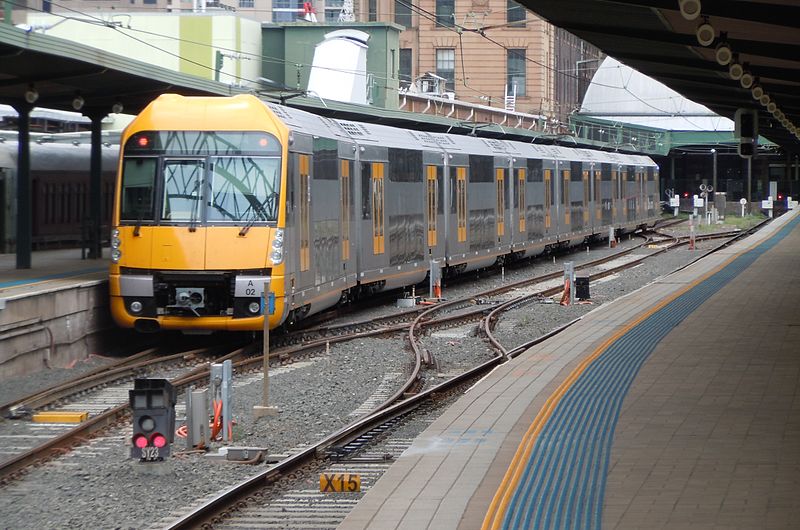
A Waratah Train.  Photo from Wikipedia
John Watkins, then transport minister, said in 2006 that they would be on the tracks by 2008.


This delivery was important and urgent not only because these carriages are an essential upgrade of the rolling stock.  They will result in more carriages on the tracks, but also will allow the retirement of older models.


According to Wikipedia, the train design is based on the Millenium trains. Given the extraordinary difficulties encountered with the Millenium trains shortly after their launch, perhaps we should have expected some drama.


Millenium Train.  Photo from Wikipedia
The CityRail website says that there will be 626 waratah carriages delivered, which is "equivalent to 50% of the current suburban fleet".  What this allows CityRail to do is retire the entire L, R and S sets, which entered service between 1972 and 1980, and are not air conditioned.


One of the old carriages.  Photo from Wikipedia
These non-air conditioned carriages are hated by everyone for at least 6 months of the year, and getting rid of them will no doubt drastically increase passenger comfort.  


Additionally, there are only 498 carriages in the L, R and S sets, meaning that the number of active carriages will be increased by 128.


Whether this will lead to an increase of the number of services does not appear to be clear, as of course there will be staffing and other cost implications.


The concern is that the process has been so fraught with delay and drama it has become a "I'll believe it when I see it" kind of project (like so, so many under the Labor Government).


The Herald reported today that the trains may be entering service within two months, but that Downer EDI (the manufacturer) has released the trains to RailCorp before all the work on them is completed.


If RailCorp is not satisfied with the trains or if significant operational issues become apparent, then all hell could break loose.


Downer has apparently already anticipated a $440 million loss on the whole project.


The project was another of those public private partnerships that have been such a disaster over the last decade (the Cross City Tunnel and Airport Link spring to mind).  Perhaps counter-intuitively, the private stakeholder having awful financial results is not a good thing.


If companies can't make a financial success of these partnerships, then they will quickly lose interest in being involved, meaning the government is going to have to not only manage the project (something governments at all levels don't have a great record with) but also absorb all the financial risk.


The question is, of course, WHY have these projects been a disaster?  Is it the government simply picking the lowest bid - a bid that they know the company cannot possibly hope to meet and make a profit?  


An Inquiry into Public Private Partnerships was conducted by the Public Accounts Committee in 2005 and 2006.  The report noted that "the Government’s aim is not to maximise risk transferred to the private sector" but rather to "optimise the allocation of risks to the public and private sectors according to which party is best able to manage these risks."


That's all good and well, but it seems clear that this goal has not been achieved to date.


The position that the Coalition government finds itself in is that the trains are now arriving on their watch.  The trains will be an improvement, and should be recognized as such, although we can all expect to hear a great deal about how long ago they were promised.


That said, the government is going to have to have a close look at how we manage major contracts like this, whether for infrastructure, vehicles or the like,


There are probably very few people who think that private companies should not be involved at all.  Government should stick to government where possible, and (where appropriate) use private companies to produce and build.


But these arrangements need to be mutually beneficial.  If NSW is seen as a place where the lowest bidder wins and then inevitably makes a crushing loss on the project, we will lose the top bidders, to everyone's detriment.


It remains to be seen whether the Coalition government is any better at dealing with business to get things built.  If so, it could be the starkest distinction between this government and the one before it.