Wednesday, July 6, 2011

Plan, Campaign, Action!

Campaign finance has been an issue in NSW for a long time.


When lobby groups and companies are allowed to make large donations to political parties it is very difficult to accept politician's word when they say that the donations do not influence them in any way.


At the very least, these donations buy access.  More importantly, however, the look suspicious, which is almost as bad because it breeds a cynicism in politicians and their decisions, with a corresponding decrease in support and engagement.


In South Africa (where I spent the first 14 years of my life, and where it is easier to simply assume that politicians are corrupt, because the prospect that these decisions are honest decisions is too horrifying to contemplate) there is a particular phrase that I like: riding the gravy train.


A person will get into a position of power (elected or otherwise) and ride the gravy train to prosperity, to the detriment of society as a whole.
Cartoon by the brilliant Zapiro
It is easy to simply demand that political donations be banned, but the fact remains that political parties are essential to our democracy, and they need to be funded somehow. Membership fees could not possibly suffice unless they were enormous, and in a time of falling engagement in the political process this would be unsustainable.


Banning political donations (or, at least, the big ones) would also require some form of public funding for campaigns, and this will have a corresponding effect on the budget's bottom line.


Having said all that, the biggest reason that the rules have not been changed to date is the same reason we never see changes in the rules that govern the operation of parliament and the appointment of the speaker - these changes would benefit the opposition more than the incumbent. They are easy to complain about in opposition but there is little motivation to take action once in power.


The exception to this rule is when the government is almost assured of a defeat - much of the planning can then take place with a view to an expected time in opposition. NSW was of course in this position for much of 2010.


This lead to NSW Labor introducing changes in October 2010 that: 

  • limited donations to political parties at $5000
  • limited donations to individuals at $2000
  • limited a candidate's campaign expenditure to $100 000, whilst a party could chip in a further $50 000, and
  • limited upper house party expenditure at $1.05 million

What infuriated the Coalition at the time was the fact that third parties were able to spend up to $1.05 million.  Given that there are 22 unions affiliated with the Labor party, this in theory would allow those 22 unions to spend a total of $23 million on a campaign.


What O'Farrell's complaint conveniently ignored was the fact that there are a number of 3rd parties closely affiliated with the Liberal Party who would be able to take advantage of the same "loophole".


In any event, this was no doubt at least in part why, as part of his 100 Day Action Plan, O'Farrell committed to "Enact Campaign Finance legislation that includes restricting political donations to individuals".
From the cover of what no doubt was a glossy brochure
On the Liberal's website, he commits to, amongst other things:
You will note that this makes no explicit reference to third party spending, which is more than a little concerning, and perhaps suggests that he was not ignorant of the fact that the Liberal Party is probably as well placed to take advantage of the "loophole".


The above quote comes from a post on their website dated 6 October 2010.  An earlier post (on 9 September 2010) is phrased differently, committing the Coalition to:
You will note that the promise to cap election spending by "other groups including unions and employer groups" was dropped from the list in the October posting.


Now, that may be a simple question of brevity, because we do not know precisely what changes O'Farrell plans to make.


Ignoance of what changes are planned is of course the precise issue raised by this Herald article.


The 100 Day Action Plan promised to "enact" the changes within 100 days, a time limit which expires next week.  As parliament is presently not in sessions and will not be sitting til well after next week, it appears that this promise will not be kept, or at least not as soon as expected.

As I said earlier - it is easy to be righteous and demanding when in opposition, but once it power it can be just as easy to put off change.


This is more than a little odd, especially given the profile O'Farrell gave the mooted changes before the election. The Herald in fact claims that this is the "only one of his action plans he has failed to deliver."


In the absence of an explanation O'Farrell is practically begging the opposition and the media to speculate as to why, and the Herald obliges, saying:
Presumably only upon being contacted by the journalist, O'Farrell claimed that the reason for the delay was "due to the government agreeing to a review of NSW electoral laws, including the Election Funding Act." Apparently he wants to "ensure that any legislative changes do not conflict with the end goal of that review."


The explanation is not a convincing one. It seems far more likely that John Kaye (GRN) is right when he says that the Coalition is (ignoring the hyperbole): "so addicted to corporate cash that the government was prepared to breach this unequivocal promise to let the rivers of gold flow for two more lucrative months".


It's all silly politics, because surely O'Farrell must have seen this attack coming. All he needed to do was take some positive steps (perhaps by releasing some draft legislation for comment) and he could point to a process in place.


There was another story published by the Telegraph earlier this week that said that MPs have been complaining about O'Farrell being too focussed on the plan, to the exclusion of all else.
Robertson took the opportunity to explain what a nothing list the 100 Day Action Plan was, saying "When you set the bar as low as Barry O'Farrell did in his 100-day plan, you can hardly expect a prize when you manage to jump over it... The majority of the O'Farrell government's 100-day plan involves handing a piece of a paper to a bureaucrat."


Another anonymous Coalition MP fed a quote to the journalist about how "We have not been able to concentrate on anything else," such has been the focus on the 100 Day Plan


It may well be that Labor has engaged in some savvy politics by feeding the Telegraph the quotes earlier in the week about how piddling many of the action points were so that when the story about the lack of campaign finance change was run it would be all the more powerful.


There may well be nothing sinister in the fact that the changes have not been made yet, and it may be that case that it was just one big goal too many for the first 100 days. 


If O'Farrell is to be believed, then it was pretty poor planning that, of all the changes, he promised, this was the one that fell by the wayside.


Especially in this state, it is just too sensitive an issue to give the media a sniff.


And that's what he did.

Tuesday, July 5, 2011

Burqa Burqa


The Burqa story was made for tabloid.

It has all the ingredients.  A sense of injustice because someone has apparently dodged the law because of a sneaky lawyer.

Racial elements, with a heady dose of Islamaphobia. There were scuffles outside court and a chance to use the words "radical cleric" in a headline.

Finally, who could resist the chance to have a shot at the court system?


In short, it was a tabloid editor's wet dream.

For those of you not in the know, a Muslim by the name of Carnita Williams was pulled over by a highway patrolman for not displaying her P-plates.  

For some reason that is not clear, she then leaves the car, and is clearly captured on the car's video camera ranting and raving at the officer.  The officer, to his credit, keeps his composure and does his job well.


The view from the in-car camera.  Photo from The Daily Telegraph
Later on that day, police alleged, Carnita Williams made an official complaint by lodging a statutory declaration at Campbelltown police station that the officer had threatened to rip her veil off.


The video was retrieved and viewed, and not long after Police launched a prosecution against Ms Williams for making a false complaint.


I'm not sure precisely what she was charged with, but by way of example, section 314 of the Crimes Act says that "A person who makes an accusation intending a person to be the subject of an investigation of an offence, knowing that other person to be innocent of the offence, is liable to imprisonment for 7 years."


At the Local Court she was convicted and sentenced to six months imprisonment. On 22 June that decision was set aside on appeal to the District Court, and she was acquitted.


The problem lay in that police could not prove beyond a reasonable doubt that it was Ms Matthews who made the complaint.  Police apparently did not ask her to confirm her identity when the filed the complaint.


It appears that Police may not have in fact had the power to force her to remove her veil when making the complaint, although whether they should have accepted her complaint without her doing so is worthy of reflection.


Ms Williams outside court.  Photo from The Daily Telegraph
Suffice to say, the media went into a bit of a frenzy over the case.


As you can see from the watermark on the above video, the major networks all played the video.  The Daily Telegraph led with little else for over a week, milking the story further by covering the paper's attempts to have a copy of the statutory declaration in question released to the media.


When the Police Commissioner sought the power to order women to remove burqas, the Tele had this graphic for us:


From The Daily Telegraph
Barry O'Farrell quickly acted on the pressure from the Tele, and was quoted yesterday as saying "I don't care whether a person is wearing a motorcycle helmet, a burqa, niqab, face veil or anything else - the police should be allowed to require those people to make their identification clear."


The changes mooted would allow police to force a person to identity themselves when spoken to by police in relation to minor matters, not just serious ones (as section 11 of the Law Enforcement (Powers and Responsibilities) Act empowers).


The interesting thing for me was that just most Islam-related lobbies and interest groups have supported the changes. The Islamic Council of NSW and Mulsim Australians were good examples.


Watching SBS news as I write this, a reporter claimed that every Muslim she spoke to on the street (both those wearing burqas and those not) supported the changes.


Predictably, civil libertarians were unhappy, but then they never are.


The issue of burqas is a sensitive issue.  Accusations of racism and xenophobia are often just below the surface.  


On the other side, the campaign by the Telegraph was a powerful one, and you don't need a Newspoll to tell you that changes would be popular.


That said, the poll on the Telegraph website (96.5% in favour of changes) was probably less than scientific.


Normally I would bemoan any change brought on by a newspaper campaign.  Often they are ill-founded and based more upon stoking fear in the community.


This time round, however, there seems to be a genuine need for the changes. Police need to be able to positively identify people who they suspect have committed an offence.


The real test is going to be the precise composition of the laws.  On what basis will police able to demand that a woman remove her burqa? What safe-guards will there be to ensure that the new powers are not abused?


No doubt there will be a lot of people (including me) taking a very careful look at the wording of the section when they are released to ensure that the government is not using this as a chance to dramatically increase police powers.

Sunday, July 3, 2011

In the Firing Line

This morning I shared the following exchange with Greens MLC David Shoebridge:


The tweet linked to his blogpost on the topic.  

The blogpost seems to be more about shining a light on the Coalition's relationship with the Shooters and Fishers Party.

This is looking more and more like a concerted strategy by the Greens and Labor - in truth, it is something they should have been doing a long time before the election.  The fact that the Coalition sits on the same side of the political spectrum to the Shooters and Fishers as well as the Christian Democrats would have been a great way to fill the policy vacuum that O'Farrell cultivated in the lead-up to the vote.

The ad in question is this:

The associated blurb clearly does use language that leaves a bit to be desired:

But writing bad copy is not a crime.

Shoebridge's blogpost calls for two changes:
  • "laws to prohibit these advertisements" and
  • "stop easy access to guns"
The claim that these advertisements should be stopped is more than a little confusing.  It doesn't refer to some gun tragedy, nor does it make false claims - all it does is suggest that firing a gun is fun and then (perhaps) glamourises the sport a bit.

Whether you agree or disagree with the sport, it is a legal activity. No doubt the participants enjoy the sport and have fun doing it - if not, no doubt the sport would not exist.

Now, I am as anti-gun as the next guy.  I don't own a gun and (as far as I know) I don't know anybody who does.  I would be horrified if there was a sudden proliferation of guns in the home or (even worse) concealed guns being carried around, as is so common in the US.

If the Shooters and Fishers were to start pushing for expanded rights to carry a concealed weapon you'd be hearing all about it on this blog.

But this brings me to Shoebridge's second claim - this is an ad for gun use at a range.  Shooting at paper targets, using a gun that you cannot remove from the centre.

The post from Shoebridge appears to have been motivated by a Daily Telegraph article he came across while munching on his cornflakes this morning.  I usually try not to read any comments on news articles for fear of getting a headache from all the stupid, but a few of the comments to this story make some sense:

The last comment is (I can't believe I'm saying this about a comment on a news website) a particularly astute one.

A lot of people want to race their cars.  We don't want them doing it on the street at night, so we make that illegal but then allow Eastern Creek Raceway to run "Car Track Days" where people can go and drive fast.

A lot of people want to box as a sport.  We don't want them meeting in a basement to flog each other, so we have the sport of boxing, with all the associated regulation and medical supervision.

People are going to want to give shooting a gun a try, whether it is legal or not.  Far better they do that at a licensed gun range, with instructors and safety gear rather than on a mate's farm where anything could happen. 

To suggest that to allow them to do so is somehow fostering a destructive gun culture is, in my view, an overreaction.

Friday, July 1, 2011

Tweet Tweet Baz

So is 147 tweets a week too much?


Today the Daily Telegraph published this article criticising Barry O'Farrell for the amount that he tweets.


Clearly the journalist involved has a little too much time on his or her hands this week, what with Parliament not sitting.  I suppose we all have to make work for ourself from time to time, but surely there was investigating that could be done?


I mean more than calling round for a quote and counting tweets, obviously.


There are, however, two things I want to say about this article.  


The first is this: engagement with the community is a good thing, and I can't believe anyone would suggest otherwise.


I think most of us want leaders who talk to the people - who are prepared to discuss, argue, debate, and have regard to the community's views.  I want a leader who will listen and respond to what people are saying.


Before I had twitter and my blog to vent my spleen, from time to time I used to write to politicians to urge or dissuade them from some course. These letters weren't written with a crayon on the back of an envelope - I sent detailed submissions running to several pages on whatever it was that had gotten my goat up that day


Most of those letters never received so much as a form letter thanking me for my contribution. The only exception were the letters I wrote to Barry O'Farrell, he being my local member.


Each letter I sent to him got a reply thanking me for my contribution, making a comment and then committing to pass the letter onto the relevant shadow minister (as they would have been then).


Inevitably the letter was ignored by said shadow minster (or at never replied to). But the point was that he (or, at least, one of his staffers) took the time to at least acknowledge the letter.  And that was a good thing.


On Twitter, O'Farrell engages with the electorate.  He responds, he debates, he has things to say.  I'm more than a little shocked that anyone could possibly think that is a waste of his time.


Let's have a look at what O'Farrell has tweeted about this week:


Comments about the musical Hairspray
A response to an enquiry about the lack of Oystercard style ticketing
A @StephenFry retweet
The Liberal Party's Federal Council
Meeting the Newcastle MPs and then watching the Newcastle Knights
A campaign he helped launch for more courteous driving
His City2Surf fundraising efforts 
A debate with @greenat15 about the meaning on ANZAC day
A reply to @latikambourke about a new Federal Labor policy she reported on
Criticising @johnkgreens for "always [being] so negative"
Attending a rotary dinner
Tweeting that this morning "#imonlytalkingtoGladys" to promote cheaper CityRail tickets
A tweet about this morning's Tele article, with a link to it
And a whole lot of tweets about Origin and Rugby League in general


If you are critical about that interaction then you and I have very different ideas about what makes a good Premier.


The very best part about O'Farrell's time on Twitter is that he is doing Twitter right.


A lot of politicians don't really seem to understand what they are meant to do with this tweeting thing.  Some simply tweet when they have given a speech, written and article or been quoted somewhere.  Others disappear for weeks or months on end, then reappear and say "TOOK DOG FOR WALK MUST VOTE LATER" Still others simply tweet the party line on that particular day.


One politician in particular used to drive me crazy with the way she would announce some position or policy and then promptly retweet 10 replies telling her what a brilliant policy this was.


All of the above fit into the "better than nothing" category (but sometimes only just).


What O'Farrell does that is so good is that he not only tweets what he happens to be doing that day ("Giving a speech here" or "Big vote on this today") but he also makes comments, shares a reflection and tweets about his life.  The same way most every-day people use twitter - every tweet does not have to be on message.


Even better though, he reads his @ replies (or, at least, some of them).  He might then respond to your reply and, heaven forbid, even have a conversation. 


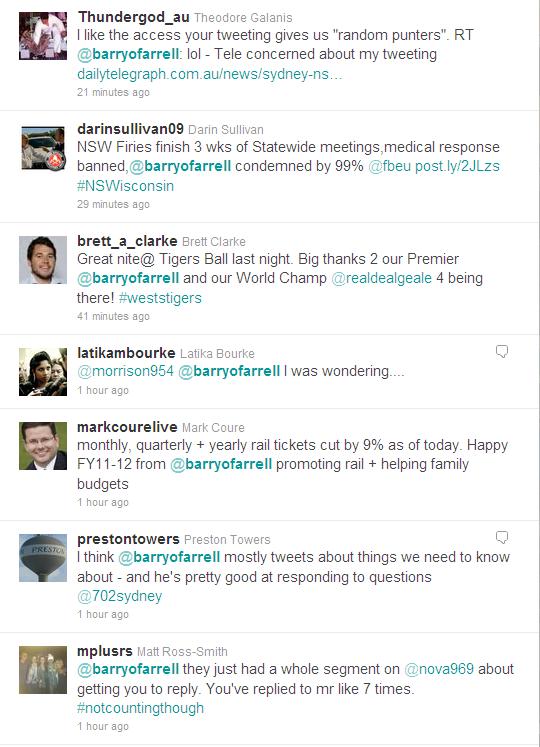
Some of @barryofarrell's replies from this morning
We hear so much these days about how companies pay over huge wads of cash for access to the Premier/Prime Minister - well, here is a Premier who is willing to engage with someone on twitter simply because they took the time to respond.


Any politician who wants to criticise O'Farrell for that is, I think, showing an unfortunate arrogance. I'm sure it does take up some of his time.  To me, there are few better ways for him to spend it.


This brings me to the other thing I wanted to say about this article. Who is the idiot Liberal giving the Tele a quote for this story?


The way I see it, there are a few possible reasons the Liberal gave the quote.  Maybe they think Twitter is a bad idea and want to pressure O'Farrell to stop. On the other hand, maybe they want to tear him down because it suits their ambitions, although I suspect they are dreaming if they think a Labor-style leadership spill is possible anytime before the next election.


More likely, however, this quote was given to curry favour with a journalist, on the theory that it can never be a bad idea to have a journo who owes you a favour.


It is stupid, and disloyal to boot.  But I suppose this is the world we live in today - this is what politicians do.


I for one hope O'Farrell never disappears off Twitter, and ignores stupid stories like this. His community engagement is wonderfully refreshing and should be applauded, not criticised.

Tuesday, June 28, 2011

Bearish Behaviour

It is sometimes difficult to know what NSW politicians are trying to achieve when in the Bearpit.


The Bearpit.  Photo from here
Federal Politicians have a well deserved reputation for behaving like idiots in the House of Representatives.  Question time when viewed on TV or (as I have been lucky enough to do) in person is a lesson in petulence and immaturity.


Constant heckling, name calling and worse is, in my opinion, unbecoming of the office.


I suppose there are a few reasons why such behaviour is appealing to the perpetrators.  


Many of them no doubt enjoy letting off a little steam at the other side.  Others no doubt find their comments witty and clever, despite the fact that, for the most part, they clearly are not.


I suppose others feel that they are achieving some political purpose, although what that could possibly be is difficult to imagine


At least with the Federal Parliament, proceedings are broadcast live, and we frequently see excerpts on the evening news. There is therefore at least some audience for the shenanigans.


State Question time is not, to my knowledge, broadcast in any way.  The only people hearing the words would therefore be those in the gallery, which would no doubt number in the dozens, at best.


Not withstanding that, it appears from the Hansard that the interjections, heckling and constant noise is continuous and oppressive. Given that surely I must be one of a very, very small group not directly involved in politics who takes the time to peruse the Hansard, I doubt any votes are won or lost on that basis.


Respect lost, however, is another matter entirely.


There is another question there on the point of parliamentary speech-making and question-asking, given that just about no one outside of the system (except for wonks like myself) is aware of what is going on.


Except when the action excites the media (for example, when a six hour speech is given) the public get very little insight into the proceedings.


Which forces us to ask: "If a politician gives a speech to an empty room and no one listens, what was the bloody point?"


This is all a roundabout way of getting us to Shelley Hancock and this article by Andrew Clennell, a News journalist.


The Speaker.  Photo from here
What Clennell says, in short, is that Hancock is seeming to be just as partisan as John Aquilina was when he sat in the Speaker's Chair, thereby risking an unflattering legacy.


Clennell's main criticism appears to be that Hancock is not even-handed in her decisions and on several occasions spent "the entire session putting Opposition members on calls to order (after three and subsequent misbehaviour a member is ejected) while not censuring misbehaving government MPs."


That may well be true, although the criticism is perhaps a little harsh.


Most (but by no means all) of the shouting and other nonsense in the Bearpit occurs during Question Time, as one might expect.  


Further, as questions must be directed at Ministers, most of Question Time is taken up by Ministers having their say, and opposition members misbehaving.


That's not to say that the Government members are not just as awfully behaved.  It is just perhaps that the opposition has the larger opportunity to do so.


The result, however, is a speaker who will almost inevitably appear biased.


This could all be avoided if the Speaker was in fact independant and, while we're on the topic, empowed and encouraged to restore some order to the Bearpit.


I imagine a constitutional amendement would be required, and it would no doubt go against tradition, but if a Speaker was (say) a retired judge, it would seem that the State would be well served.


If the Speaker was then given rules that would permit the immediate suspension of a member for an apporpriate period, we might finally see some adult behaviour.


But while a Speaker is simply a member of the Government, it seems that we will continue to be subjected to members far more intrested in letting off steam than engaging in sensible debate.


Which, I think we can all agree, is to the detriment of governance in this state.

Wednesday, June 22, 2011

Total Recall

*There are no pictures in this post - just a whole lot of text.  Blogger has decided that today I am not allowed to post pictures, most likely to punish me for some perceived slight.  I apologise if it makes the post hard going*


Recall elections are back on the agenda in NSW.


The issue was first highlighted by the then Coalition Opposition in 2009, in what was no doubt an attempt to capitalise on the anger the NSW public felt about the Labor government.


Shortly after Kristina Keneally ascended to the Premier's seat, having disposed of Nathan Rees, Barry O'Farrell wrote the following on the NSW Liberal website:


Earlier this year I announced that a NSW Liberals & Nationals Government would examine the option of 'recall' elections for NSW… It increases accountability, offer a safeguard against political abuse by government and can help restore confidence back into the political system… The idea of being forced to an election by the community would provide Government - even this NSW Labor Government - with the incentive to perform throughout the entire four-year term and not just in the months leading up to an election.


He also promised, if elected, to put together a panel of "experts" to advise on how a recall election might work in NSW.


That panel was announced on Monday (20 June 2011).  Barry O'Farrell answered a dixer on Monday, selling the changers as being a "safety valve to rid voters of corrupt, incompetent governments".


Broadly speaking, a recall election is an election to decide whether a government or an elected official should be recalled.  Most jurisdictions that have recall elections require that a petition be presented with a particular number of signatures.


If this is accomplished, a special election is then held where a majority can "recall'" the government or official.  In some cases, a new election is run in conjunction with the recall election, where voters first vote whether to recall, and then also vote who the successor should be.


The call for recall elections gained further traction in late 2009 after the Herald launched a campaign to have a referendum alongside the 2011 election to introduce recall elections in conjunction with the 2011 election.


Naturally O'Farrell backed the petition, and whilst Kristina Keneally "supported a debate", the campaign never really got anywhere.


The issue has been brought back to the forefront with the Coalition announcement this week that a panel has been appointed to discuss the possibility of a change.  


According to this posting on the Liberal website, the panel will be chaired by David Jackson QC, and will include Professor George Williams and Dr Elaine Thompson.


It is worth noting, to the Coalition's credit, that not only has Professor Williams written previously that he is "sceptical about its merits" of recall election, but he has also unsuccessfully stood for Labor preselection for the federal ACT seat of Fraser.


There can be no suggestion that O'Farrell is stacking the deck in his favour.


Of course, another reading might be that he is hoping that the panel suggests that recall elections are not such a good idea after all, meaning he can shelve the idea.


It is right that very careful attention be given to the question of recall elections. The issue is not a simple one.


There is a major difference between the American states and jurisdictions that have recall elections and NSW.  Most of those jurisdictions have something quite different from the Westminster system that operates in NSW.


In the US, the President/Governor is not a member of the lower house.  As was clearly demonstrated at the Federal level last year, in Australia the Prime Minister/Premier is a member of the lower house, chosen by a majority of the members of that house.


In the US, the President/Governor is elected in what essentially amounts to an election held in parallel with the lower house.


In a federal election, a US voter therefore would usually vote for a local lower house representative, a statewide senate representative and a Presidential candidate.


The result is that the President may have a "hostile" lower house - where the opposition party commands a majority in the lower house. As of the 2010 mid-term elections, the US President is Democrat Barack Obama, the lower house was a Republican Majority (242 seats to 193) and the Upper House was a Democrat Majority (53 seats to 47).


It's messy, but for the most part it's effective.


Coming back to recall elections - as best I am able to tell, most if not all of the US jurisdictions that allow recall elections (and it should be noted that this does not include the federal jurisdiction) allow only for the recall of the head of the executive (for example, the Governor or Mayor) - not of the entire legislature.


This would clearly make no sense in NSW - we would need to be able to recall the government as a whole. According to Wikipedia, several Swiss cantons provide for the recall of the legislature, but I'm not aware of any other jurisdiction that have a similar provision.


In O'Farrell's response to the dixer on Monday, he said that the recall provisions he has in mind "could, and would, trigger an early general State election" suggesting that he has a full government recall in mind.


Of course these details are precisely what the panel will be tasked with investigating, and it will be interesting to see what their conclusions are, and especially whether it will be an election for both houses, and what effect this will have on the fixed terms system we have in place.


In NSW we have had 4 year fixed terms for governments since a referendum in 1995.  This change was made, at least in part, due to the frequency of elections in the years preceding.


This change made sense.  It does not seem equitable that a government can call an election at the time that suits them best - the timing of an election should not rest in the hands of one party.


The benefit of a fixed term is that the ruling party has time to implement an agenda.  A long-standing criticism of governance in NSW has been the short-term vision - few things that do not have a payoff within the election cycle were getting done.


Often there are changes a newly elected party wants to make that they know will take some time to "bed in". Further, a government deserves the opportunity to get stuff done for a while without the ever-present threat of an election hanging over its head.


If a party knows that if they make any change that is politically sensitive then they may be subject to a recall, it seems likely that we will see even more middle of the road, hum-drum, focus group pleasing policy, and none of the decisive, aggressive decision making that we really need in NSW.


This is why the suggestion by George Williams that a minimum term of incumbency be required before a recall makes sense.  He suggests three years, although what he doesn't address is the other side of that argument - if an election is due within a year anyway, would there be much point in the expense of a recall?


The number of electors required to sign a petition would also need to be carefully considered.  Many other electorates mandate a percentage of people who voted in the last election, although any NSW change would have to consider compulsory voting in NSW and the resulting increase in people who vote but would have zero interest in any petition to recall a government.


Finally, consideration would need to be given to whether the legislation should specify the circumstances in which a recall is appropriate.  There are several jurisdictions in the US that specify circumstances in which a recall would be allowable.


These issues are not insurmountable, but nonetheless my view is that recall elections would not benefit NSW as whole.


I am concerned about the prospect of a recall paralysing a government - nothing risky, nothing that might upset too many people, nothing showing real vision for the state.


Now, more than ever, we need bold, forward looking leaders.  Leaders willing to look beyond a 4 year election cycle and look at what is good for NSW in the long term.


They need the freedom to introduce things that may not be immediately popular if they believe that the electorate will see the benefit over time.


Without that freedom, we risk a legislature even more focussed on holding onto power at all costs, to the detriment of everyone.

Monday, June 20, 2011

Driven to Drink

It is difficult to know what to do with Burt Bassett.


He was charged last week with Driving with the Low Range Prescribed Concentration of Alcohol.


There are a few things that are beyond doubt, assuming that he pleads guilty (as the overwhelming majority of people charged with drink driving do).


Firstly, he has committed a criminal offence, and not an insignificant one.  Whilst the offence does not carry the possibility of gaol, conviction will result in a criminal record and a mandatory loss of drivers licence.


That said, he only just sneaked into the low range (having blown 0.053, the legal maximum being 0.049).
Burt Bassett.  Photo from the Daily Telegraph


I have no idea what his traffic record (or, for that matter, his criminal record) is, but the statistics show that 40% of people charged with low range escape conviction - so all is not lost.


Further, the Constitution Act 1902 does not require that he be removed.  According to section 13A of the Act: 


(1) If a Member of either House of Parliament:
(a) to (d) not relevant
(e) is convicted of an infamous crime, or of an offence punishable by imprisonment for life or for a term of 5 years or more...
his seat as a Member of that House shall thereby become vacant.


As the offence does not carry gaol, the second part of subsection 13A(e) is not activated.


However, it is disturbingly unclear exactly what an "infamous crime" is.  According to this article, apparently written by ICAC,  in the case of Re Trautwein (1940) SR (NSW) 371 infamous crimes were defined as crimes that were "contrary to the faith, credit and trust of mankind".


In that article, it is suggested that the words "infamous crime" be deleted from the NSW constitution. Clearly this has not occurred.


In any event, it would hardly seem likely that a low range drink drive could be regarded as being an offence that brings section 13A into play. Bassett will not have to be removed under the constitution.


Rather the issue becomes what is to be done with him.


The Labor government that we were relieved of earlier this year were infamous for their inability to stay out of trouble,


As expected, this was a major issue in the election, and upon assuming office O'Farrell prudently warned his party-room to ensure that they behaved.


Clearly Mr Bassett is the first to come a cropper in this area.


But should he be sacked?  No one has called for this at this stage, but O'Farrell would be right to come down hard on him for this indiscretion.


The comparison to the previous government is sharpened by the fact that the Coalition hammered Labor MP Cherie Burton when she was charged with "Refuse/Fail Breath Test" in 2010.


Cherie Burton.  Photo from here


After being heckled by Ms Burton last week with "You've got a standard, you uphold it!" O'Farrell responded with "I do not take drink driving lightly, and if my member had done what you did, which is avoid a blood test, he'd be out of this place on his ear."


O'Farrell is playing a dangerous game if he thinks he can start comparing the gravity of offences and criticising Labor for being worse.


Whilst Labor's corruption and ineptitude can be avoided if O'Farrell governs well, at the end of the day some MLA's and MLC's are going to get into some sort of trouble.  Hopefully for O'Farrell's sake the trouble will not be significant.


However, once O'Farrell starts holding offences up to a fixed, set in stone standard, he sets himself up awkwardly should those offences ever be committed a Coalition member.


That is not to say that there is no objective standard - merely that O'Farrell would be wise to avoid stapling his colours to the mast before he has to.


In the interim, it will be interesting to follow the Bassett story and see what eventuates.


Will it be a drama to rival that of Matthew Chesher (wife of Verity Firth and then chief of staff to David Borger who was caught with ecstacy)?


Or will it disappear without a trace, as the tone in the various articles published today suggest it might?