Sunday, September 23, 2012

A PaRole for the Court

The decision to release an offender on parole is always a difficult one.

This is particularly so with serious offences, and doubly so with high-profile ones. The media is often intensely interested, not least of all because it allows them to dredge up scandals in the past.

It's all to easy for the media to get a quote from the victim of victim's family, something inflammatory from some victim's group, rewrite a retrospective article, and there's five o'clock.

The release of Victor Chang's killer was always going to upset a lot of people.

For those of you who are too young (or, like me, too foreign) to know much about the events, this from Wikipedia:
At a public hearing earlier this week, the Parole Board ordered that Liew be released.

In deciding to release a person on parole, the Parole Board is bound by section 135 of the Crimes (Administration of Sentences) Act 1999:
Obviously it's a complicated matter.

In any event, the Parole board ordered that Liew should be released. He had been sentenced to a maximum of 26 years in gaol and had completed his 20 year non-parole period (ie minimum term he has to serve before he can be considered for parole) in July 2011.

Naturally enough, Greg Smith has indicated that the state was going to appeal:
From the SMH
Now, Regular Readers will know I'm usually keen to rant and rave about government's making decisions purely on populist grounds. And this is what Smith is doing - the above article doesn't actually provide any information from Smith explaining why parole is a bad idea or why the Parole Board was wrong.

But, in this case, I'm happy for Smith to take it to the Supreme Court. Obviously I'm not thrilled on the State's resources been wasted if it is in fact a wasted application - but I'm happy to see the state approach these things in a proper fashion.

It's quite different from those times where we frantically legislate to appease the Daily Terrograph. Of course, that is the motivation here, no doubt - but there's nothing wrong with going to the court and asking for a review. It's quite different to just changing the rules to the community's detriment.

What remains to be seen is whether a curmudgeonly Supreme Court judge raps the State over the knuckles for wasting the court's time, or whether there is in fact a valid basis for complaint.

Not that Smith is likely to care either way.

Tuesday, September 18, 2012

An Opportunity to Improve?


Well, we were waiting to see what the suggested amendment was going to be, and now we know. Except, I'm not certain what to think.

I wrote about the proposed changes to the right to silence a little while ago, and I won't repeat the reasons that I think it is an awful idea.

One thing I mentioned last time was that it would be interesting to see the way the actual law was drafted.

This is what part of the new section 89A of the Evidence Act looks like:
That's interesting, for a number of reasons.

The big problem with the changes is that they are going to pressure lots of people, particularly innocent people, into giving an interview when it would be hugely contrary to their interests to do so.

When similar changes were introduced in the UK, a 24 hour legal aid service was provided so that anyone arrested would be able to get in person advice before deciding to give an interview.
And extract from a UK government website
The English courts have held, as I understand it, that if a person could not get legal advice before the interview then the "old rules" applied.

Naturally enough, the efficacy of the changes for the UK was used to justify the changes in NSW, even though there was no intention of providing funding to Legal Aid so a similar service could be provided.

My experience is that if a person is arrested and says they want to speak to a lawyer, the police usually just fling a yellow pages at them and give them a cordless phone.

Since a lawyer is unlikely to come down to a police station unless the person is able to pay for their attendance, it's extremely rare for a person to actually get legal advice before they get interviewed.

The new section says that the new rule will only apply once they have been given the "opportunity" to obtain legal advice.

It will be fascinating to see the way the courts interpret the word "opportunity".

Technically, every arrested person is already afforded the "opportunity" to seek legal advice. If they say they want to speak to their lawyer, or any lawyer, the police will give them that cordless phone.

But I fancy the drafters had something a little more substantial in mind. But what?

The good thing about the drafting is that it means that the issue will be left up to the courts to interpret with very little precedent to be guided by, other than the UK system.

Given the way in which this section flies in the face of centuries of legal protection for the rights of the individual, it is my hope that the court reads "opportunity" very narrowly, perhaps limited to an in-person conference with a solicitor who has been given the chance to obtain a detailed account from you.

Of course, there are still a number of significant problems with that system. People will be giving interviews before the police have had to provide a brief of evidence, before it is clear what charges will be preferred, and before it is clear whether police have any prospect of proving the charges without you opening your fat mouth.

But it's something at least.

The full proposed amendment can be found here along with an invitation to make a submission. If you are so inclined, you have my permission to plagiarize as much of my writing as you like.

Wednesday, September 12, 2012

Teach Our Children Thrift


Yesterday must have been a pretty tough day to be a Coalition supporter.

The reasons given for the dramatic cuts being made to the education budget are sound. True it is that state revenues are falling, and that cuts are going to have to be made.

And I don't think anyone could argue that the wage bill for the public service is exploding, and, if not reigned in, risks a legacy of endemic deficits.

But why it is that education needs to bear the brunt of the cuts remains unclear.

I've written previously about other places the budget could do with a trim - but powerful groups need to be kept happy. Days like yesterday are the price you pay for looking after power rather than need.

Unlike the cuts being made in Queensland, O'Farrell's cuts usually do not seem petty or vindictive - they are probably better described as universal.

Unsurprisingly, the condemnation to the education cuts has been uniform.


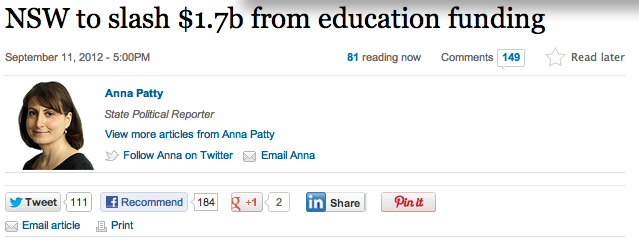
I don't think anyone was fooled by the Coalition pulling the all too common trick of leaking a draconian plan and then quickly "responding to community concerns". They did earn some headlines like the below, but no one is really fooled:
When it comes down to it, the Coalition does have to make cuts somewhere. Revenues are not showing signs of going back up, and expenses do need to be controlled.

But the choice to cut education funding (as opposed to freezing or indexing it, both reasonable enough options) smacks of something a little more sinister.

What remains to be seen whether we will have another last-minute backdown.

Wednesday, September 5, 2012

A Driving Ambition?

The criticism of O'Farrell's draft 20-year Master Plan has been almost universal.

It's surprising, and a little unfair, but not unexpected.

The people at the Terrorgraph have continued their campaign to paint O'Farrell as being a dithering planner rather than the bold doer they would rather write about.
Full editorial here
That criticism is not without basis. O'Farrell has showed himself to be quick to plan and slow to do.

Other papers have focused on the lack of confirmed funding for plans. Whilst the projects highlighted in the plan are categorised as being short, medium or long-term, there is no specific information as to how the projects will be paid for.

Precisely how the state of the budget in 2020 is meant to be predicted accurately enough to say that a project will be paid for in a certain way is beyond me.

That said, the plan is still only a draft - we won't get the final version until later this year. Plus, it's a PLAN - not a budget.

O'Farrell does deserve credit for planning in this way. An oft-repeated and richly deserved criticism of Labor's history of transport planning is that it was all "back-of-the-envelope" stuff - plans announced and then dropped before you knew it.

If ever an area of public policy required forward planning, it is transport. It is appropriate and commendable that these steps are being taken.

The problem for O'Farrell is that the public is restless for more action.
Full story on the Herald Sun site
That's not all O'Farrell's fault - he is being forced to carry the can for the failings of his predecessors. People are all out of patience.

He's snookered in because he came to power talking big about infrastructure and transport - but his budget just doesn't have the space.

These projects are going to be hugely, massively expensive - and he is committed to starting the North-West Rail link soon. This all in the face of a shrinking tax base and the exploding cost of the public service.

When the retrospectives are being written, no one is going to remember whether announced funding at this time, or the number of plans released.

What will be remembered is whether O'Farrell, like the Labor Premiers before him, announced then shelved plans, never once showing the citizen an ounce of respect.

Did he deliver on his promises? That's the question that matters.

PS Memo to John Robertson: No, you can't criticise yet. Give it a decade.

Thursday, August 30, 2012

Provoking a Response

This week an Upper House committee has been consider changing the law on provocation.

The review was no doubt motivated, at least in part, by the decision of the jury in the case of Singh.
Full story from the Hun
Charmanjot Singh was found not guilty of murder due to provocation. He cut his wife's throat with a box cutter after, he said, she told him she loved another man.

This story, not unreasonably, sparked outrage in the community, and highlighted some of the problems with the law of provocation today.

Let's take an example to explore the issue a bit.

Let's say you're in a pub, and you punch someone in the face. Perhaps you're charges with Assault Occasioning Actual Body Harm (turns out you have a decent punch on you, and you split the guy's lip).

When your matter comes up for sentence, the court will consider all the relevant circumstances - your age, background, criminal record (or lack thereof), whether you plead guilty, any remorse you have shown, and so on.

Let's say, however, that the court is satisfied that you punched this guy because he just said that he would like to rape your sister.

In that case, you could on sentence ask the court to consider provocation as a mitigating factor. Provocation is listed as a mitigating feature the court has to take into account in deciding what the appropriate sentence is for any matter:
You can find the full list here
It doesn't mean you won't be punished, but it does mean that the court will take that factor into account.

When it comes to murder (and only murder) the law is a little different. The briefing paper for the inquiry defines the test as follows:
If the crown cannot disprove provocation, then you can only be found guilty of manslaughter, and will receive a drastically shorter sentence.

Whilst the committee is also examining whether the law on provocation should be amended or tweaked in some way, the main discussion is whether it should be retained at all.

I'm not going to review all of those or try to provide a detailed argument, because the size of that task exceeds my available time.  What I will do is quickly summarise the reasons that I believe the defence should be abolished entirely.

This would mean that provocation would simply be treated as a mitigating feature of a murder, much like it would be for any other violent offence.

It IS murder. These people intended to kill the victim, and did so. They may have been angry, and they may have been sorely provoked, and that should be considered, but to suggest that the offence is not murder is disingenuous.

Other States have done it. And, more importantly, the sky does not appear to have fallen in. Have a look at pages 6 to 8 of the briefing paper if you're interested in the details.

Sentences would increase. It is difficult to dispute that, if the law was changed as suggested, the sentences for these criminals would be longer. I think the community would approve of that, and, for once, I think the community would be right. To take the example of Singh, he should be punished as a murderer, because that is what he is.

It is impossible to accurately estimate what his sentence might have been had he been convicted of murder but been able to plead provocation, but it would have been several times as long.

It's too easy to prove. To again use Singh as an example, we have only his word that his wife said anything to provoke him. As the briefing paper said:
How could the prosecution in Singh's case possibly prove beyond a reasonable doubt that he had not been provoked by his wife? As is so often the case, the only person who could deny the provocation is the victim.

Some people have suggested reversing the onus, or at least forcing the defendant to prove provocation on balance, and if the defence is to be retained then that would appear to be an excellent suggestion.

Ordinary Person. This is a slightly obscure objection, but I have a difficulty with the "ordinary person" test. Are there any circumstances that could motivate the "ordinary person" to form an intent to murder? The test takes into account age and maturity, but I still struggle with the suggestion that there are anything other than the most incredible circumstances that could cause an ordinary person to intend to murder.

Of course, juries over the years have found that an ordinary person might have formed the intention to murder, so I'm not sure what we are to do with that. Are juries just too confused by the (very complicated) "ordinary person" test and simply allowing leniency to an accused person they felt sorry for?

The Special Treatment of Murder. As I have explained above, no other offence has a partial defence of provocation, not even very serious violence offences carrying 25 years gaol as a maximum penalty. This does not appear to be causing any great difficulty, so it is reasonable to assume the same if the law on provocation in a murder is changed.

More subtlety on sentence. If the problem of how to deal with provocation is given to a judge on sentence, then the judge can make as much allowance as he or she deems appropriate.

At present, a finding by a jury that a person was provoked immediately reduces the offence to murder and drastically decreases the sentence.

Now, naturally a manslaughter where the provocation was slight will get a heavier sentence, and a murderer who just "misses out" on provocation will get a lighter sentence, but there is nonetheless a huge jump.

If provocation becomes simply another mitigating factor, a judge will be able reduce a sentence exactly as much as is deemed appropriate when the offender's conduct is weighed against the level of provocation.

There is far more to say than that, but it's a start. Hopefully there will be a detailed response published, and I will endeavour to review it as and when it appears.

Disclaimer: I was part of a committee that provided a response to the Provocation Inquiry, These views are, obviously, my own.

Sunday, August 26, 2012

Swinging By

The Heffron by-election came and went yesterday with a predictable Labor win.

I've written about the circumstances that lead up to the by-election here.

Suffice to say that, as expected, I didn't hear anyone complain about Keneally leaving early, which just goes to prove that a promise to stay and serve your local electorate no matter the state-wide result is a promise that no one is ever going to hold you to.

In the end, as discussed the post where I reviewed the candidate list, only 4 candidates nominated: Labor, Christian Democrats, Greens and Australian Democrats. In the 2011 election, there were an additional 2 (insignificant) independants as well as the Liberal candidate. In 2012, we were short those three but added an Australian Democrats candidate.

Given the likelihood of an easy Labor victory, the interesting part was going to be where the Liberal voters allocated their vote. All the state-wide polls since the election are very similar to the election result, so it is fair to assume that those that voted ALP or Green last time would vote the same way.

The only exception would be strictly progressive voters who voted Green or Labor last time and may now find a more comfortable fit with the Democrats.

It's unclear exactly how many voters there are who want to vote progressive but dislike the ALP (perhaps because they are a major party, or because of the union ties) but also don't want to vote Green (perhaps being put off by the focus on environmental issues).

This is the (an am sure growing) group that the Democrats would be perfect for - but whether the Democrats can ever rebuild and capture that group remains to be seen.

In any event, this was the result (not including postals, naturally):
Table from the ABC
38% of the voters would have had to vote differently to how they voted in 2011, and every candidate benefitted.

The first remarkable thing is the size of the vote for the Democrats. If the Democrats website is to be believed, in 2011 they ran in only 1 lower house seat, where they garnered just 1.4% of the primary vote. In the upper house, they didn't even manage 1%, which is less than the No Parking Meters Party.

So, where did that 10% come from? I'd say people like this:
It appears that this guy probably voted Green (however begrudgingly) but I suspect a large portion of that 10% were Liberal voters who could not contenance voting Green or Labor. That doesn't really make sense if you've read the Democrats platform, but there you go.

I also wonder how much of it was what I like to think of as the Liberal Democrats effect.

The Liberal Democrats are a party that drew 1.8% of the Senate vote. This is despite them being a fairly anonymous party with a platform that is libertarian and small-government. What I wonder is how many people, put off by the major, better known parties, liked the sound of a name that really told them nothing about the policies, but sounds like something they might like (progressive voters like the word Democrat, conservative voters are comforted by the word Liberal).

In other words, they may have scooped up voters who didn't like the sound of the other parties by having a name they liked.

That could be completely wrong, and we'll never really know what goes on in the mind of the "makes up his mind in the voting booth" voter. But it bears thought.

Other than the Democrats, the biggest rise was reserved for the Labor party.

Why? This tweet from Green upper house member John Kaye caught my eye last night:
He's right. Except when bickering over a few particularly divisive issues, there is hardly a vast chasm between the Liberals and Labor.

Most Liberal voters, when given the choice between Labor (in theory a centre-left party, although views differ) and the Greens (left - or loony left, if you prefer) will choose Labor.

There's no mystery about that. What remains to be seen is whether the Greens can start to capture a greater portion of the vote.

Many feel that Labor (both Federal and State) have drifted further and further to the right - becoming a centrist party. The Greens are not going to win Labor voters by outflanking them on the right - the only way they can take voters off Labor are going to be by winning the voters who are frustrated by Labor's apparent renunciation of left-values.

There's far more to say about that. Suffice to say, it's a pretty fair explanation of why the Greens didn't benefit more from the Liberals not running.

The next by-election with probably be Sydney if Clover Moore (as expected) is re-elected mayor and is forced to resign her state seat. With a prominent local member stepping aside it will be fascinating to see where her votes flow.

Stay tuned.

Wednesday, August 22, 2012

A Bill for Change

Maybe that cheque isn't quite as blank as Labor would have you believe.

In the lead-up to the election last year, Labor conceded defeat and started campaigning with the line "Don't give Barry O'Farrell a Blank Cheque".

The theory was, I expect, that people would be scared about what the Coalition would get up to if they won too convincingly.

As things eventuated (and as most people expected) the Coalition did of course win the election, and convincingly so - but did not win enough Upper House seats to have an outright majority there.

This of course means that to get legislation through the Upper House they need to bring either Labor or a minor party with them.

The presence of the Shooters and Fishers means that the task is a little easier than perhaps some might like - but nonetheless something is better than nothing.

We saw the Coalition having to give something away earlier this year when it came to getting their Power Sale Legislation through the Upper House. Of course what they had to give was a massively unpopular opportunity for hunting in our National Parks - but, as I said at the time, it was democracy at work.

Earlier this week, however, we saw a far more edifying example of this process.

Last year the Coalition introduced a real dog of a bill on graffiti.

I wrote at the time about why it was such an awful bill, at least in part. In short, there were there main changes to be made in the way that offenders could be dealt with.

The first was to require a court sentencing a person to community service for a graffiti offence to spend time cleaning up graffiti. This is sensible.

The second was to give the court various powers in relation a person's driver's licence if that person is convicted of a graffiti offence.

The powers included:
  • Extending the time the person could spend on their L's or P's by up to 6 months
  • Suspending a person's licence for up to 6 months, or
  • Reducing the threshold number of points before a person can have their licence suspended
I wrote about why it was a dumb idea at the time.

The third change was to remove the power to issue a caution to young offenders. Again, why it was that this change was necessary, and why the additional burden this would place up the court was justified was never properly explained.

In any event, the bill (as expected) sailed through the Lower House. An amendment was moved by Paul Lynch (ALP) to allow police to issue a caution for a first offence, but this was easily defeated. The bill was promptly passed and sent to the Upper House in August 2011.

Here, the Coalition ran into some more trouble. First, Labor moved a amendment. It was explained Adam Searle (ALP):
The changes he suggested were as follows:

  • To allow police the power to give a warning for a child where the offence was a first offence, and
  • To remove the power over drivers licences.
These amendments were made with only the Coalition opposed, and the bill was passed (with the Greens opposing the bill in its entirety) and returned to the Lower House.

The very next day, the Lower House rejected the amendments. When the bill bounced back to the Upper House in mid-September, the Upper House took the unprecedented step of asking for a "Free Conference" - essentially a working group of 10 Upper House and 10 Lower House members to try and reach a mutually acceptable solution.

The motion for a Free Conference was passed by the Upper House with the Coalition and the Christian Democrats Opposing it.

There matters ground to a halt. O'Farrell pontificated about how the Coalition had made this promise but couldn't get the bill passed, and it appeared that that was were things would lie.

Then, earlier this week, completely out of the blue, the Lower House rejected the request for a Free Conference and sent the bill back to the Upper House.
When it arrived, the leader of the Shooter and Fishers moved an amendement. As best I am able to understand it, the amendment removed the power to extend the period of time a young person must spend on L's or P's, removed the power to suspend a licence, but retained the power to reduce the number of points a person must accumulate before their licence as suspended.

As David Shoebridge said when speaking on the amendment, it improves the act (he said "marginally", but I suppose that is a matter of perspective).

The bill as amended was passed and returned again to the Lower House, where it will no doubt promptly pass.

The deal was reported in the Daily Terror as below:
I stand by my opinion that the bill remains a pretty awful one. It is a vague attempt to do "something" without any evidence whatsoever that the "something" will achieve anything. It is another example of politicians engaging in back-of-an-envelope lawmaking.

But it is good to see a bill being improved (however marginally) through the convoluted and drawn out parliamentary process.

It is also interesting to see the Shooters using their position in the Upper House to do this - so many have written about how the Shooters are merely O'Farrell's lapdogs, but here they have forced him to abandon what was seen a key promise made to take action of graffiti.

It remains to be seen if this is the trend or the exception.

*(I'm a little unsure about some of the procedural details above as, in places, I had some not inconsiderable trouble understanding the Hansard transcript. If I've misunderstood something, please let me know in the comments or on twitter)*