Showing posts with label Greg Smith. Show all posts

Monday, September 24, 2012

Stay Directly In Gaol


Sometimes standing up for an individual's rights can put you in a difficult position.

As many of you would know, my day job is a criminal defence lawyer. Some of my clients have been accused of pretty awful criminal offences. Others who I have represented on sentence have admitted committing awful offences.

That's ok. I'm proud to stand up for someone and make sure they receive the just penalty, rather than the penalty that an ill-informed public baying for blood might deem appropriate.

Having said that, I'm sensitive to society's views on criminal punishment. By way of example - at present the maximum penalty for a person who sexually assaults a person under the age of 16 is 20 years imprisonment.

At present, there are a select group of offences that are deemed worthy of imprisonment for life (including, for example, murder and some examples of gang-rape.

If someone wanted to make the argument that sexual abuse of a child should be added to that list, then that is a discussion we should have. I'm not backing any such change - but it's a reasonable argument for someone to make.

What I will almost always oppose are changes that remove a court's discretion. I wrote earlier this year about the new law mandating life-imprisonment for murder of a police officer earlier this year.

But if there is a particular maximum penalty that needs to be increased, then so be it.

This is why I was so interested to watch this documentary from the always excellent Louis Theroux:
Screenshot from here
The doco is fascinating, and thoroughly worth a viewing. In short, Theroux spends a few days in a mental hospital in the US that was built for paedophiles who are still deemed to be too great a risk for a release, but who had finished their court-imposed sentence.

The offenders were kept in good conditions (at least when compared to a prison). They had all sorts of luxuries and benefits that are not afforded to regular prisoners.

And so it should be. These men had all completed the sentence that was imposed by the court, and there was no longer any basis for "punishing" them. They had rec-rooms, DVD players, sports competitions - they just weren't allowed to leave and re-enter the community.

The problem was that an idea that is perhaps good in theory was perhaps always destined to fail - the "inmates" were almost never approved for release. Even those that completed all the necessary rehabilitative programs found that accommodation difficulties, judicial review or plain bureaucratic SNAFU's meant that they tended to remain there indefinitely - even once approved for release.

But in theory, I think the idea has merit. A person who had completed his or her sentence should not be punished further - but surely there is merit in keeping those people separate from potential victims.

The problem in NSW is that there is not even an attempt to ensure that punishment is not any part of the preventative detention.
Full Act available here
This act, in short, allows the state to apply to the Supreme Court of NSW to keep a person in custody after the completion of his or her sentence if the person is service a sentence for a "serious sex offence".

This isn't simply keeping the person away from potential victims - a person who is subject to such an order is kept in gaol, as if their sentence was not yet finished.

It is abhorrent, but no one really seems that fussed. They're just sex-offenders, after all.

Today Greg Smith announced that the scope of the act was to be widened:
If it was simply a matter of preventing these offenders from re-integrating into the community, and if they were housed and cared for in such a way that made that clear, then I would have some sympathy for the position.

But that is clearly not the case. These people will simply be kept in gaol as if they were still serving their sentences.

And that's the problem. An idea that would be a necessary evil if carefully thought through and sufficiently funded becomes an arbitrary, capricious law that unnecessarily and grossly breaches human rights.

Why? A few cheap headlines in the Terrorgraph.

Worth it?

Sunday, September 23, 2012

A PaRole for the Court

The decision to release an offender on parole is always a difficult one.

This is particularly so with serious offences, and doubly so with high-profile ones. The media is often intensely interested, not least of all because it allows them to dredge up scandals in the past.

It's all to easy for the media to get a quote from the victim of victim's family, something inflammatory from some victim's group, rewrite a retrospective article, and there's five o'clock.

The release of Victor Chang's killer was always going to upset a lot of people.

For those of you who are too young (or, like me, too foreign) to know much about the events, this from Wikipedia:
At a public hearing earlier this week, the Parole Board ordered that Liew be released.

In deciding to release a person on parole, the Parole Board is bound by section 135 of the Crimes (Administration of Sentences) Act 1999:
Obviously it's a complicated matter.

In any event, the Parole board ordered that Liew should be released. He had been sentenced to a maximum of 26 years in gaol and had completed his 20 year non-parole period (ie minimum term he has to serve before he can be considered for parole) in July 2011.

Naturally enough, Greg Smith has indicated that the state was going to appeal:
From the SMH
Now, Regular Readers will know I'm usually keen to rant and rave about government's making decisions purely on populist grounds. And this is what Smith is doing - the above article doesn't actually provide any information from Smith explaining why parole is a bad idea or why the Parole Board was wrong.

But, in this case, I'm happy for Smith to take it to the Supreme Court. Obviously I'm not thrilled on the State's resources been wasted if it is in fact a wasted application - but I'm happy to see the state approach these things in a proper fashion.

It's quite different from those times where we frantically legislate to appease the Daily Terrograph. Of course, that is the motivation here, no doubt - but there's nothing wrong with going to the court and asking for a review. It's quite different to just changing the rules to the community's detriment.

What remains to be seen is whether a curmudgeonly Supreme Court judge raps the State over the knuckles for wasting the court's time, or whether there is in fact a valid basis for complaint.

Not that Smith is likely to care either way.

Tuesday, September 18, 2012

An Opportunity to Improve?


Well, we were waiting to see what the suggested amendment was going to be, and now we know. Except, I'm not certain what to think.

I wrote about the proposed changes to the right to silence a little while ago, and I won't repeat the reasons that I think it is an awful idea.

One thing I mentioned last time was that it would be interesting to see the way the actual law was drafted.

This is what part of the new section 89A of the Evidence Act looks like:
That's interesting, for a number of reasons.

The big problem with the changes is that they are going to pressure lots of people, particularly innocent people, into giving an interview when it would be hugely contrary to their interests to do so.

When similar changes were introduced in the UK, a 24 hour legal aid service was provided so that anyone arrested would be able to get in person advice before deciding to give an interview.
And extract from a UK government website
The English courts have held, as I understand it, that if a person could not get legal advice before the interview then the "old rules" applied.

Naturally enough, the efficacy of the changes for the UK was used to justify the changes in NSW, even though there was no intention of providing funding to Legal Aid so a similar service could be provided.

My experience is that if a person is arrested and says they want to speak to a lawyer, the police usually just fling a yellow pages at them and give them a cordless phone.

Since a lawyer is unlikely to come down to a police station unless the person is able to pay for their attendance, it's extremely rare for a person to actually get legal advice before they get interviewed.

The new section says that the new rule will only apply once they have been given the "opportunity" to obtain legal advice.

It will be fascinating to see the way the courts interpret the word "opportunity".

Technically, every arrested person is already afforded the "opportunity" to seek legal advice. If they say they want to speak to their lawyer, or any lawyer, the police will give them that cordless phone.

But I fancy the drafters had something a little more substantial in mind. But what?

The good thing about the drafting is that it means that the issue will be left up to the courts to interpret with very little precedent to be guided by, other than the UK system.

Given the way in which this section flies in the face of centuries of legal protection for the rights of the individual, it is my hope that the court reads "opportunity" very narrowly, perhaps limited to an in-person conference with a solicitor who has been given the chance to obtain a detailed account from you.

Of course, there are still a number of significant problems with that system. People will be giving interviews before the police have had to provide a brief of evidence, before it is clear what charges will be preferred, and before it is clear whether police have any prospect of proving the charges without you opening your fat mouth.

But it's something at least.

The full proposed amendment can be found here along with an invitation to make a submission. If you are so inclined, you have my permission to plagiarize as much of my writing as you like.

Tuesday, August 14, 2012

The Silent Menace


Here's a hypothetical situation for you to consider.

You're out with some friends on a Saturday night. You've had a few drinks - you're not drunk, but you're enjoying your night. It's a dark pub in the city - there is music, flashing lights, people everywhere.

You look over your shoulder and see your friend being punched by someone you don't recognise. You don't know how it started, and your friend may well deserve that punch, but you immediately run over to try and help your friend.

As you arrive, suddenly there are people everywhere. You get a knock to the head - you're not sure who or it was. Suddenly you're just trying to defend yourself.

After 10 seconds of chaos, someone grabs you round the throat, and before you know it you're on the ground, handcuffed. You're taken to a police station, put in a 1m by 2m cell with a clear plexiglass wall and given an icepack for that lump on your forehead.

You wait there for about 2 hours and start to sober up. You are offered the chance to call a lawyer, but it is 1am on a saturday night, and of course you don't have any lawyer's mobile phone number. The few law firms that you find in the Yellow Pages don't pick up, and in any event, how would you pay for their services?

Then, a police officer approaches you, takes you in a room. As he's setting up, you ask what is going on, and he says "We're investigating what happened in that pub. This is your chance to tell your side of the story."

You respond "Do I have to?" and he replies "No." You say "Am I going to be charged" and he says "Maybe."

He turns the video camera on and is joined by another officer. The say "You are not obliged to say or do anything unless you wish to do so, but whatever you say or do may be used in evidence. Do you understand?"

You say yes, and police start asking questions.

You know you did nothing wrong, and you've got nothing to hide. Do you answer the questions?

If you said yes, you almost certainly just made a massive mistake. Don't feel bad - the vast majority of people (innocent or guilty) who are charged with an offence give an interview. People who are innocent are even more likely to start talking.

I've been working in criminal defence work for four and a half years, and I am yet to see even one interview given by a client that helps them. Not once. I have NEVER even heard of a situation where police decided not to charge someone because of what they said in their interview.

The problem is this - by the time they speak to you at 1am that night, police have taken statements from security, the barman, the alleged victims, and anyone else who they think might help. They have viewed the CCTV footage, if it exists. They have sat down and worked out what they think happened.

They have all the information. You have none. They know what they plan to charge you with, and what the elements of the offence are. You do not.

If you say anything, ANYTHING that differs from what the CCTV footage shows, the police will do everything in their power to use it to your disadvantage. If you forget something, or in your muddled, disorientated state of mind during the interview and then bring it up when your matter is heard, you will be hammered for it.

If you get home and find a huge bruise on your back and suddenly remember that punch you got just before you got hit in the head, or if you remember something that you forgot to mention - too bad so sad, you missed your chance. Anything you add now looks like something you've invented specially.

Interviews are almost universally a very bad thing for accused persons.

This is what makes the changes announced today all the more shocking:

NSW will be the very first jurisdiction in the country to take these steps.

Why is this change such a bad thing? A lot of reasons.

Firstly, the person being interviewed will almost never have had the benefit of legal advice. There will usually not be a lawyer there to protect and advise them, even if they could afford to pay for one. They won't know what they are to be charged with, they won't know the elements of the offence, and they won't know if they are guilty or innocent.

Police, by contrast, will know what they are trying to prove, and will ask difficult, confusing questions to trap you into admitting something, or at least into contradicting what they know they can prove.

These changes will be an even more powerful emotional tool for police to use to convince a person to give an interview. Of course they cannot literally force someone to start answering questions - but once people are told that, in effect, that if you don't tell us what happened it can be bad for you, it is difficult to resist the natural willingness to answer questions.

Moreover, at present I can as a solicitor give general advice that an interview is almost universally a bad thing. I tend to tell anyone who talks to me about my job for more than a few minutes.

If this change is made, that advice will change to "it depends". It will be pretty much impossible to advise a person whether giving an interview is a good idea without spending a decent amount of time talking to them about what has happened - and that assumes that you even know what you are going to be charged with. At 2am in the morning, there is no way that going to happen.

The second issue is the presumption of innocence. The basic principle is that the Crown needs to prove its case beyond reasonable doubt.

That is a heavy burden - but it is the right burden. Anyone can make an allegation against someone, but we don't want to have to come to court and prove that we didn't do something. Not only is proving a negative all but impossible, but the prosecution have far, far greater resources than all but the wealthiest of defendants.

Police have incredible investigative powers that are not even worth comparing to an individual's. 

The third issue is that there has been no report, no investigation, and no consultation.

Well, that's not quite true. In 2000 the Law Reform Commission closely examined the right to silence and produced this quite excellent report. Their conclusion?
Section 89 of the Evidence Act presently reads:
This mooted change comes completely out of the blue. To my knowledge no one has been actively campaigning for it, no one has suggested that it is a major problem to be fixed, and no other jurisdiction in Australia has tried because it because it is a pretty bloody stupid idea.

The only people quoted in O'Farrell's press release are O'Farrell, AG Greg Smith, the Police Minister Mike Gallagher (3 Liberal politicians) and Police Commissioner Scipione (police being famous for never having met a new power they didn't like).

It is also pretty interesting to look at the reasons that have been proffered by the Coalition as the story broke today.
If by exploited O'Farrell means "being used to the accused's advantage" then I suppose a lot of other rights are in danger.  On that definition, accused person's constantly "exploit" their right to a trial, and their right to legal representation, not to mention their right to a presumption of innocence. 

Unless O'Farrell can point to some evidence of this right being somehow illegitimately exploited then this is a non-sensical criticism.

And to say it an "importan legal right" and then comprehensively rip it to shreds - I don't even know what to say about that.
Well, yes. Of course accused persons restrict information given to police! The police are trying to prove them guilty of an offence that they deny committing! Is O'Farrell expecting these people to actively assist police in trying to prove them guilty?

If police uniformly and reliably investigated matters with the intention of finding the truth (not just "getting their man" as is so often the case), and if the police never made a mistake, never jumped to a conclusion and never relied on their "gut" rather than the evidence, then perhaps this wouldn't be such a problem. But we all know that is a fantasy.
Ah, that old chestnut! Common sense! Also known as "We have no evidence that this is a good idea, but it sounds good, so we're going to do it!"

That's why you hear so much talk about "common sense" from some people. It's a wonderful way to avoid annoying things like "evidence", "specialised knowledge" and "research".
Brad Burden is the head media guy for O'Farrell, and his tweets today got me madder than any others.

Bring into line with the UK? What possible reason is there that we need to have the same laws on this topic as the UK does?

Bringing laws into line with other states can sometimes makes sense. At the moment the states are working on bringing together the laws surrounding heavy vehicles. This makes a lot of sense - the heavy vehicle regulation in NSW is eye-wateringly complicated, and having to work with the laws in 6 other states and territories must be an absolute nightmare.

To suggest that there is a good reason to bring laws into line with the UK is ridiculous in the extreme.

It is also worth noting that in the UK there is a scheme whereby any accused person can at any time have access to legal advice 24/7. There are duty lawyers who are always available to attend police stations and give advice

In NSW, you have the right to access legal advice, but it is impossible to find unless you have the mobile number of a criminal lawyer in your pocket. Legal Aid do great work in NSW but their funding has no prospect of even coming close to this level of service - they are hard-up providing enough lawyers just to make the court appearances for their clients during waking hours.
This was the tweet that really made me crazy. This change has nothing to do with victims of crime. It is about making it easier to convict someone of an offence. To link it to "victims of crime" is just plain deceptive.

That segues pretty well to the biggest complaint I have about these changes.

Everyone is going to be talking about the way that these changes will affect people who are guilty of crimes and trying to hide it. Case in point:
I have no problem with something that makes it easier to lock up people who are guilty of offences. That's good, and proper, and should be encouraged.

What upsets me about these changes is the effect that it will have on people who are not guilty of anything.

If you are innocent of any crime, the absolute worst thing that can happen to you is a police interview, especially before you get legal advice. Police will know the evidence they want to get from you. They will spin your answers, they will provide you with information as and when it suits their questions, they will change tack and try and catch you in a lie, and they will give you every opportunity to say something they can prove is untrue.

There is no magistrate to rule questions out, and there is most likely no lawyer there to help explain things to you. And your answers will be mercilessly used to convince a jury that you are in fact guilty.

And more innocent people will go to gaol as a result. Fact.

Nice one Barry.

Sunday, April 8, 2012

Poor Judgment

The controversy over appointment of judges is (luckily) a spectacle that we are typically spared in Australia.

As a lawyer, and moreover one specialising in criminal law, I strongly believe that there are few things less edifying than "electing" judges.

There are probably few other decisions that should be as non-political.  After all, judges are tasked with applying the laws made by the legislature. They are a separate head of government, and should be entirely divorced from the political arena.

It goes without saying that judges will make decisions that have political consequences.  But there should not even be the slightest hint that any decision is coloured by an ideological perspective.

Nowhere is this unedifying spectacle more obvious than in the United States.

In the US all Supreme Court judges need to be "confirmed" by the Senate. This means that a majority of the US Senators need to vote to "confirm" an appointment made by the President.

It is a grotesque spectacle.  Every decision, every on-the-record word ever uttered (and many more off the record comments) are raked over by opponents in a desperate attempt to shape the court. Abortion being the political hand-grenade that it is in the US, the justice's position on abortion alone will often define whether he or she is even nominated.

The particular power of the US Supreme Court (for reasons beyond the ambit of this post, far greater than the Australian High Court) as well as the appointment for life (as opposed to the compulsory retirement at 70 in Australia) mean that an appointment can radically affect the Court and, consequently, the country for decades to come.

All in all, it is yet another reason I am grateful to live in Australia.  Here, the AG consults widely, lawyers speculate frantically, a recommendation is made by the AG to cabinet, and the cabinet makes a recommendation to Governor General.

The process in NSW is identical.  The AG takes advice, and makes a recommendation.  Whilst there are obviously political considerations, the process is remarkably apolitical, and whilst there will always be a wide range of views, the particular politics of an appointee are seldom in issue.

And so it should be.

Judges and Magistrates of course are human beings with their own particular prejudices, views and opinions.  Some will sentence harshly in criminal matters; others will tend to find duties of care others cannot in negligence matters; still others will often accept the word of an employee over that of an employer in a work-safety case.

But the close supervision of higher courts (as well as monster egos that cannot countenance being put in their place by higher courts) mean that, as a rule, NSW courts are as predictable and reliable as could be expected from a system run by human beings.

That is why this article came as such a surprise when I saw it yesterday morning.
The article went on to say the following:
There are a few things that are just plain stupid about what Phelps has had to say, working on the assumption that he did in fact say them.

The first is the idea that we can be choosy about who we appoint as judges (and, for that matter, magistrates).

There are a very limited number of people who have the necessary ability, experience and temperament to be a judicial officer.  Moreover, just about anyone good enough to be appointed a judge takes a significant pay-cut to do it (often reducing their income by as much as 75%). We simply cannot afford, if the standard of the bench is to be maintained, to start considering "political leanings".

The next assumption is that the system would be better if we did consider such matters.  Firstly, as discussed above, the ideology of a judge means less than in the US.  Sure, there are judges who are more conservative - but they are more to do with conservative views about the role of the judiciary, rather than conservative political leanings.

This is especially so in any court below the High Court - to suggest otherwise would betray a profound ignorance about the operation of the legal system.

The most infuriating part of this article, however, was the below:
To question the suitability of a judge based upon a client they have represented is truly disgraceful.

Firstly, as a spokesman for the AG Greg Smith noted, when one is at the bar the "cab-rank rule" applies.  This means that if a person approaches you to act for them, you HAVE to take them on, as long as they can pay your fee and you have capacity.
It's the same as a queue of cabs (hence the name) - a cab doesn't get to reject a fare because they don't like the journey length, and a barrister doesn't get to reject a client because he or she finds them morally reprehensible.

There are a number of reasons for this, but the most important one is that everyone is entitled to representation. As someone practicing in criminal law myself, I understand that better than most - I represent some people who have done or are accused of doing awful things.  What kind of legal system would we have if such people were not able to obtain representation but rather had to fend for themselves?

That point is the basis for my second criticism - who is to say that the fact that these barristers represented Mamdouh Habib and David Hicks tells us anything at all about the kind of judge they would be?

I know these judges only by reputation, but I can assure you that the fact they acted for these clients tells us absolutely nothing about their politics or their prejudices.

To criticise Mr Maiden on the basis that he acted for Orkopoulos is, to put it simply, gutter politics at its worst.  As a barrister, Mr Maiden had no choice whatsoever when he was approached to act for Orkopoulos, and to suggest otherwise is unfair and misleading.

Finally, it is plain wrong to suggest that the previous clients of a lawyer tell us which side of the fence they will fall on when it comes to dealing with serious criminals.

There are a lot of defence lawyers I speak to who have become remarkably cynical about the stories their clients tell them.  By contrast, a great number of prosecutors (who only hear the stories filtered through the lawyers) display remarkable compassion towards accused persons.

Typically a magistrate or a judge is lenient to a fault upon being appointed, and then starts to become more cynical and hard-hearted as their career drags on.  That is not ideal, given that all judges would (in an ideal world) be 100% consistent and predictable, but my point is that any leniency almost always has nothing whatsoever to do with the judicial officer's background.

To suggest otherwise is grossly unfair to those judicial officers, and a concerning hat-tip to the overly politicised and frankly unpleasant judicial system in the US.

Here's hoping it is the last we hear of it.

Monday, February 20, 2012

Shooting from the Hip

Nothing is more likely to create bad law than a political crisis.

The media focus on the shootings in Sydney has clearly reached the stage where O'Farrell and Greg Smith felt they had to act.  And act they have.

No one seems to have considered whether there was actually any problem with the law.  Do the present laws provide police with the charges they need to do their job?

Are there gaping holes in the law where police are powerless to act? Is there evidence that the shooters would be stopped by tougher penalties or new laws?

I think you know the answers to those questions.

What I wanted to do was have a look at the changes at the law and try to analyse what (if anything) will be achieved through their introduction.

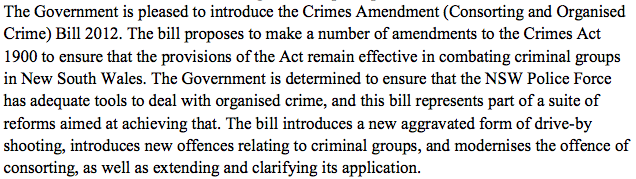
The relevant bill is the Crimes Amendment (Consorting and Organised Crime) Bill 2012. It can be found here.

It introduces some new offences and increases penalties for some others.  I'll cover the changes one at a time, in the order they were discussed in Smith's speech.

Firing at a Dwelling House
At present section 93GA of the Crimes Act) reads as follows:
The change is the insertion of (1B):
In other words, the maximum penalty is increased by 2 years where the shooting was part of "organised criminal activity".  Does change accomplish a great deal?

Probably not a lot, but there is no inherent difficulty with the change. It makes sense that such an offence should carry a heavier penalty where it was performed as part of orgnaised criminal activity.

The next definition is small change to law on criminal groups.  Presently section 93T reads, in part, as follows:

The change will replace subsection (1) with this:
Essentially the change softens the prosecution's burden, in that the police no longer need to prove that the offender knew or was "reckless as to whether the conduct contributes to the occurence of any criminal activity", they now need only prove that the offender knew or ought reasonably to have known.

This offence is notorious for being difficult to prove - how can the police prove what a person knew, or ought reasonably to have known?  It requires the prosecution to provide enough evidence about the all the circumstances of the offender's involvement in the "group".

It's not even easy to prove what a criminal group is - have a look at the definition:
Moreover, this is an offence that is most commonly "tacked on" when a person is charged with a far more serious offence, such as drug supply.  This means that the number of criminals who police are now able to prosecute that they couldn't otherwise prosecute will be small indeed.

The bill also adds a new offence of directing a criminal group, and directing a criminal group whose activities are ongoing:
Essentially, all the same issues arise.  Criminals not being in the habit of taking minutes when meeting mean that it will be pretty difficult to prove that a person was "directing" the activities of a group.

Any time police are able to charge a person with directing a criminal group, they will almost certainly be able to charge the person with all the offences committed by that criminal group.  How is this new law supposed to assist police in prosecuting anyone they wouldn't otherwise be able to prosecute?

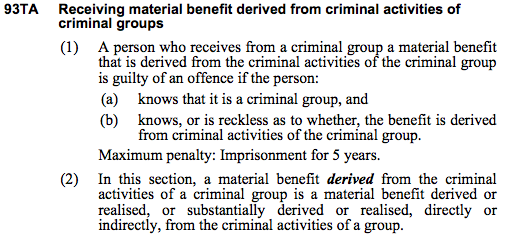
The next change is the introduction of section 93TA, which reads as follows:
As Smith puts it:
That's true.  What he doesn't mention is that we already have section 193B, which reads as follows:
It is difficult to imagine who could be guilty under the new section 93TA who is not also guilty of s193B, meaning that this change accomplishes precisely squat.

The final change, and by far the most troubling one, is this:
There is also a defence:
There is presently section 546A, which reads as follows:
It should also be noted that, as best I am able to tell, no one has ever been prosecuted in s546A.  Ever.

It is a deeply troubling section, for a number of reasons.  First of all, it is the very definition of "guilty by association". If you spend time with people who have convictions, you are committing an offence.

Moreover, police have to warn you first.  That's fair enough, given that you may not know that they are convicted persons.

What that means, however, is that police will be able to approach you and tell you that someone is a "convicted person", and to hell with their privacy.  There is otherwise no entitlement or reason for you to have that information.

A convicted person is someone who has been convicted of an indictable offence.  Without getting stuck into the detail, that casts an incredibly broad net.  I don't have the resourses to determine how many people in NSW fit that category, but it must be an enormous number.

There is also the fact that the law will be applied pursuant to a police discretion (ie only people they have warned first) means that it is open to police to pursue whoever they want in relation to this offence.  Groups or people can be targeted maliciously or without good reason.

That is a power that worries me.

It gets worse.  The defences to the offence are so broad that they can be easily manipulated by people committing the offence.

If you are given an official warning for consorting with someone, get them to hire you, or enrol you in some bogus "training".

It seems unlikely that police will be able to prosecute many people at all for the offence, despite the repugnance of the provision.

But we should come back to the original intention of the changes.  As Smith put it:
You can read that as "Do SOMETHING legislatively to get Labor off our backs."

The result?  Four minor changes at the margins that will interest criminal lawyers and no one else.  One change that is entirely redundant.  And one change that gives police truly incredible powers but then includes defences that will make the offence easy to circumvent, meaning that it is unlikely that anyone will be prosecuted for it.

How is it that these changes are meant to help police stop the shootings?  No one's really sure.  I'm not even sure whether anyone has asked what the hold-up is.  I doubt it is the lack of useful laws, and if it is then it is difficult to see how these changes will help.

The end result - Labor are now reduced to whining about the efficacy of the changes in a way that will not resonate with most people.
 Mission accomplished, I'd say.  Good governance be damned.

Monday, January 23, 2012

A Nudge in the Right Direction

This is unfortunately going to be an abridged blogpost, because I'm on holiday and was planning on leaving this blog alone for a few days.  But this is an issue I simply cannot let slide past without comment.

Look at what the Terror served up for us today:
Now I've had plenty to say, both here and on Twitter, about our old friend Laura Norda.  To be expected I suppose, given my job as a criminal lawyer.

On one hand, I agree that harsh sentences are often not just appropriate but also required.  In many cases, gaol is the only appropriate response, and the community is right to be demand it.

On the other hand, there are a lot of people who are in gaol for no good reason, forced there by vicious laws created only to keep TalkBack Radio and the Tabloid Media off politicians' backs.

There needs to be balance in the debate, and Greg Smith has been one of the first politicians to suggest that the issue is far more nuanced than "tough sentences equals less crime".

The problem for him, however, is that certain media outlets are always going to hammer him for any change that softens sentencing.  This article, which shamelessly labels him "soft on crime", is a textbook example.

Again, this post isn't meant to be another complant about the media (although God knows that is what I would like to write).  What it is about is an observation that this is the kind of rubbish that is going to be printed (and no doubt believed by many) if Mr Smith wants to actually achieve something good and worthwhile whilst the Coalition is in power.

Labor had this little nuggett of wisdom for the AG:
That's nice.  Let's make it about the fact he lives on the North Shore and therefore cannot possibly comprehend the "gang war raging" on the streets of South-West Sydney.

I mean for heaven's sake - a "gang war"? Spare me.

Smith going to cop it in the neck for this.  But what better time to do it?

We've already seen that this government appears to have a licence, at least for the moment, to do what they want and not get penalised for it. I've written about that here and here.

That window of opportunity won't last forever.  Smith should take the chance to push these reforms through now before the populist rubbish has a chance to really penetrate.

I've never met Smith, and I have no idea what he is like as a person.  The fact that he is pushing these reforms that (surely) won't win him many votes is a good sign that he was sincere when he said, before the election, that he was determined to make the right changes, not the popular ones.

It bodes well for our state.