Showing posts with label budget. Show all posts

Wednesday, September 12, 2012

Teach Our Children Thrift


Yesterday must have been a pretty tough day to be a Coalition supporter.

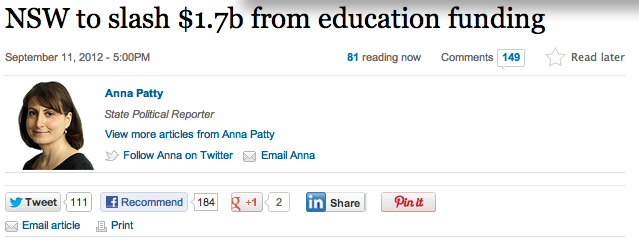
The reasons given for the dramatic cuts being made to the education budget are sound. True it is that state revenues are falling, and that cuts are going to have to be made.

And I don't think anyone could argue that the wage bill for the public service is exploding, and, if not reigned in, risks a legacy of endemic deficits.

But why it is that education needs to bear the brunt of the cuts remains unclear.

I've written previously about other places the budget could do with a trim - but powerful groups need to be kept happy. Days like yesterday are the price you pay for looking after power rather than need.

Unlike the cuts being made in Queensland, O'Farrell's cuts usually do not seem petty or vindictive - they are probably better described as universal.

Unsurprisingly, the condemnation to the education cuts has been uniform.


I don't think anyone was fooled by the Coalition pulling the all too common trick of leaking a draconian plan and then quickly "responding to community concerns". They did earn some headlines like the below, but no one is really fooled:
When it comes down to it, the Coalition does have to make cuts somewhere. Revenues are not showing signs of going back up, and expenses do need to be controlled.

But the choice to cut education funding (as opposed to freezing or indexing it, both reasonable enough options) smacks of something a little more sinister.

What remains to be seen whether we will have another last-minute backdown.

Wednesday, June 13, 2012

A Goods and Services Budget


The NSW State budget was released yesterday with the usual fanfare.

Journalists were locked away for hours to pore over the documents and then breathlessly emerge like time travellers to frantically tweet and post articles telling us who the WINNERS AND LOSERS were, and the reasons that people would spend the next few days being very very outraged.

The budget is obviously a complex creation, and I'm not going to try and summarise the whole thing. If that's what you're after you'll find that information easily enough somewhere else.

I still view my task as a blogger to plug a gap that the mainstream media is leaving, and that's what I plan to do tonight.

So, what particular issue is it that is most deserving of further attention?

This:
Cut from this SMH article
$5 billion??? That is an enormous number. To provide a sense of scale, that is an average of $1.25 billion per year, or more than 2% of the projected revenue for 2012/2013.

ALL gambling revenue in 2012-2013 comes to approximately $1.8 billion revenue. A similar amount will be received in royalties -  the amount paid by mining companies to the state for the right to mine our minerals (in NSW, mostly coal).

So I thought a closer look was required at how this enormous amount of money was stripped from our books, and why.

To start with, it's important to look at last year's budget to work out exactly how big the change was.
And this year?
The difference?
2012-2013: $1 424 000 000
2013-2014: $1 443 000 000
2014-2015: $1 394 000 000

That's a total of $4.3 billion just over the next 3 years - presumably the figure for 2015-2016 (not provided in last year's papers to enable a comparison) brings the total to $5 billion.

What do this years papers have to say about this?
Further on:
Chapter six of the budget papers tells us more about why the total GST collected by the Federal government is falling.

These reasons include:

  • People are saving more and spending less
  • The price of GST-exempt goods are rising faster than the prices for taxable goods, meaning we are spending a greater percentage on GST-free goods:
  • Finally, NSW's GST share has fallen from 30.9% to 30.7%
These changes are significant, and place enormous strain on an already stretched budget. The Coalition can't be blamed for it, but most punters are not going to understand or even be aware of the fall in GST revenue, meaning that whilst they won't be blamed for it they also can't use it an excuse.

How permanent the loss is also remains to be seen. Certainly the trend in food increasing in price is likely to continue.  Of course, that only serves to further highlight what utter folly exempting food from the GST was, but that is a battle lost.

This $1.25 billion per year will barely garner a headline, mostly because it is boring and no one is going to march anywhere because of it.

But it is important to contrast it to the viciously derided "Labour Expense Cap" that will result, apparently, in the loss of 10,000 jobs and result in compulsory redundancies. IT will save just $2.2 billion over 4 years, or approximately $500 million. 

THAT is just how significant this figure of $5 billion over 4 years is. And why it is a little amazing that it is not getting more attention.

Monday, May 14, 2012

Courting Disaster


Late last week we found out that the High Court has granted special leave to the Public Service Association and Professional Officers' Association Amalgamated Union of NSW (who I'll call the PSA, for convenience) to argue that the Industrial Relations Amendment (Public Sector Conditions of Employment) Act 2011 is invalid.

To understand that, we need to climb back in time a bit.

In 2007, the Labor government recognized that if the NSW budget was to be kept in check, then public sector wages would need to be tightly controlled.  Wage growth was outstripping revenue growth, and if action was not taken then enormous budget deficits would become entrenched.

The policy they came up with was that public sector wages would be limited to 2.5% except where specific productivity savings could be identified.  Sensible enough.

The problem was that, as Greg Pearce (Minister for Finance) said, "The policy was first introduced by the previous Labor Government in 2007, but that Government failed to implement it." The policy was inconsistently and weakly applied, which pretty much rendered it useless.

The Coalition decided on a different approach, and introduced the the bill in question.

What the bill did was insert s146C into the Industrial Relations Act 1996.  The section reads as follows:
It essentially forces the Industrial Relations Commission to apply the 2.5% policy.  Labor had lost multiple battles in the Industrial Relations Commission before losing government, and it was hoped that this law would effectively remove the Commission as a recourse for aggrieved public sector workers.

The PSA brought an action to the Industrial Relations Court asking that the amendment be declared invalid. Their main submission was as follows:
This was more or less the same argument that had succeeded in the notorious bikies case.  In that case, the bikie clubs challenged the legislation as compelled the Supreme Court to act in a certain way, and in that sense made the court little more than a rubber stamp. This was held by the High Court to be inconsistent with the purpose of a judiciary and, in short, breached the doctrine of separation of powers.

That decision would have been extremely embarrassing for the O'Farrell government but for the fact that the legislation had been passed by the Labor government.

This bill was a Coalition creation - and notwithstanding the fact that the 2.5% had been Labor policy, Labor had argued strenuously and at some length against it when it passed in June 2011.

I don't want to get stuck into a detailed analysis of the decision, given that it lies thoroughly outside my professional experience. Having said that, the decision appears to be a fairly straightforward one, which is usually a bad sign for any challenge. Suffice to say that the Court seemed pretty unimpressed by the PSA's argument.

That makes it perhaps a little surprising that the High Court has agreed to hear the matter.

The High Court is the highest court in Australia, and the final point of call for any party. Given that there are only so many days in a year, the court has to be selective in which matters it agrees to hear.

The court regularly conducts Special Leave Hearings where one or two judges sit and hear a large number of short arguments as to whether special leave should be granted to argue the matter before the full court.

An overwhelming majority of applications are rejected. Having a good chance of winning is not enough - the court will need to convinced, in short, that the matter is significant enough to warrant their time.

Unfortunately the transcript of the special leave application has not, at the time of writing, been published, so for now we are in the dark as to what went on at the hearing. But the news that special leave has been granted must have sent a shiver up O'Farrell's spine.

He has a big agenda.  A very big, very expensive agenda. He will have enough trouble paying for it with moderate wages growth.  If wages grow out of control, he is going to struggle to find the money he needs.

I suspect he'll be saying a little prayer the night before the High Court hears the appeal.

UPDATE: The transcript of the application for special leave has now been posted, if you're super-keen.

Thursday, March 22, 2012

A Promise from the Heart II

Sometimes election campaigns can become frustratingly predictable.

Candidate crops up at a location that is either relevant or (if you're lucky) metaphorical.  The announce X millions for this or that, take a few questions that usually have nothing to do with the announcement, and the media toddle off the write about the announcement or whatever minutia is distracting them at that time.

It's rare to see a politician jump up and say "This is how we will do it BETTER" - it's all about spreading about the pork, thus perpetuating the idea that all the public care about is cash, and damn the implementation.

It often reaches the point where papers publish a "gauge" of the amount of spending promised, as if it is the sheer size of the promise rather than its brilliance (or lack thereof) that should define its value.

Moving on.

The next category of O'Farrell promises I wanted to look at was what he, into the "Contract with NSW", called "Return to Quality Services".

It continues the focus on "frontline services" which seems to me to be one of the sillier media/politician creations. I don't doubt the importance of police who are actually "on the street" - but what use are they without the people that train/equip/support administratively?  Is it reasonable to say that a "frontline officer" is ALWAYS better than a backroom employee?

Of course not. I'm sure the same goes for nurses - if they can't do their job because the guy who orders the drugs got sacked, what bloody use are they?

I'll have a look at them all individually:
Impossible to assess. Which was no doubt the intention.
This is covered in the budget speech, where the promise is in fact exceeded by some margin
Next?
This is met in part.  In fairness, one can't just summon teachers out of fresh air - they need to be trained, attrition needs to be reduced and a place to put them needs to be found.  But no complaints as yet.
The integrated Transport was, as I indicated previously, has been created.  As for the extra express services, I've looked and have found no evidence at all that this has been done, nor have I found evidence that things are happening.

That said, the plan may be to introduce them when the long-overdue Waratah's hit the tracks - it would make sense that the extra capacity makes the promise feasible.
Impossible to assess
Also impossible to assess - although I suppose if their had been falls in the raw numbers there would be a case for some criticism.

The problem, really, is that promises like this are easy to keep.  They are not expensive promises (comparatively) - it's fairly easy to just throw millions are the key issues (health, education, law and order) - but it's not good governance.

The steps O'Farrell has taken to limit/cut public sector conditions since the election are a case in point - a promise like the above would be easy to keep if harsh cuts are made in other areas.  Would we be better off as a result?

We need to expect more from our politicians - not to just sign a cheque, but rather to be constantly searching for better ways to do things.

That doesn't just mean more efficient (thereby pissing off the unions) - it also means searching for "Best Practice" to make sure our limited resources achieve the best outcomes available.

I'm by no means on top of the Gonski reccommendations, but I understand they go a whole lot deeper than needing $5 billion more per year (although you'd be forgiven for thinking that, given the media coverage).

How wonderful if, next election, rather than just making promises that offer to throw money at this problem or that, a government or an opposition offered to do something differently, or take the challenging job of restructuring something to make it better.

It can be a tough sell, because of vested interests - but if NSW is going to be the best it can be then it needs to be done.

Wednesday, August 3, 2011

A Pokie in the Eye

I try not to rant too much on this blog.


There are already plenty blogs out there where you can read shamelessly partisan, bile-driven blogs on politics.  Frankly, for the most part, they hold little interest to me.


Today, however, I've found it hard to write without, well, getting angry.


Why? This:


Full story from the Tele
As the report quite neatly puts it, these cuts fly in the face of the "horror budget" and "budget black-hole" we've been hearing about since the Coalition was elected.


According to Mike Baird, the Treasurer, the budget is "utterly out of control".  


He was quoted in the Tele as saying "It is the medicine that this state has needed for a decade, and no one has wanted to administer it because it's tough".


I've already written about the cuts to the Prison system.  This report says that there will be big cuts to DOCS.


The entire basis for the proposed IR changes is that the state's wage bill is out of control. Whether you agree with that statement or not, the clear implication from the Coalition is that the state cannot afford the wage bill and that it needs to be contained.


So why ON EARTH are we gifting a massive tax cut to the clubs?  


I'll tell you why - the completely disproportionate lobbying power wielded by the club lobby in NSW. Its power in this state is somewhat similar to the National Rifle Association in the States - and the government's response is not dissimilar.  Snivelling subservience.


O'Farrell has used the "budget black-hole" to justify all manner of cuts and changes.  Why has this disproportionate and unnecessary tax cut been spared - a tax cut that will be fromally announced at the same time as any number of budget cuts to rescue the state's "disastrous finances"?


It's disgusting.


I'm not going to write about the social harm that gambling causes - if you're interested google will tell you all you need about that.  But I would also commend @cyenne40's excellent blog to you.


What I would like to do is look at is the budget implication of this change.


First of all, what is the annual tax payable at present?


Note that this is clear profit - it's is not a portion of each bet.  It is a proportion of the amount of cash that is pulled out of each machine every morning,


The precise calculations are complicated, so I've not replicated them here, but if you're interested you can find the details here and here.


We all know who the majority of this cash comes from.  It's the people least able to afford it.


Despite what the clubs would have you believe, pokies cause an incredible amount of misery and suffering, which makes it all the more horrifying to see the power the clubs command over the government.


The total value of the proposed cuts is approximately $75 million per year.


John Robertson was quoted as saying that the funds would pay for "2250 police officers or 3030 nurses," which appears to the standard yardstick for budget cuts these days.


If you look at the budget papers, you can see that the revenue from  "Club Gaming Devices" is approximately $700 million - meaning that the tax revenue from poker machines in clubs is to decrease by approximately 10%.  


Total Tax Revenue is approximately $20 billion and total revenue is approximately $55 billion.


The change is only 0.1% of the total revenue of the state, so the net effect to the bottom line is minimal.


One thing that I learnt from examining the budget papers to prepare this post is this: we are so often told that the reason that the government will never outlaw pokies is that they rely on the gambling revenue.


This is not borne out by the budget figures.


Total revenue is, as I have said, approximately $55 billion.  Total poker machine revenue is $1.1 billion.  That's about 2%.


There can be no doubt that the government could find other sources for that revenue. $1 billion is one sixth what we collect in payroll tax, is equal to 4% of what we receive in commonwealth grants, or just over twice what the state collects in fines every year.


The most laughable part of these changes are the extra "community grants" that the clubs are "required to make".


The present CDSE guidelines state:


What does this mean? The clubs get a "deduction" for every dollar they donate to these programs!  


As a deduction, the pokie machine revenue is reduced by the same amount as the community contribution. So, if the club is on the highest tax bracket, then their pokie machine tax is reduced by approximately $0.30 for every $1 donated.


Let me put that another way.  The government chips in three out of every 10 dollars.  So, to say that the clubs donate a certain amount is downright deceptive - they do donate the money, but the government refunds up to 30% of the donation!


I will wait with interest to see whether the payments will continue to be offset against the poker machine tax, but it is difficult to imagine they will not be.


In any event, it is shameful to suggest that the deal is good for NSW.  The value of the tax cut vastly exceeds the increase in the community payments - so why on earth not simply axe the tax cut and commit to donate $75 million per year to community projects?


Look, clubs are great in theory.  I visit clubs - heck, I'm a member of my local club.  I go there for a meal, sometimes a show - I've even enjoyed the odd game of bingo.  Occasionally I may even put $5 through a pokie.


They do provide a community service, and I appreciate that a lot of good is done.


But there is no way that the good that is done outweighs the enormous and often irreparable harm that is done to the community as vulnerable, hopelessly addicted people pour their paychecks, their savings and heaven knows what else into a poker machine.


Perhaps some clubs can't survive without their poker machine revenue.  Perhaps some would have to close.  


On the other hand, imagine if the money that the government saved as the problem gambling diminshed was used to fund community clubs.


Imagine if we forced clubs to find a way to survive other than ripping cash from the pockets of the addicted.


Imagine if we had a government that was determined to finally wean NSW from her disgusting gambling habit.


Instead, we can see that the snivelling subservience that we got so used to with the Labor party looks likely to continue.


Hang your head in shame.  Barry.  The lot of you standing with him too.  I hope one of the no doubt many gambling addicts in your electorates contacts you and tells you about the havoc that gambling has wrought in their lives.


Maybe then you'll reflect on what you've done here.  And weep.

Monday, August 1, 2011

A Corrective Approach?

The debate over the cutting of corrective services jobs is, in some ways, an odd one.


On one hand, i have long been a proponent of identifying corrective options other than imprisonment.  That is not simply a function of my employment (criminal defence lawyer) - rather, my experience with the system has shown me that an alarmingly small number of offenders are "bad".


The typical criminal offender is not evil.  Childhood abuse, social dysfunction, drug abuse and resulting mental deficiency - these are the trends that defence lawyers see in serious offenders.


That is not to say that people should not be imprisoned - many offenders are a danger to the community.  Others need to be rehabilitated.  Moreover, the community needs to know that if you commit a serious offence then you risk a term of imprisonment.


But that does not mean that many people who end up in gaol could not be dealt with in another way that produces a better result for the community.


An example is the chronic kleptomaniac, who is far better dealt with by a referral into treatment rather than time in prison.


Unfortunately, a large proportion of the community has a fundamental misunderstanding about the conduct of the criminal justice system, fueled mostly by talk-back radio.


Perhaps this is a little mean.  On the other hand, perhaps it is 100% accurate.
The utterly indefensible survey being undertaken by the Victorian Government is a terrible and yet entirely unsurprising example of a government pandering to the perception that judges are "out of touch".


The survey can be found here, but please don't complete it.
It was for this reason that I loudly applauded the NSW Coalition for "swearing off" the law and order auction that had characterised previous NSW election campaigns.


Of course, as I wrote about here, they promptly ruined all their good work by enacting life sentences for cop killers.  As I said then though, given the offence remains extremely rare it will not have an appreciable impact on inmate numbers.


In any event, I am hopeful that the government will continue to investigate alternatives to imprisonment for offenders.  Whilst periodic detention was abolished last year (a decision I disagree with) it appears that Intensive Corrections Orders (info about them here, if you're interested), which were introduced in its place, have been a success to date.


I hope that NSW will not follow Victoria's lead in abolishing suspended sentences.  A suspended sentence is a manifestly useful and frequently appropriate sentencing option, and its abolition would inevitably lead to an increase in inmate numbers.


With the abolition of periodic detention numbers last year, those persons on Periodic Detention Orders are slowly leaving the system as their sentences end and they are not replaced by new offenders.


As of January 2011 (the most recent figures I have easy access to) approximately 1500 inmates were serving periodic detention.  Compared to a full-time custody total of approximately 10 000 inmates, that is a significant portion that is now being weaned out of the system.


Even if some people who would previously have been getting periodic detention are now been imprisoned full time, that is still a large number of spaces opening up.  The obvious implication is that it may be necessary and prudent to reduce capacity.  Any reduction in capacity will lead to a fall in staffing.


In fact, at the time that periodic detention was abolished, I accused the then Labor government making the changes, at least in part, because it would be a cheaper option.


Of course, there are two sides to the argument.  The government has spoken to the unions to "foreshadow wide budget cuts".  The Herald is reporting that Parramatta, Tamworth and Berrima may all close.


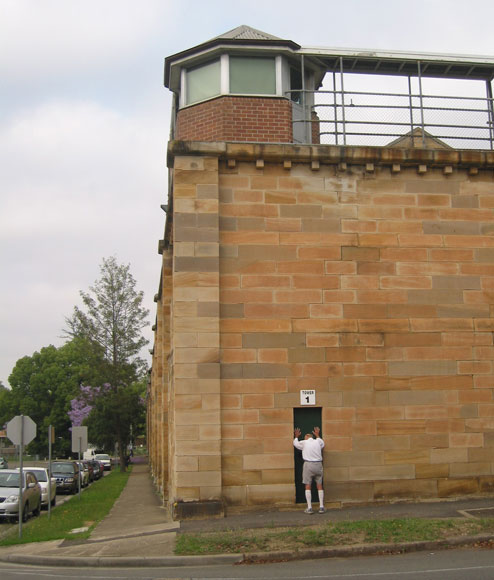
Parramatta Gaol. Photo from here
Once the cuts are officially announced, we can expect more talk about the savings and, if we are really unlucky, Labor's black-hole.


The opposition are already speaking: shadow attorney-general Paul Lynch was quoted in the Herald as saying that ''Fewer prison staff must mean prisons will be less safe. If the cuts cause longer prisoner lockdowns, then they'll make prisons even harder to manage.''


Hopefully the unions will be able to come up with a better argument than this, from Public Service Association general secretary John Cahill: "It's all about money, not rehabilitating inmates ... which is a good short-term approach but when they get out they're more cranky and they're more likely to reoffend."


It's hard to imagine a sillier analysis - I'm no criminologist, but I suspect that you would find that "ex-inmate crankiness" is pretty low on the list of causes of crime.


In any event, this all comes as the government continues its tussle with Fred Nile over ethics classes, which looks more likely to become a major problem if this tweet from @marktobinsydney is to be believed:


With a little luck, the government will be able to cut through the rhetoric on correctional services with some numbers about prison populations and the fact that there is simply excess capacity in the system.


A commitment that conditions at the prisons (for staff and inmates) will not be negatively affected should go a long way to assuaging concerns.  Of course, whether that is a commitment they can make is another question.


What O'Farrell will be desperately hoping is that this does not become another front he has to fight, as it seems likely that he is going to have his hands fairly full in the months to come.