Showing posts with label crime. Show all posts

Thursday, August 30, 2012

Provoking a Response

This week an Upper House committee has been consider changing the law on provocation.

The review was no doubt motivated, at least in part, by the decision of the jury in the case of Singh.
Full story from the Hun
Charmanjot Singh was found not guilty of murder due to provocation. He cut his wife's throat with a box cutter after, he said, she told him she loved another man.

This story, not unreasonably, sparked outrage in the community, and highlighted some of the problems with the law of provocation today.

Let's take an example to explore the issue a bit.

Let's say you're in a pub, and you punch someone in the face. Perhaps you're charges with Assault Occasioning Actual Body Harm (turns out you have a decent punch on you, and you split the guy's lip).

When your matter comes up for sentence, the court will consider all the relevant circumstances - your age, background, criminal record (or lack thereof), whether you plead guilty, any remorse you have shown, and so on.

Let's say, however, that the court is satisfied that you punched this guy because he just said that he would like to rape your sister.

In that case, you could on sentence ask the court to consider provocation as a mitigating factor. Provocation is listed as a mitigating feature the court has to take into account in deciding what the appropriate sentence is for any matter:
You can find the full list here
It doesn't mean you won't be punished, but it does mean that the court will take that factor into account.

When it comes to murder (and only murder) the law is a little different. The briefing paper for the inquiry defines the test as follows:
If the crown cannot disprove provocation, then you can only be found guilty of manslaughter, and will receive a drastically shorter sentence.

Whilst the committee is also examining whether the law on provocation should be amended or tweaked in some way, the main discussion is whether it should be retained at all.

I'm not going to review all of those or try to provide a detailed argument, because the size of that task exceeds my available time.  What I will do is quickly summarise the reasons that I believe the defence should be abolished entirely.

This would mean that provocation would simply be treated as a mitigating feature of a murder, much like it would be for any other violent offence.

It IS murder. These people intended to kill the victim, and did so. They may have been angry, and they may have been sorely provoked, and that should be considered, but to suggest that the offence is not murder is disingenuous.

Other States have done it. And, more importantly, the sky does not appear to have fallen in. Have a look at pages 6 to 8 of the briefing paper if you're interested in the details.

Sentences would increase. It is difficult to dispute that, if the law was changed as suggested, the sentences for these criminals would be longer. I think the community would approve of that, and, for once, I think the community would be right. To take the example of Singh, he should be punished as a murderer, because that is what he is.

It is impossible to accurately estimate what his sentence might have been had he been convicted of murder but been able to plead provocation, but it would have been several times as long.

It's too easy to prove. To again use Singh as an example, we have only his word that his wife said anything to provoke him. As the briefing paper said:
How could the prosecution in Singh's case possibly prove beyond a reasonable doubt that he had not been provoked by his wife? As is so often the case, the only person who could deny the provocation is the victim.

Some people have suggested reversing the onus, or at least forcing the defendant to prove provocation on balance, and if the defence is to be retained then that would appear to be an excellent suggestion.

Ordinary Person. This is a slightly obscure objection, but I have a difficulty with the "ordinary person" test. Are there any circumstances that could motivate the "ordinary person" to form an intent to murder? The test takes into account age and maturity, but I still struggle with the suggestion that there are anything other than the most incredible circumstances that could cause an ordinary person to intend to murder.

Of course, juries over the years have found that an ordinary person might have formed the intention to murder, so I'm not sure what we are to do with that. Are juries just too confused by the (very complicated) "ordinary person" test and simply allowing leniency to an accused person they felt sorry for?

The Special Treatment of Murder. As I have explained above, no other offence has a partial defence of provocation, not even very serious violence offences carrying 25 years gaol as a maximum penalty. This does not appear to be causing any great difficulty, so it is reasonable to assume the same if the law on provocation in a murder is changed.

More subtlety on sentence. If the problem of how to deal with provocation is given to a judge on sentence, then the judge can make as much allowance as he or she deems appropriate.

At present, a finding by a jury that a person was provoked immediately reduces the offence to murder and drastically decreases the sentence.

Now, naturally a manslaughter where the provocation was slight will get a heavier sentence, and a murderer who just "misses out" on provocation will get a lighter sentence, but there is nonetheless a huge jump.

If provocation becomes simply another mitigating factor, a judge will be able reduce a sentence exactly as much as is deemed appropriate when the offender's conduct is weighed against the level of provocation.

There is far more to say than that, but it's a start. Hopefully there will be a detailed response published, and I will endeavour to review it as and when it appears.

Disclaimer: I was part of a committee that provided a response to the Provocation Inquiry, These views are, obviously, my own.

Monday, February 20, 2012

Shooting from the Hip

Nothing is more likely to create bad law than a political crisis.

The media focus on the shootings in Sydney has clearly reached the stage where O'Farrell and Greg Smith felt they had to act.  And act they have.

No one seems to have considered whether there was actually any problem with the law.  Do the present laws provide police with the charges they need to do their job?

Are there gaping holes in the law where police are powerless to act? Is there evidence that the shooters would be stopped by tougher penalties or new laws?

I think you know the answers to those questions.

What I wanted to do was have a look at the changes at the law and try to analyse what (if anything) will be achieved through their introduction.

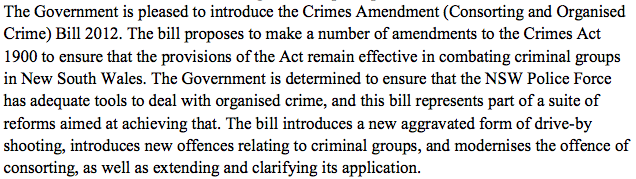
The relevant bill is the Crimes Amendment (Consorting and Organised Crime) Bill 2012. It can be found here.

It introduces some new offences and increases penalties for some others.  I'll cover the changes one at a time, in the order they were discussed in Smith's speech.

Firing at a Dwelling House
At present section 93GA of the Crimes Act) reads as follows:
The change is the insertion of (1B):
In other words, the maximum penalty is increased by 2 years where the shooting was part of "organised criminal activity".  Does change accomplish a great deal?

Probably not a lot, but there is no inherent difficulty with the change. It makes sense that such an offence should carry a heavier penalty where it was performed as part of orgnaised criminal activity.

The next definition is small change to law on criminal groups.  Presently section 93T reads, in part, as follows:

The change will replace subsection (1) with this:
Essentially the change softens the prosecution's burden, in that the police no longer need to prove that the offender knew or was "reckless as to whether the conduct contributes to the occurence of any criminal activity", they now need only prove that the offender knew or ought reasonably to have known.

This offence is notorious for being difficult to prove - how can the police prove what a person knew, or ought reasonably to have known?  It requires the prosecution to provide enough evidence about the all the circumstances of the offender's involvement in the "group".

It's not even easy to prove what a criminal group is - have a look at the definition:
Moreover, this is an offence that is most commonly "tacked on" when a person is charged with a far more serious offence, such as drug supply.  This means that the number of criminals who police are now able to prosecute that they couldn't otherwise prosecute will be small indeed.

The bill also adds a new offence of directing a criminal group, and directing a criminal group whose activities are ongoing:
Essentially, all the same issues arise.  Criminals not being in the habit of taking minutes when meeting mean that it will be pretty difficult to prove that a person was "directing" the activities of a group.

Any time police are able to charge a person with directing a criminal group, they will almost certainly be able to charge the person with all the offences committed by that criminal group.  How is this new law supposed to assist police in prosecuting anyone they wouldn't otherwise be able to prosecute?

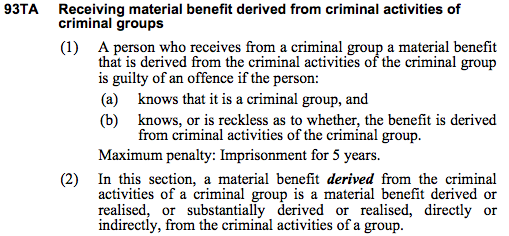
The next change is the introduction of section 93TA, which reads as follows:
As Smith puts it:
That's true.  What he doesn't mention is that we already have section 193B, which reads as follows:
It is difficult to imagine who could be guilty under the new section 93TA who is not also guilty of s193B, meaning that this change accomplishes precisely squat.

The final change, and by far the most troubling one, is this:
There is also a defence:
There is presently section 546A, which reads as follows:
It should also be noted that, as best I am able to tell, no one has ever been prosecuted in s546A.  Ever.

It is a deeply troubling section, for a number of reasons.  First of all, it is the very definition of "guilty by association". If you spend time with people who have convictions, you are committing an offence.

Moreover, police have to warn you first.  That's fair enough, given that you may not know that they are convicted persons.

What that means, however, is that police will be able to approach you and tell you that someone is a "convicted person", and to hell with their privacy.  There is otherwise no entitlement or reason for you to have that information.

A convicted person is someone who has been convicted of an indictable offence.  Without getting stuck into the detail, that casts an incredibly broad net.  I don't have the resourses to determine how many people in NSW fit that category, but it must be an enormous number.

There is also the fact that the law will be applied pursuant to a police discretion (ie only people they have warned first) means that it is open to police to pursue whoever they want in relation to this offence.  Groups or people can be targeted maliciously or without good reason.

That is a power that worries me.

It gets worse.  The defences to the offence are so broad that they can be easily manipulated by people committing the offence.

If you are given an official warning for consorting with someone, get them to hire you, or enrol you in some bogus "training".

It seems unlikely that police will be able to prosecute many people at all for the offence, despite the repugnance of the provision.

But we should come back to the original intention of the changes.  As Smith put it:
You can read that as "Do SOMETHING legislatively to get Labor off our backs."

The result?  Four minor changes at the margins that will interest criminal lawyers and no one else.  One change that is entirely redundant.  And one change that gives police truly incredible powers but then includes defences that will make the offence easy to circumvent, meaning that it is unlikely that anyone will be prosecuted for it.

How is it that these changes are meant to help police stop the shootings?  No one's really sure.  I'm not even sure whether anyone has asked what the hold-up is.  I doubt it is the lack of useful laws, and if it is then it is difficult to see how these changes will help.

The end result - Labor are now reduced to whining about the efficacy of the changes in a way that will not resonate with most people.
 Mission accomplished, I'd say.  Good governance be damned.

Friday, January 13, 2012

A Shot in the Dark

Shootings are scary things, and they are all the scarier when they appear to be at random.

Sydney journos have whipped themselves into a frenzy over the recent spate of shootings in Sydney, mostly confined to the city's West and South-West.

We have had front pages, large colour spreads and the usual proliferation of online articles.
From this ABC report
From this Daily Terror report
These stories are scary - there can be no denying that.

What's all the more unnerving are suggestions that innocent parties are being targeted.

Having said that, any suggestion that the residents of a home shot are entirely innocent should be taken with a grain of salt.

The residents are hardly likely to say to the police "Well, yeah, there is that guy I owe $100 000 for that bulk purchase of ecstasy I made, so yeah, maybe that was who it was."

Same goes for speculation that the shooters got the wrong house.  Some crims are stupid, no doubt, but few are as bumbling as we've seen in many movies, and crims aren't generally in the business of shooting up homes for fun.

That's not to say I'm certain that every victim is actually a drug dealer - there is no way I could know that. It's also not to say the public's fears are entirely unfounded. I'm just suggesting that if you're not involved in crime, the chance of having your house shot up is pretty miniscule.

The fact that the people being shot at are not so pure is reflected in the unwillingness of many victims to give statements to police.

From this 9News story
Which bring us to this fairly idiotic tweet from Labor:
What, exactly, does Labor suggest that O'Farrell has done to bring about this rise in shootings?  Has he relaxed gun laws?  Has he released bikies from prison?

Of course not.  If ever there was a case of an opposition trying to blame a government for something that is beyond their control, this is it.

Labor knows that they can't say "You should have X or Y before now" because whatever it is that they want to allege the Coalition should have done, Labor didn't do it either.  So better to just criticise and try to make a fuss.

Having said that, the government is in fact doing something, or at least thinking about it.
From this 9News story
Whilst I can't criticise the government for considering such a change, I certainly hope that they don't start moving down this path.

People who have been arrested have a right to silence. Except in very particular circumstances, that right is pretty universal.  You don't have to talk to police if you don't want to.

The fact that these victims don't want to talk to police is almost certainly because they have something to hide. They shouldn't be forced to give a statement to police about it.

If police want to investigate the victims on the assumption that "If bikies are shooting up their place, they must have something to hide" then they are free to do so.  But to force people to give a statement would seem to be a step too far.

In any event - if your husband is a drug dealer, your place is shot up and police then force you to give a statement, are you going to tell police all you know?  Of course not - you'll lie, which means the police will at best get nothing useful,. but at worst will get set off on wild goose chases.

The last thing I want to write about is this press release from Nathan Rees, Shadow Police Minister.
So, Rees knows that that the High Court struck down the bikie laws brought in by Labor, but thinks that O'Farrell should "replace" them?  How?  With what?  And how will that help?

He also wants O'Farrell to "outlaw bikie gangs."  How, exactly, does he propose that be done?  What kind of law would permit that?  If Rees offering a serious alternative, or is he just criticising with no reasonable alternative?

There's no doubt that it is an opposition's just to criticise, highlight flaws and (in a perfect world) try and push a government towards better solutions.

But Labor's approach here is to simply try and blame the Coalition for something outside their control, and then suggest that Something Must Be Done without offering any sensible basis for doing so.

I'll leave the final word to @PrestonTowers.

Thursday, October 6, 2011

Teach our Children Well

Teachers have a bloody tough job.  I don't envy them, and I think most people in the community celebrate and even venerate the work they do.

Being a teacher has, however, become far more difficult in recent years.  Part of the reason is the incredible sensitivity to allegations of child abuse, meaning that teachers have all sorts of restrictions on what is appropriate in their interactions with children to shield them from accusation.

One of the biggest burdens that teachers bear is the fact that they are "mandatory reporters" - if a teacher has reason to believe that a child is being abused or neglected then they are required to report it.

I have no doubt that this obligation rests heavily on the shoulders of teachers.

It is in this environment that I saw this story this afternoon on the Daily Telegraph website:


In order to make sense of any of this, it is important to get our head around the details. To do this, it's essential to carefully read the judge's reasons for the decision.  They are available online here. Having read the media's commentary on the decision today, it is worth speculating how many of the reporters actually took the 10 minutes it took me to track down the decision and read it.

It's also interesting to wonder why it is NOW that the story has broken.  The judgment has been available for 4 months - I assume that either the jury came back with their verdict this week, or perhaps someone issued a press release - perhaps the NSW Teacher's Federation who was quoted in the Daily Telegraph article.

The 14 year old was accused of Armed Robbery in Company. Sometime after being charged, he started at a new school.

The Year Advisor at the new school approached the boy not long after he started and spoke to him.  The conversation was detailed in the judgment ("The accused" is the 14 year old boy):


The issue at trial was whether this evidence was admissable to prove (in part) that the boy had committed he offence.

The judge ruled that the evidence was not admissable.  In due course, the trial proceeded and the boy was found not guilty.  Not having access to the full transcript of the trial we can have no real idea as to why, but of course even the lawyers who sat through the trial can only guess the reasons that the jury had to finding him not guilty.

The ONLY issue that the judge looked at in the above decision was whether the evidence was admissible; that is to say, whether the jury should be able to consider it.

Questions of admissability are considered in just about every contested legal hearing.  Evidence is excluded for all sorted of reasons - it might be because it was irrelevant, because it was hearsay, because it was illegally obtained, or because it was prejudicial.

There are all manner of tests that have been established in the law as to whether evidence is admissable.

In this case, the relevant test is in section 90 of the NSW Evidence Act,  It reads as follows:


The discretion this gives the court is broad.  An obvious example would be where the admission is extracted through torture, or where a person was offered some sort of reward for confessing.  In those cases, it would be unfair to allow the admission into evidence because, plainly, it would be an unreliable admission.

This case was different.  Was it unfair to allow a court to rely on this admission?

The court firstly observed that there was no useful precedent for this kind of decision. The court also noted 4 reasons that could convince the court that the admission of the evidence was unfair:


For those reasons, the court found that it was unfair to allow the Crown to rely upon the evidence, and excluded the evidence.

It is a difficult decision - the fact that there is no precedent is perhaps not surprising given that the unusual circumstances.

I don't propose to engage in a detailed discussion as to whether the decision was correct, excepting to say that I do have some reservations.  I do agree with this statement from the Judge:


I do not imagine that this scenario is one that any teacher would expect, let alone have received training for.

The important issue I want to clear up initially is this: no one here is criticising the teacher.  The teacher is not "in trouble" - he/she is not been counselled and has not been stood down.  No one is suing him/her/the department, and no one is suggesting that he/she has done the wrong thing.

The ONLY issue is whether the teacher's statement detailing the conversation is admissable evidence against the boy.

That point appears to have been lost in the discussions I've followed today.

No one is suggesting that teachers now have to warn every child before they speak to them - the court is merely saying that if the Crown wants to rely on these admissions, then it is appropriate that before discussing such issues with a child then a teacher should follow what this teacher said was his/her usual practice of "cautioning students in relation to the disclosure of criminal offences."

That's it. If a teacher doesn't want to ensure that he/she can report any disclosures to police, then he/she can chat to a student in whatever fashion he/she likes. It is only if the teacher plans on reporting any admissions to police that he/she needs to warn the student.

Now, as I have said, I'm not myself certain that the decision was correct.  Given the outcry today, the DPP may well appeal the decision to clarify the law.  It is curious that the DPP did not appeal the decision before the conclusion of the trial so that the decision could have been (potentially) overturned before this boy was acquitted. Now that the jury has reached a decision, the ship has sailed on this prosecution.

Greg Smith's reaction, as quoted in the Herald was fair and measured.


Barry O'Farrell's reaction was not:


Further on in the article:


His reaction also betrays a misunderstanding of the decision.  Nothing stopped the teacher reporting anything, and no one is criticising him/her for what was done.  The only issue is whether the evidence is admissable.

O'Farrell's comment reveals the danger of making comments about legal decisions when you don't actually understand the issue being discussed. 

O'Farrell in jumped into a twitter conversation I had this afternoon with two teachers who I have a great deal of respect for.  We were in the middle of discussing the decision and the media reports when O'Farrell said the following:


It is exactly these kinds of statements that fan the flames of community outrage.  The comments are based upon an incorrect understanding of what has actually happened. O'Farrell has either not read the decision or doesn't care, because it is politically convenient to make an argument based on "common sense".

Greg Smith has done exactly what an Attorney General should do - respectfully suggested that he disagreed with the decision, set out an appropriate path to dispute the decision and left it there.

In preparing this BlogPost I did what I normally refuse to do, and subjected myself to some comments on the Daily Telegraph article. Suffice to say that almost without exception the comments were a cascade of the most aggressive and unpleasant criticism of the judge, the court system and lawyers generally.

Climbing on board that bandwagon is easy politics for O'Farrell - it is simple to agree with an angry, poorly informed mob.

Greg Smith has done the right thing and respectfully disagreed with the judge.  It's a shame that our Premier could not take the same approach.